
 Hendu (listening in Guarani) word brought by Sandra Benites
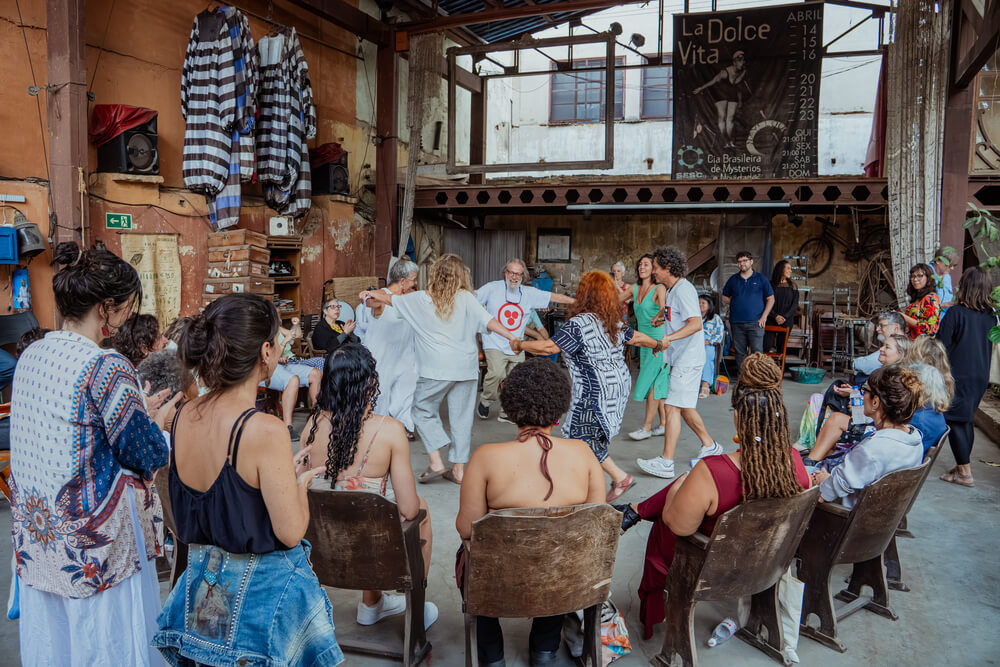
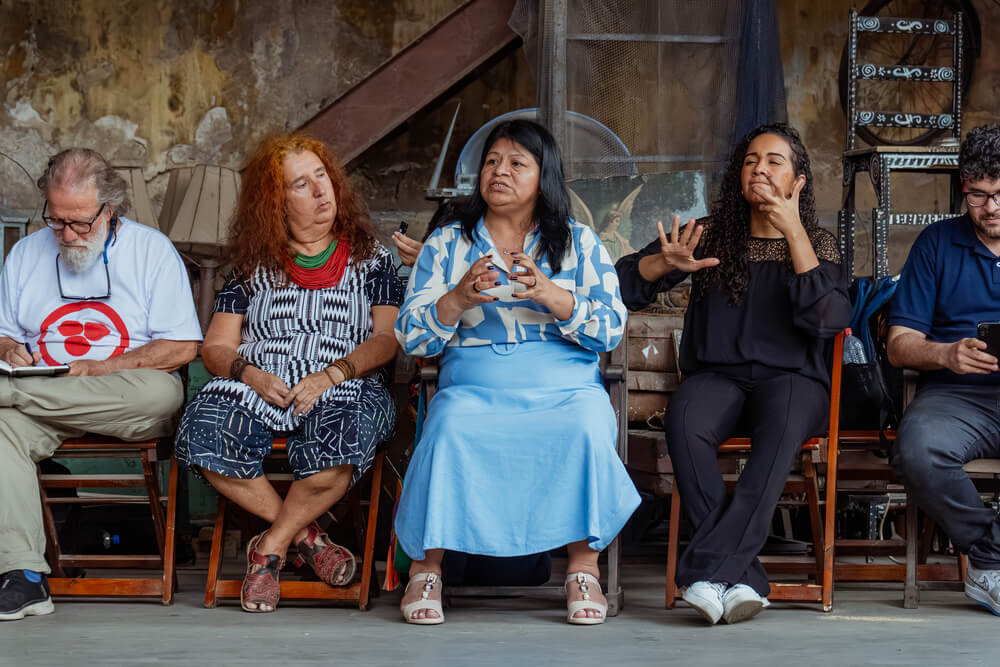
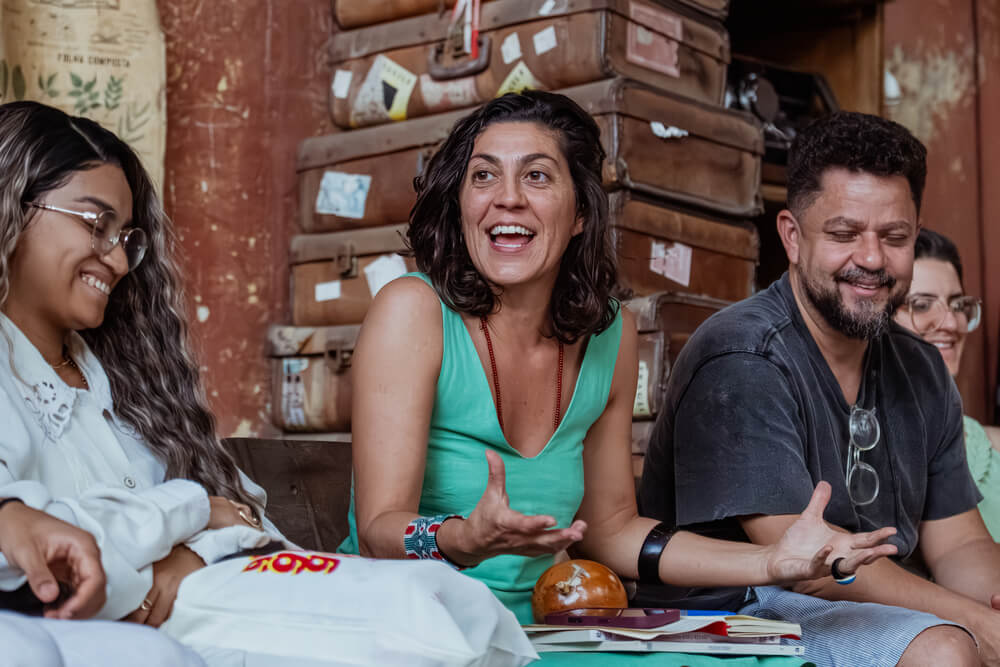
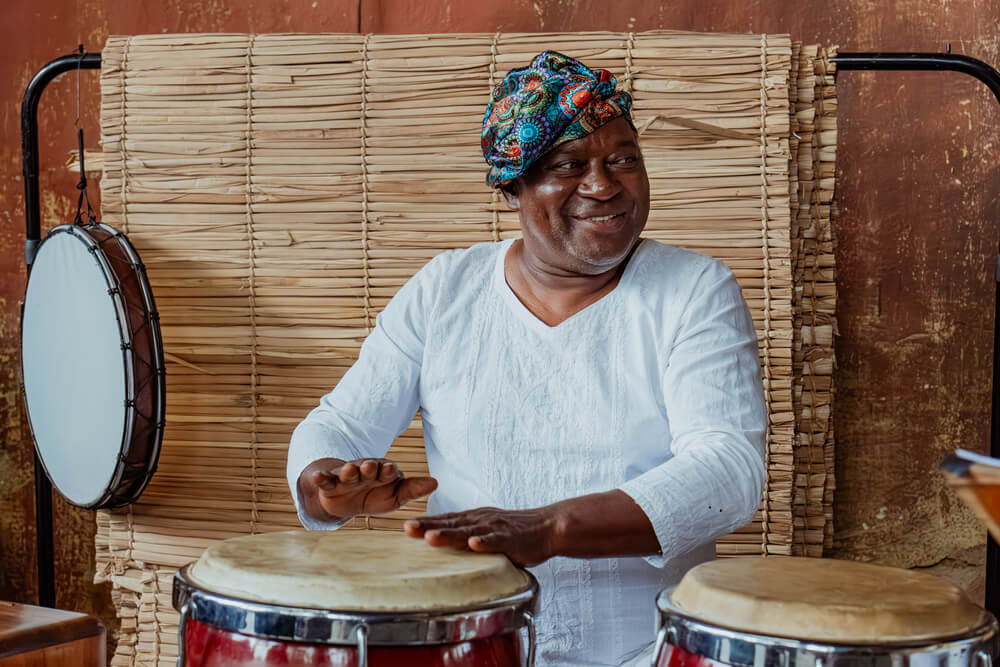
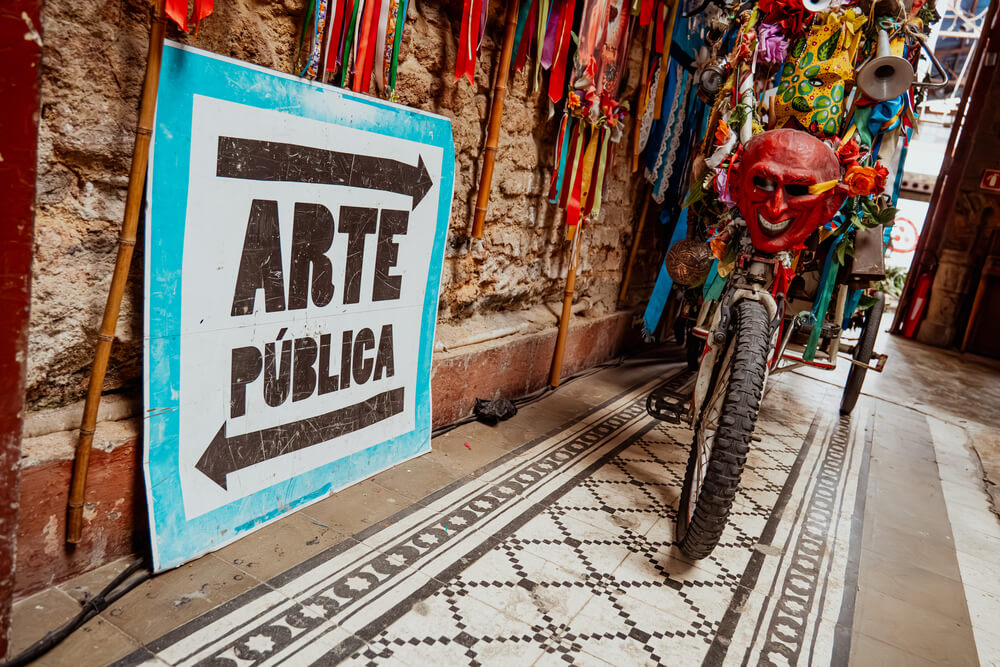
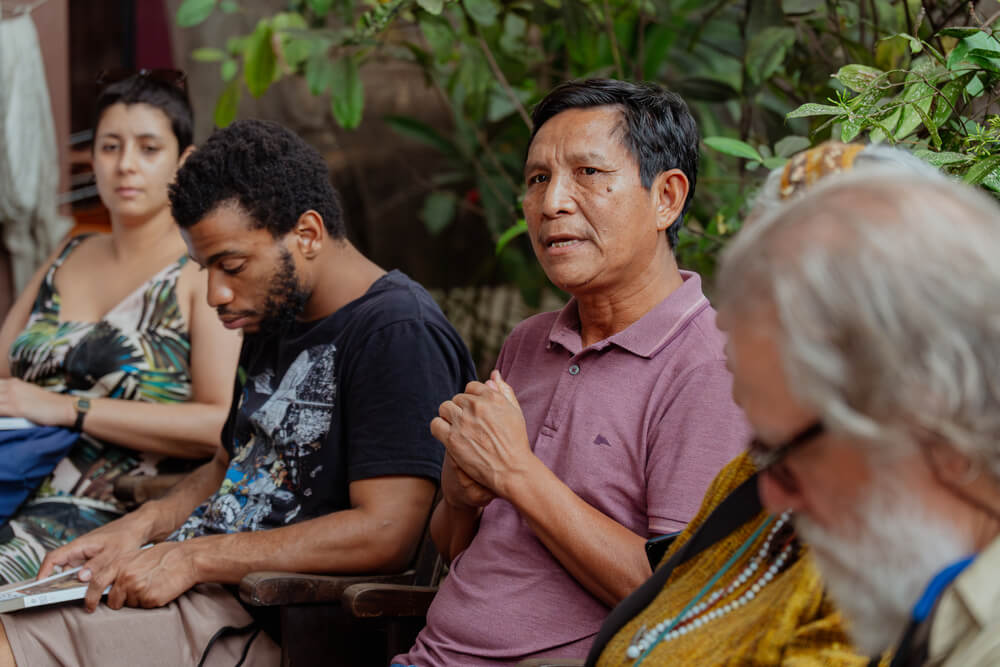
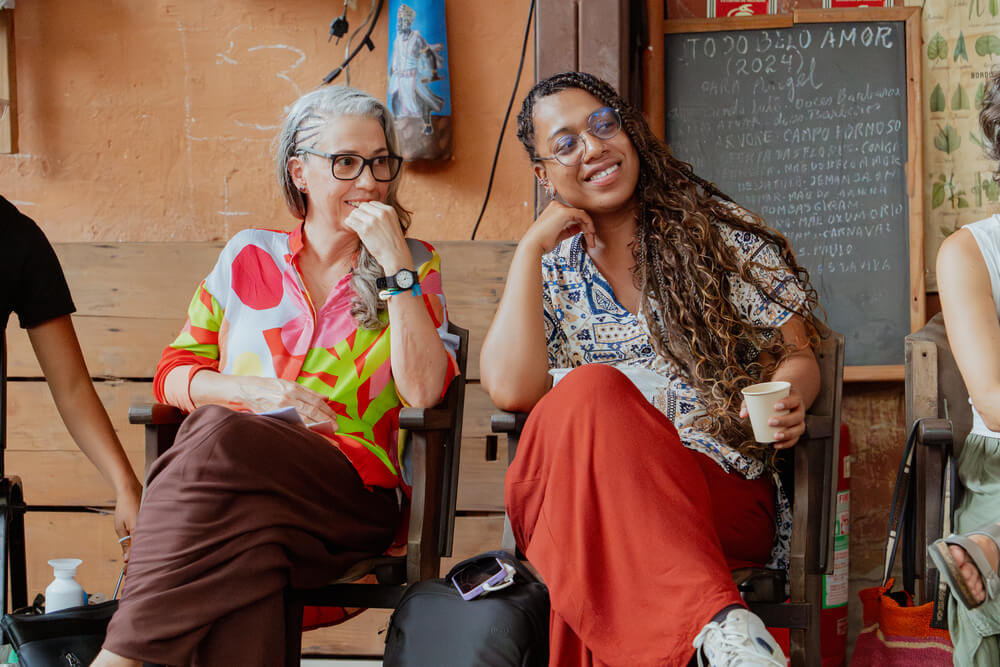
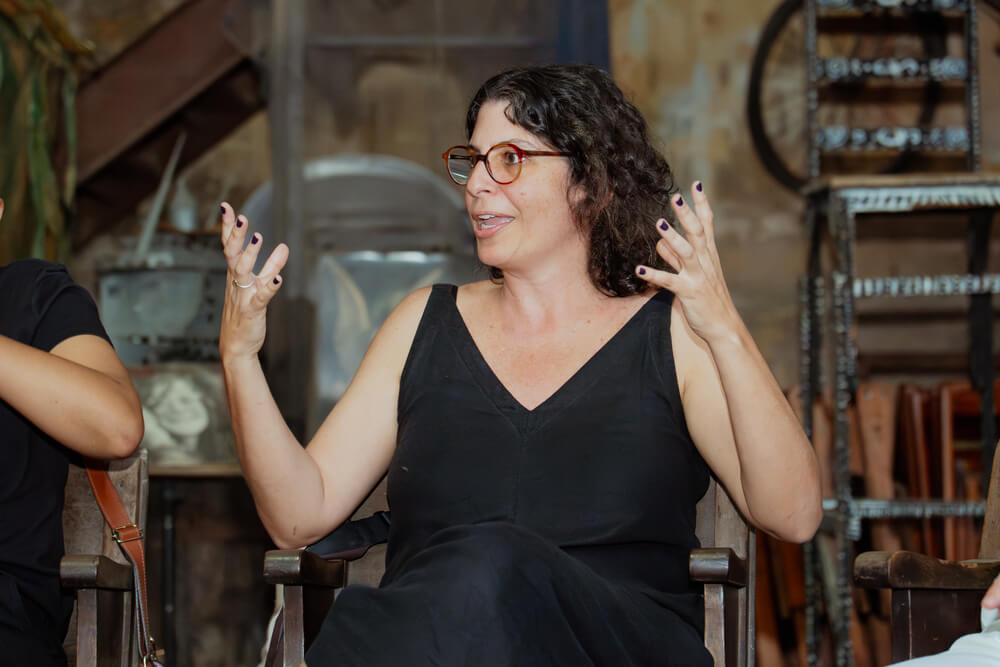
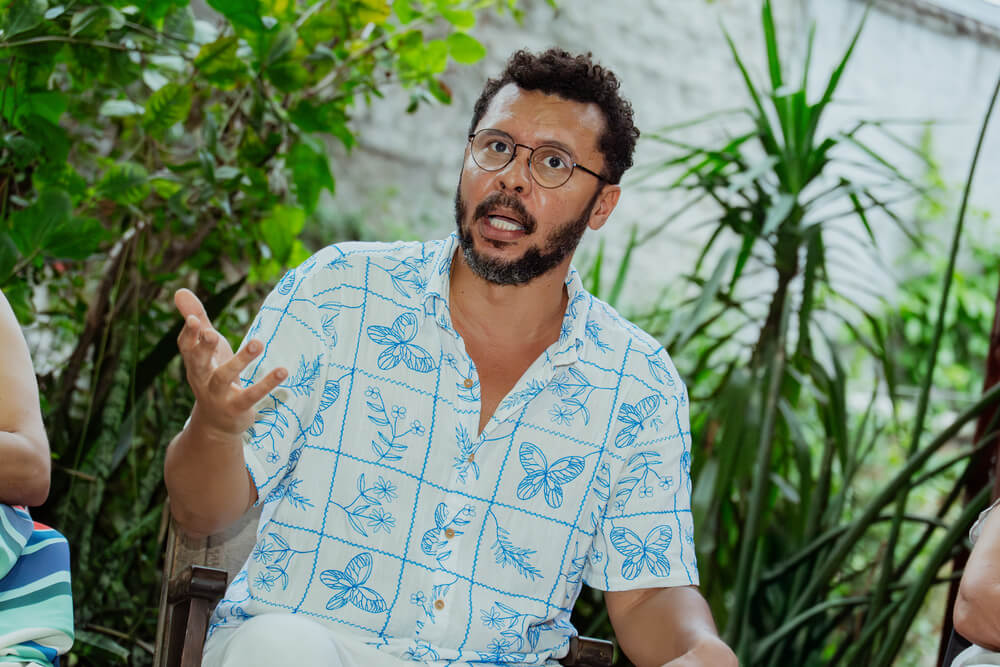
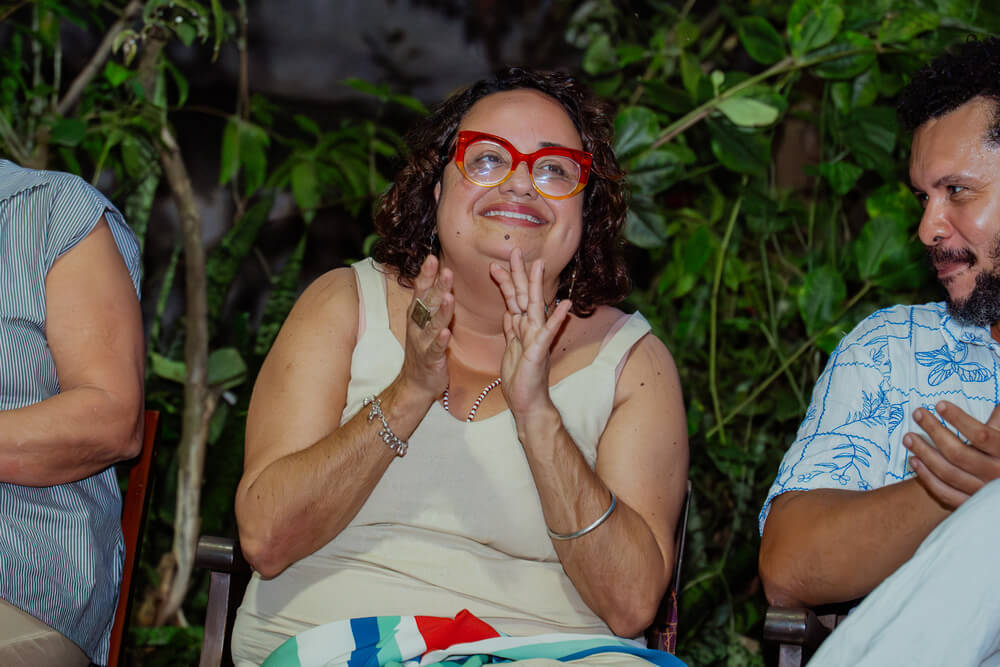
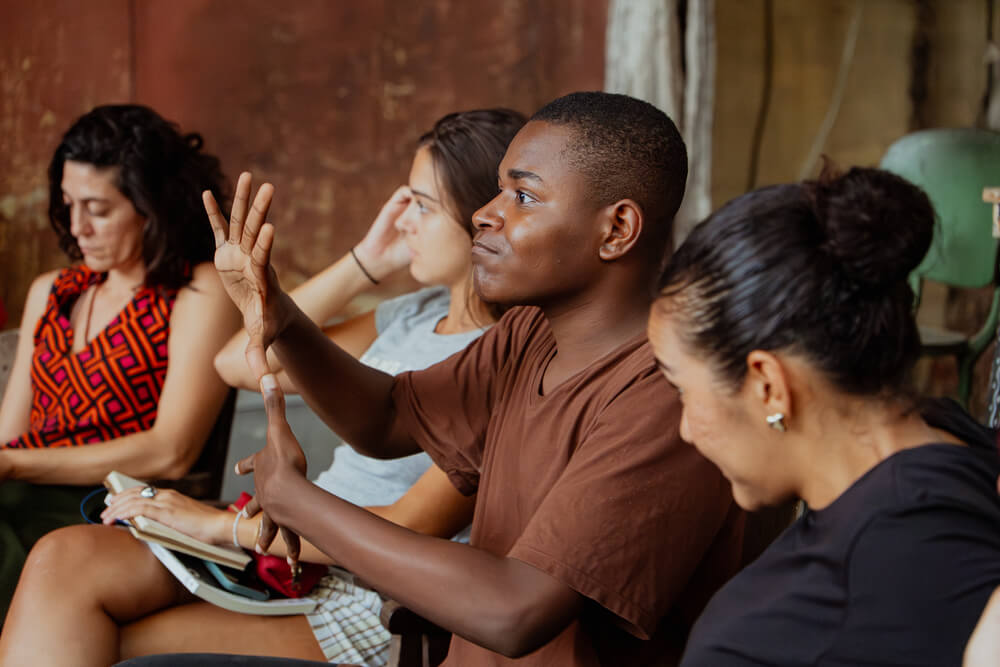
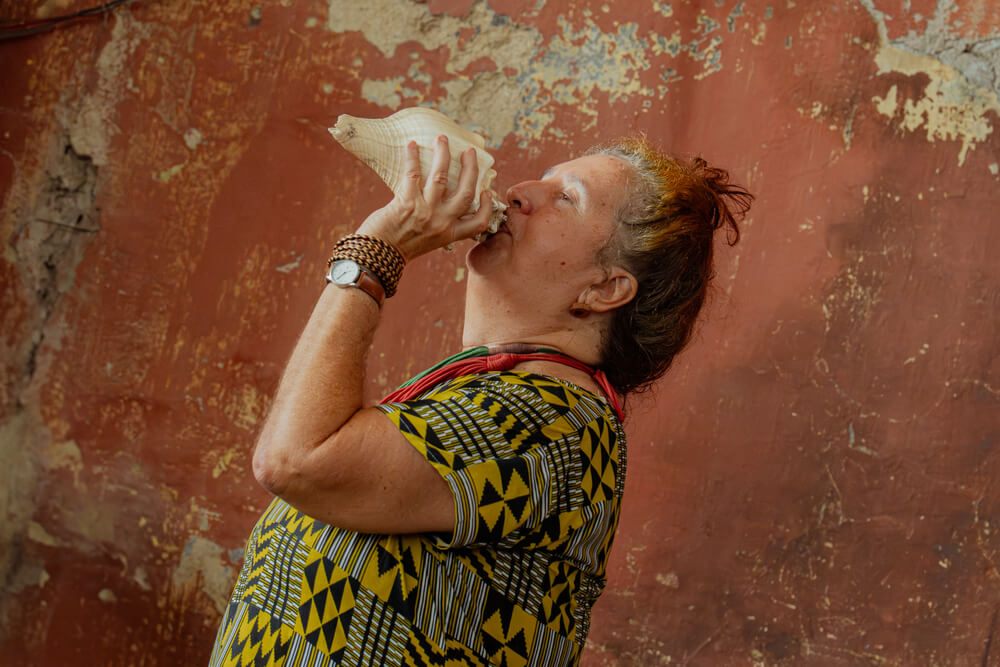
Launch of the 7th edition on October 4th, 2025 and (11-20) conversation circle “Art and Health at the Ground Level” on November 5th, 2025. Both events were held at the Casa de Mystérios e Novidades: Photos: Guará do Vale






Glossary
Affect(ion), bahsese (medicinal repertoires in indigenous Tukano culture), continuity, conversation circle, counter-cartography, co(reo)listening, care, crossroads, denunciation, experimentation, favelophagy, forest, ground, guardians of knowledge, hendu (listening in Guarani), I can be who I am, landguages, mycelium and mystery, patience, radiochoreography, reparation, rewriting, resistances, respect, sea breeze, security, sunset, swinging body, technologies of the earth, territory, vivência (lived experience), welcoming.
These thirty word-expression-concepts were edited from transcriptions of the conversation circles held as part of the program launch of the 7th edition of Revista<MESA>Platform “Body Ground Heart”. Speakers were invited to bring a word-expression to the circle. The events took place in various cultural and independent spaces in the cities of Niterói and Rio de Janeiro (RJ) between September and December 2025: Auditorium of the Graduate Program in Contemporary Studies of the Arts, Federal Flumiense University, Gragoatá, Niterói; Casa de Mystérios e Novidades (homebase of the street procession and theater collective Grande Companhia Brasileira de Mystérios e Novidades), Gamboa, RJ; Casa Resistências (cultural center and shelter for LGBT women) Maré favela, RJ; Hélio Oiticica Municipal Art Center, City Center RJ; and Tropigalpão, Glória, RJ.
Presented here in an expanded glossary format as a new collective contribution to the 8th issue of MESA, these word-expressions are resonant, soulful, utopian, and grounded. Eco-ethical-esthetic reflections, they propose an ecosystem of voices, practices, pathways, and politics for a global alternative, sensibilities to live and act by in this (im)possible world.
We are immensely grateful to the authors:
Alice Poppe; Ana Luiza Nobre; Angela Mascelani; Anna Carolina Vicentini Zacharias; Brenda Vitória; Camilla Felipe; Carla Santana; Carolina Rodrigues; Caroline Valansi; Cesar Oiticica Filho; Danielle Pena; Dayana Gusmão; Diana Kolker; Eloah Van de Beuque; Erika Tambke; Felipe Eugenio; Iazana Guizzo; Jialu Pombo; João Paulo Lima Barreto; Jorge Menna Barreto; Kimberly Veiga; Lohana Karla; Lucas Van de Beuque; Maria Carolina; Marília Felipe; Sandra Benites; Sara Ramos; Suellen Cloud; Taísa Vitória; Tania Rivera.
Special thanks as well to Casa de Mystérios e Novidades and Casa Resistências for their partnership and to Centro Municipal de Arte Hélio Oiticica, Guerrilha da Paz, Imagens do Povo, Museu Bispo do Rosario and Tropigalpão for their support and collaboration as well as to the university initiatives: Floresta Cidade FAU/UFRJ, PPGCA and LAARTE of UFF and UC Santa Cruz Office of Research.
Additional thanks to the organizations and authors, as well as the artists, individuals, and institutions who collaborated and/or facilitated access to images and other audiovisual material for the 7th edition of Revista Mesa highlighted here in the Glossary: Ana Luiza Nobre, Ana Julia Souza Teodoro, Carla Guagliardi, Cesar Oiticica Filho, Denilson Baniwa, Erika Tambke, Jorge Menna Barreto e Pedro Leal, Jhony Aguiar, Patricia Ruth, Rian Penha, Suellen Cloud, Taísa Vitória, Museu Bispo do Rosario, Pinacoteca São Paulo, Sertão Negro and especially to Guará do Vale for his photography of the events at Casa de Mystérios e Novidades.
***
Affect(ion)
I’d like to speak a little about the process that has brought us all here – the collective and collaborative making behind the photo essay documenting the LGBT community of Casa Resistências [House/home of Resistences] – that we are celebrating today with this small exhibition, opening, and discussion circle. I think what makes this meeting today so beautiful, is to have followed the process, selecting the photographs, reading the text. When Jessica [Gogan] contacted me, I was coordinator of Imagens do Povo [Peoples’ Images], a photography organization based in the Maré favela [in the north of Rio de Janeiro]. The organization comprises several initiatives, one of which is the Escola de Fotografia Popular [School of Popular Photography] where Suellen [Cloud, photographer of the Casa Resistências essay] was also a student and whose work is now included as part of the Imagens do Povo archive. When Jessica contacted us, we knew we would need to select a female photographer, and Suellen loved the idea and was very happy with the invitation to accompany and document life at Casa de Resistências. The value of these kinds of projects is very much about the commitment to process. It’s not about coming here for a day and a half and doing whatever you want to do. It’s a construction, it’s a dialogue, it’s about truly accompanying. Suellen already knew of the Casa Resistências. She didn’t just parachute in. So, she was able to engage in a dialogue and develop a photographic documentation that was woven together with Bia and Kimberly [Beatriz Virgínia Gomes Belmiro and Kimberly Veiga, Casa collaborators who wrote the text to accompany the visual essay]. Constructing collectively how the text and images would emerge was key.
During this process we exchanged so many ideas, the possibility of the photos being displayed at Casa Resistências was always something that motivated us a lot. [During the project I left Imagens de Povo], so, I was no longer in the coordination role, but I continued to accompany the project because we were all very emotionally involved; we were all eager to see what would happen. And Suellen was also happy about it. She’s very sad that she can’t be here today; she obviously would like to be here at this moment, but she’s pregnant and the doctor has recommended rest, but she’s here with us in her photos. She’s part of this energy.
In choosing the photos we went through various selection processes, thinking about aesthetic issues, of course, but also, very importantly, community ones. For this display we thought about exhibiting images throughout the Casa. We liked the idea, for example, of starting with a collective photo and then also with images of current and potential future leaders of the Casa community. They too may have one of their portraits on the wall in future exhibitions. I think that there is a conversation here between these images. It’s also great today to have a whiteboard mural open to everyone to write on and answer the question from the essay title “What is this Ground on Which I Step?”
The Casa has a history. Maré too. And then there’s this collaboration between Instituto Mesa and Imagens do Povo. Today we are celebrating the fruit of the many years of work behind building the Casa. With our collaboration and this event, we hope that we can contribute and be part of this construction. So, when I began to think of a word, it came to me very readily, which has a lot to do with what we talk about when we talk about popular philosophy, and with this collaborative process that we developed over this past year: the word affect(ion).² I think affect(ion) is what mobilizes us. Popular photography is very concerned with not taking photographs in the style of photojournalism; it’s concerned with complicit making between the photographer and subject – a photo in which people feel represented and respected, where there’s a dialogue. So, I think this is very much about the idea of affect(ion). The Casa is a space of affect(ion), of welcoming, of strength, of encouragement, as well as, of course, a lot of activism. But sisterhood is built first through affect(ion). It’s a joy to be here.
- Erika Tambke
Bahsese
(Bahsese : metachemical and metaphysical formulas for health
care and healing in indigenous Tukano culture
and for cosmopolitical communication.
Bahsese can be translated as blessings).
Good afternoon everyone. First, I want to thank Professor Luiz Guilherme Vergara for the invitation to be here. For some years now, we have been together in the Peoples Forum of the Rede Unida [United Network – a national health service network]. Our forum aims to bring indigenous thought and knowledge into the universe of art, health, and other areas of knowledge.
So, in the text I wrote for Revista Mesa, I addressed the concept of the body from the perspective of the Yepamahsã (Tukano), an indigenous people of the Upper Rio Negro in the northern Amazon. Upon entering here, at Casa de Mystérios, I felt something difficult to explain: the impression of being in a place traversed by many stories. A thought then occurred to me: What if our body could be understood as everything we are seeing here, that is, as everything that constitutes this house? What would that be like?
For us, the body is a microcosm, a synthesis of everything we see and experience. In other words, it is fundamentally constituted by six elements: water, earth, forest, air, heat, and the animal condition.
The person, as a synthesis of the earthly world, is not separate from it, but constitutes a living and inseparable extension of that same world. Similarly, the world we inhabit is also projected onto us, permeating our bodies, thoughts, and ways of being. This relationship is not merely symbolic, but profoundly material and continuous, marked by an interdependence that sustains life.
So, every action taken on the environment—such as deforestation, pollution, or any form of degradation—does not remain external or distant, but inevitably returns to the human body itself. There is a direct, permanent, and reciprocal connection, in which caring for the earth is simultaneously caring for oneself.
Based on this reciprocity, we structure our approach to the quality of life, understood as the very act of caring for health. It is a continuous and attentive care. Maintaining the balance of the body’s components, mediated by bahsese, is our protective practice and constitutes our preventive system. This process involves not only the individual body, but also the relationships that permeate it, including the territories [in which we live and surround us], their visible and invisible beings, and the cycles of time.
In this sense, the transitions of the constellations, understood as temporal markers, play a central role in our practices. With each change of these cycles, we perform a cleansing ritual of the territory, the community, and the people, as we understand time as cyclical. Each cycle brings with it both abundance and dangers that need to be carefully managed.
For this reason, care becomes a constant practice, sustained by bahsese, which can be understood as a technology for equalizing the body and their relationships. Through it, we seek to mitigate risks, prevent diseases, and restore balance, ensuring the continuity of life.
Another important point is that the body is a powerful force capable of transforming into anything. One time, at the Indigenous Medicine Center I coordinate in Manaus, an artist, a dancer, arrived complaining of frequent pain, especially after her performances. She asked my father to perform a bahsese. In a joking tone, he said he would transform her into a “monkey’s body.” After all, he said, who has ever seen a monkey fall from a tree or feel pain? — and so he did. This is possible because the body is made up of elements, and these are “manipulable” through bahsese. Therefore, for us, the quality of things is fundamental, because it is through this quality that the body is constructed.
Another important dimension is the person’s name: the name as a metaphysical dimension of the body, of the person. For us, the name is what connects our belonging to home, to our territory and kinship system, inserting the person into a network of social and cosmopolitical relations. From the point of view of our medicine, for example, diseases that affect the head can arise from disconnection from these dimensions, that is, from territory, home, family, water, land, and forest.
For us, life is an art. The art of combining the qualities of things. I bring this reflection to say that, in the field of science, the only model of knowledge that manages to transcend scientific rigidity is art. The language of art is equivalent to the language of indigenous peoples.For us, defining the validity of knowledge is not solely based on reason. Our knowledge production also involves dreaming, listening, seeing, and smelling. All these elements constitute channels that allow us to understand and experience the world as art.
- João Paulo Lima Barreto (Tukano)
Care
I am an artist-researcher. My trajectory has led me to merge my practice with that of transfeminist LGBT+ activism and health practices, such as psychology. But I prefer to think about this from the perspective of the term care, that is from the verb to care. It is important to note that these reflections arise from lived experience within a neoliberal capitalist society marked by coloniality. They emerge within this context and in opposition to it. In this process, I [find myself thinking with and learning from] other individuals and collectives who have managed to create alternate ways of living such as: Afro-diasporic terreiro [terrains for Afrobrazilian cultural and spiritual] practices; traditional Chinese medicine; the teachings of [indigenous philosopher and activist] Ailton Krenak; the feminisms of Gloria Anzaldúa, Paul B. Preciado, and so many others; the clinical work of Sofia Favero, Félix Guattari, among others; philosophies of Emanuele Coccia and Henri Bergson among others; and the art of Castiel Vitorino Brasileiro, Jota Mombaça, Tom Nóbrega, Jonas Van Holanda, etc. These references have all informed my work, a summary of which I’m sharing here.
While the word care has diverse uses, some of which even trivialize its meaning, I [rather] seek to reflect on care as a practice of attentive observation and expanded listening. To provide effective care, I believe it’s necessary to observe the unique characteristics of each individual. There are no ready-made formulas. Effective care is based on a vital ethic. It is always directed towards the favoring of life and the preservation of the uniqueness and impermanence of each living being and each moment. The issue of impermanence is important because it seems we forget that life is impermanent. In the context of institutional health, the notion that life must be prolonged as much as possible for it to persevere is common. But what I seek to articulate is that the ethics of care considers impermanence an essential aspect of life. From my research, I understand that care is directly linked to the act of creating. Creating and caring, caring and creating, are essential for a life to be lived to its fullest potential.
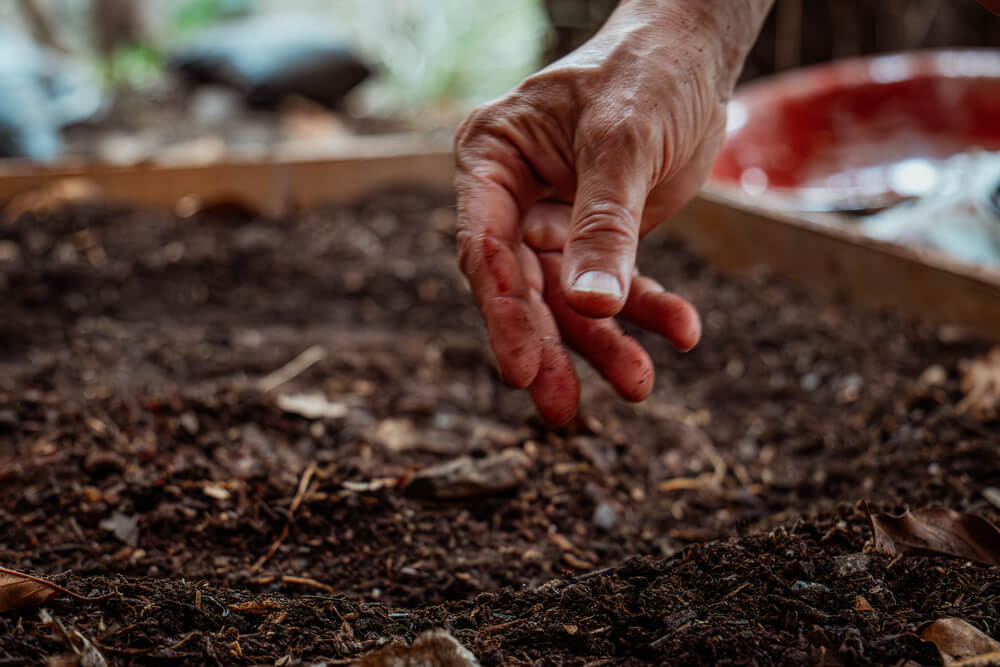
When I was invited to collaborate with the Revista Mesa magazine/platform, I immediately remembered images I took in 2017, in collaboration with Ju Borzino. These photographs document an action that propelled movements I made in favor of caring for my life: the act of burying myself. From this act of burying myself, I went through experiences that led me to have an expanded and attentive listening to my own inner self, in both a literal and figurative sense.
Being [immersed in] the ground leads us to the bowels of the Earth and allows us to observe our own inner workings. For our bodies are composed of those elements that make up all matter: water, fire, air, and earth. I consider these elements to be ancestral and the processes of creation and care for life must be intertwined and implicated with these ancestors.
When I think about creation, it’s not just about art. When I think about creation, I think about self-creation, which I understand to be very important, [especially] to those who are repeatedly placed in situations of social disadvantage. I want to emphasize how when we inhabit this place of social disadvantage the process of self-creation becomes so important. Taking care of these processes of self-creation is producing health. It’s opening up space for the creation of more favorable worlds for our existences. Art has been a great ally in this process. An initiative that exemplifies this is the work of Casa 1, an LGBT+ cultural and support center in São Paulo, which I was a part of in 2025, that seeks to articulate clinical practice with art and culture. I see this as very powerful for people’s lives.
I will wrap up leaving a question: how do we engage with creation and care within the context of a society that moves in ways that are so opposed to them? It’s not a question with a single answer, but I think that individually and collectively it’s a question that can be asked to mobilize more powerful ways of living.
- Jialu Pombo
Continuity
First of all, I respectfully ask permission to speak about the falatório [the recordings of the voice and pronouncements of psychiatric intern Stella do Patrocínio in the late 1980s which she named falatório or chatter]. Stella’s internment in the psychiatric hospital Pedro II [now Instituto Municipal Nise da Silveira] and subsequent transfer to the asylum known as the Juliano Moreira Colony occurred after she had been arrested by the police in 1962. In recounting the arrest, Stella uses the verb “to grab.” She recounts “they grabbed me” while walking in the street, saying they did it as if they had the right to govern her because she was Black, Afro-Brazilian, and Creole. So, perhaps the path to understanding her history must begin there. But little information exists about Stella – a result of over 30 years of internment. I have been gathering data since 2016, such as the correct spelling of Stella with two “l”s based on how she wrote her name in her own handwriting and on her birth certificate. Everything I have gathered points to the need to reconsider the reception of Stella and her falatório, whom most people know through the poetry book Stella do Patrocínio: Reino dos bichos e dos animais é o meu nome [Stella do Patrocínio: Kingdom of Critters and Animals is My Name] edited by Viviane Mosé and published in 2001 by Azougue. My hypothesis is that Stella was not properly heard by the institution that launched her as a poet for two main reasons. First, because she was a psychiatric subject, diagnosed with schizophrenia, and second, which also motivated the first, the fact that she was a Black woman.
In my work trying to recover Stella’s story, against the erasure produced by the psychiatric institution, I pursued a number of different directions. Initially, I began by following Mosé’s steps: finding out who she had interviewed and how she had managed to access the audios [recorded by the artist Carla Guagliardi in the Oficinia de livre criação (Free Creation Workshop) project 1986-88] and the typewritten book by Mônica Ribeiro [a psychology intern (1989-1990)] who also recorded conversations with Stella on other tapes, unfortunately lost, and who partially transcribed it]. Now, I think of the falatório as both an individual and collective archive because we can’t forget that Stella claimed to be 500 million and 500 thousand years old, the age of the residents of the Teixeira Brandão Nucleus – the name of the ward where she and other women were interned.
As Natasha [Felix] and Sara [Ramos] have pointed out, the falatório reveals a Brazil that many people ignore. This involves the history of psychiatric hospitals and police persecution. Stella helps me think of the asylum as a crime of the State and about the interface between the police and psychiatry. It’s no coincidence that, after the approval of the Paulo Delgado Law in 2001, the incarceration rate of Black women in the prison system increased by more than 400%. This is not an isolated coincidence within a broader context of racial and gender persecution in Brazil.
The falatório has profoundly transformed me and continues to do so. Beyond socio-political issues, it has also transformed my understanding of literary studies and critical theories. For example, the aim is no longer to possess absolute truth about Stella, but rather to engage with where the falatório is leading us, what themes, perspectives, and phonic constructions it presents and permits us to reflect upon.
Stella’s power of enunciation broke the silence produced by the asylum. Amidst the discourse that the falatório has produced, I have striven to restore Stella’s life trajectory, the biography erased by the institution. So, my chosen word is continuity. Stella do Patrocínio and the falatório have taught me the importance of elaborating a collective and intergenerational memory. Beyond the powerful instrument of disobedience that is the falatório, it’s important to acknowledge the work of Carla [Guarliardi] and Mônica [Ribeiro] in recording Stella’s words and allowing us to truly recognize a voice and a history that was always there. Then there are references like the work of [the curator] Diane Lima and [all of us here] who are trying to think about the falatório in a more sociocultural and political sense. I argue that the audio and transcribed material from Mônica, as well as the notes in the medical records, when they record what Stella said, are extremely relevant. In this way, it is possible to read the psychiatric archives against themselves.
Stella gave us the possibility of understanding the falatório not only as a product of asylums, but also as a provocation and a statement against asylums, a double opposition where she both denies that she should belong in a psychiatric hospital and condemns the actions of those hospitals. If the falatório as an archive has survived some of the erasures caused by the psychiatric institution and literature’s dedication to disseminating the intellectual and aesthetic production of Stella do Patrocínio, I necessarily think of this place of continuity, as an act of continuous and insistent memory, that works to preserve and disseminate
- Anna Carolina Vicentini Zacharias
Counter-cartography
First of all I ask permission to step on this ground [here at Casa de Mystérios e Novidades]. We are stepping on bodies, and we cannot forget that. We are on sacred territory. We don’t know exactly what lies beneath, but we know there is a lot of history. A history that needs to be turned upside down and excavated.
I am an architect and historian. With David Sperling, I coordinate the project Altas do Chão [Atlas of the Ground], a cartography, or rather, counter-cartography project that seeks to map critical points based on readings of this living body that is the ground. What we have been doing over the last four years or so, through many methodological practices, workshops, and distinct teams, is constructing narratives and stories that allow us to contest imaginaries and narratives and reveal complex processes of urbanization, territorialization, and deterritorialization, whose marks on the ground are legible today, but have traversed many different historical times and scales.
Atlas do Chão is one of the offshoots of a research trajectory that came to a turning point during the pandemic. As an architect, the relationship between architecture and the ground is more or less obvious. The ground is the foundation of architecture and architecture needs a stable ground. But the pandemic left me completely without ground. This feeling of abyss was very important in shifting my focus and bringing another dimension to this research, based on attention and careful observation in relation to this body that unites us. Of course, “ground” is a mongrel word, as Donna Haraway suggests. So, deliberately, the choice of “ground” was one based on choosing a non-scientific, but also polysemous word, that is intertwined with earth, with territory, and with soil. Then as part of excavating the polysemy of this word, together with the architect Caio Calafate, I coordinated a series of meetings called Sentidos do Chão [Meanings of the Ground]. This was at the height of the pandemic, in 2021. In other words, we were all on Zoom talking about the ground as a body that has materiality, life, presence. Throughout these meetings, several people were invited to speak: Denilson Baniwa, Patrícia Ferreira Pará-Yxapy, Lígia Nobre, Luiz Rufino and others. We opened a Google Docs so that all participants who were on Zoom could freely write words that evoked different meanings of the ground. This generated a list of 332 words that, at the end of the cycle of meetings, became an audio piece in the voice of the artist Carla Guagliardi who read the words. She is Brazilian, lives in Berlin, and accompanied the entire cycle of meetings.
What I’ve brought to share with you today is this audio, which I consider a kind of mantra, an infinite audio, because the list is also endless, we can all think and include infinitely more meanings. So, I’d like to invite you to listen to this audio while maintaining an upright posture, precisely to allow our body to make the connection between the ground and the sky, between the earth and the sky. Close your eyes, firmly plant your feet on the ground, and feel the vibration of this mantra, which will last about six minutes, in your own body. Breathe along with these meanings. Let them flow through us and breathe with us.
- Ana Luiza Nobre
Co(reo)listening
Good afternoon everyone. The word I want to propose is choreolistening, but using parentheses, so we can read both c(h)o(reo)listening and co-listening simultaneously. The word emerged during a round table conversation for the 6th International Meeting of RACS Multiple Voices in the Defense of Lives, One Health Plural Art and Human Education, organized by the Collective Health Department of UFF [Federal Fluminense University] prompted by the invitation of Guilherme [Vergara]. It was this conversation that gave rise to our contribution to Revista Mesa. Alice Poppe, Caroline Valansi and I were at the conference to talk about “Body, Gesture, Affect: A Project with Women from Talavera Bruce Prison.” Tato Taborda, composer and professor in the art department at UFF was also hosting another conference roundtable at the same time about “audionutrition” and had decided to join us, catalysing a special moment of co-being/co-listening. I don’t remember who said it first or if it indeed was me who proposed co(reo)listening but whatever the origin it certainly emerged from and was inspired by listening to my roundtable colleagues.
Primarily, the word serves to emphasize collectivity in art – in the same vein as [the artist] Carla [Santana] described [in her talk here today] when she mentioned that the colors in her paintings are created together, as “co-colors.” The philosopher Georges Bataille said “what I think, I didn’t think alone” and I agree. I agree with the idea that one is never alone, whether in thought or art, despite a certain persistence of the idealized figure of the artist, a recurrent narcissism that we are now trying to undo in contemporary art as in life.
Our project at Talavera Bruce was very much about that, about trying to do something counter to a narcissistic idealization of the artist and, at times, a somewhat simplistic view of the place of art in situations of social vulnerability. Maria Alice Poppe and I, as coordinators, wanted the project to be radically different from the idea of bringing art to a needy population, with the pretense of fostering some kind of transformation in an extreme situation. We wanted to reject those kinds of paternalistic and salvationist actions that have at their core a simple and terrible elitism. In contrast, we started from the basic fact that these women were in a situation of deprivation of liberty. We worked mainly with women considered “High Security” – those who are doubly deprived of their freedom as they are isolated from other prisoners, often for having committed crimes that the latter consider unacceptable – and with pregnant women, also in a situation of imprisonment within the prison, imprisonment within their own bodies, especially since many of them discover they are pregnant after they have been arrested, so therefore, are deprived of the right (albeit illegal) to terminate the pregnancy.
The idea of gesture was the central driving force of the project, which began with my invitation to Alice Poppe, as an artist, choreographer, and dancer. We decided that the work would consist very simply of us being there and producing and sharing gestures. Indeed, our most frequent modus operandi was to repeat gestures, inviting each person to propose gestures to, in turn, make them common to all.
What sustained the project was not any knowledge or particular creation of the team – which also included Natasha Pasquini, Beatriz Veneu, Taianne Lobo, and Caroline Valansi – but, rather, mere corporal and emotional availability, without any concrete objective. The context demanded a great stripping away, both in terms of renouncing our knowledge or “talent,” etc., as well as in physical terms, since we were not allowed to have any equipment with us, not even cell phones. So, it was not about recording anything, nor about showing something as a result of the project. What appears as a cover image with our contribution to the magazine is a vestige, a note that occurred at a given moment, between us: a phrase written by one of the women. It says, “For me and for you, take my hand and let’s go.” It eloquently describes exactly what the project was about, what we were doing together there, without a destination or objective other than our own shared experience.
Thanks to the collaboration with Tato Taborda as part of our roundtable, we were able to hear this idea of choreolistening, that is, where gesture can be a place of mutual listening. It wasn’t about someone being in a privileged position in hierarchical terms; it was simply about listening to each other, about constructing forms of listening with the body and gestures and expanding the usual notion of choreography. The “choreo” here means movement, but we should also remember that “choreo” has “heart” in its etymology.
Unfortunately, the “Body, Gesture, and Affect” project depended on very minimal support from the CCJF [Federal Justice Cultural Center in Rio de Janeiro], which guaranteed the team’s transportation. At the beginning of 2025, the direction of the Center was taken over by a judge who considered this type of proposal as welfare-oriented and therefore inadequate for a “cultural” center. Unfortunately, his retrograde and elitist conception of culture led to the interruption of the project. But it brings us great joy that the project somehow remains alive when someone hears us talk about it (or reads about it), re-actualizing possible choreolistenings, through the traces and words produced there.
- Tania Rivera
Crossroads
I think the word that most speaks to our process and mobilizes us is crossroads. These are the paths we travel. So, when I think about, “What is this Ground on Which I Step”, the title of our essay for Mesa, my first thought is that there are many grounds. I walk on many grounds. I am always moving through the city. The word crossroads, literally and metaphorically, has a lot of guiding power for me, it’s about guiding and opening up pathways. I think that’s what I wish for Casa Resistências [cultural center and shelter for LGBT women in the Maré favela], that it continues to traverse and open up many crossroads!
How many encounters have there been and how many paths have we crossed to get here today! I see here many faces of those that at some point crossed the path of the Casa. It is with great joy that after many months of construction, a very affectionate construction, I can think like this about this ground, this path that I and many others cross daily in Maré, in this Guanabara Bay. I am from São Gonçalo. I travel from São Gonçalo to Maré. I am always traversing different territories. Crossing roads guides me. I am not afraid of the road. I see the road as a very important guide. I think that this also represents a lot of what the Casa is – our faith and the ancestry that the Casa connects with. This living quilombo [maroon settlement] that we managed to build here with great effort. It wasn’t easy. There have been many barriers and many battles to overcome. I’m not one to romanticize, if it were easy it wouldn’t be fun. It’s okay sometimes that mud makes our paths difficult. So, yes, that’s it, my word is: crossroads. I encourage you all to welcome the street, welcome the crossroads, welcome the road. Celebrate the strength that the Casa has and the strength that each of us has here.
- Kimberly Veiga
Denunciation
My name is Carolina Rodrigues. In November 2023, I became the chief curator of the Bispo do Rosario Museum. My experience with Stella do Patrocínio’s falatório is deeply influenced both by my curatorial work at the museum and previous experiences with the museum education team in 2022, prior to assuming my position, when I acted as an educator and worked on a series of podcasts that involved children from Juliana Moreira Colony [former asylum]. It was a time when Stella do Patrocínio’s exhibition was opening, so I followed that process a little. Since starting my position as chief curator, together with the team of curators I brought together, we have been mobilized by the debates about how the art system appropriated and expropriated the identity of people like Bispo do Rosario and Stella do Patrocínio. So in speaking of how we are working toward an institutional policy that is ethically informed by Stella is to speak about an attempt to produce a form of denunciation that does not reenact the violence inflicted on her and on those who were victimized by this institution, many of whom interact with us on a daily basis.
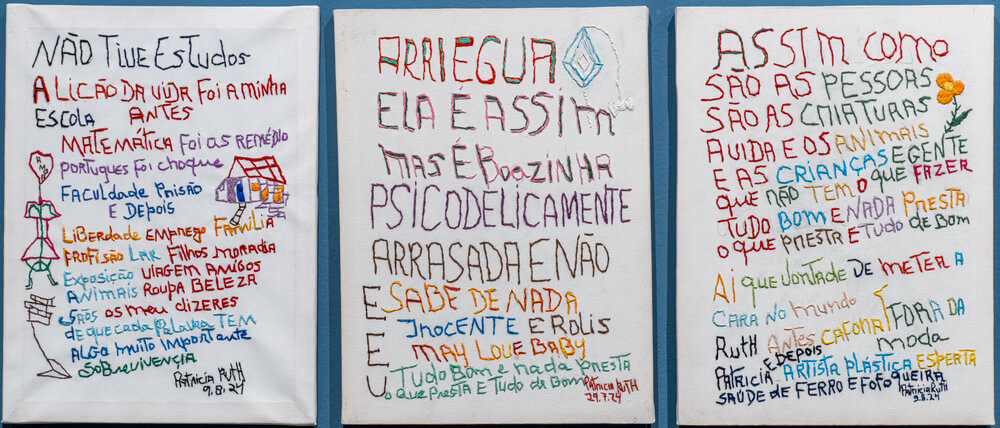
There are several ways in which I can say Stella has influenced our work. The first is the practice of listening as an institutional policy. For example, educational projects involving podcasts, which bring the voices of the people who are part of the history and daily life of this place [former asylum Juliano Moreira Colony] into a public and critical sphere. There’s also exhibitions like 100 anos da Colônia [100 Years of the Colony] where we understood that orality would be an important way for us to tell the story of this place without reenacting the perpetration of violence through images and the aestheticization of pain. So the exhibition was organized around several thematic focal points both informed by listening to Stella and also by creating dialogue points with her and historical and/or contemporary issues that we identified as problematic within the Juliano Moreira Colony. For example, Stella talks about violence directed at women, so one of the exhibition focal points addresses women’s issues. Here, we not only featured Stella’s own words, where she talks about gender issues, but also those of the artist Patrícia Ruth [member of the Ateliê Gaia collective, part of the Bispo Rosario Museum programming] reflecting on these questions. She chose to present her words in embroidered form [see the work above].
So, Stella became a kind of tour guide for this exhibition. She also affirms the perspective from which we want to tell the story of this place and involve the people who are there today. It seems to me that the worlds of art and literature don’t really understand the materiality and urgency that is present there. So, our approach also involves not prioritizing the object or aestheticization over human life.
What the art system did to Bispo, what it did to Stella, did not do justice to the human dignity of these individuals. So, the museum will bring to our everyday life a responsibility, that is, as a kind of recompense of that [former] institution, something that goes far beyond what is understood as artistic practice. For example, inviting women [in the region] who do embroidery into the exhibition space. Institutions, especially art institutions, often remain aseptic. The responsibility of articulating with the surrounding territory and bringing that community closer is largely left to education departments. So, for us, we are working towards a more integrated responsibility.
In addition, we’ve recently brought to our curatorial practice an understanding that it’s not possible to exhibit, for example, objects of torture. I think Stella points to a way of talking about this from the perspective of people who have experienced it and who have more legitimacy and will also know how to bring this to the public, rather than us uncritically bringing these objects or photographs of people in vulnerable situations into these spaces. So, when it comes to pain, I think it’s Stella who has to talk about her own pain, right? It’s not about the institution aestheticizing this pain. There is a lot of reflection involved here. So, the word I’m going to bring to the conversation here is denunciation. Denunciation shifts perspectives from a victim position. Stella does this very well. She divests herself of that victim position, becomes an agent, and speaks about her context from the place she occupies.
- Carolina Rodrigues
Experimentation
When Stella do Patrocínio’s falatório [chatter]¹⁷ became publicly accessible for the first time in 2022,¹⁸ thanks to the collaboration with Carla Guagliardi – the artist who recorded the “chatter” as part of the Free Artistic Expression Workshop in the 1980s – and exchanges with Anna Carolina Zacharias and Natasha Felix – contemporary researcher and poet – it was part of a shared understanding that the circulation of the audios was necessary in several dimensions. This was a very important moment for researchers and artists entangled with the falatório. It seemed that, finally, Stella’s spoken practice could align, at least as I understood it, with what is the vocation of falatório that is to circulate, travel, and wander.
The word I chose is experimentation. To elaborate on this I will focus on how the very process of recording the falatório was commented on and included as part of the falatorio itself. Like when Stella says the tape recorder is “important,” or when she says she likes recording. We also hear Carla contextualize that what is being recorded there will be heard by other people, beyond the walls, in an artistic context. At another point, Stella asks: “You mean you’re going to take it to the studio, right? (…) And there you’ll all hear what I said, right?”¹⁹ In some passages, we even hear a certain expectation for the next meeting, as we can also hear her silences, her refusals to continue the conversation: when Stella doesn’t want to record, when she no longer has a voice, she also states that. I bring some of these examples of metalanguage to discuss what they might mean. While separating the idea of poetry as a literary genre from idle chatter is ethically and aesthetically important, as it means respecting the form of this production, it should not, in my opinion, lead to the elimination or to turning a deaf ear to the aesthetic/performative dimension that Stella develops with the spoken word.
In the field of performance studies – and by this I am not attributing the status of performance to the falatório, but rather as a means to draw on theoretical frameworks that consider the body and voice as key elements to help us navigate the dynamism of this form – two very basic elements are necessary when we speak of performance. One of them is the mobilization of our senses, that is, it requires at least the idea of the presence of a body. When we listen to Stella’s voice here, we hear a particle of this presence, something that necessarily refers to a living body. And the other element that interests me here is the need to recognize a space of fiction. A space-time that needs to be constructed. We can call it a performative space, a space of creation, etc., but what matters for it to exist is that both the performer and the audience know they are participating in a performative encounter. When I think about the gestures and words of Carla, Nelly Gutmacher, Mônica Ribeiro, and all those involved in recording Stella’s voice, I have no doubt that they knew that what they were encountering was clearly an aesthetic work. When I think about Stella’s various mentions of the tape recorder or the falatório itself … All of this, to me, points to a recognition on her part that an aesthetic space of experimentation had been established there.²⁰
This may seem obvious, but I mention it because, from my experience, the artistic or performative intention, when we talk about the falatório, is still denied. If before the release of the audios this happened mainly based on Stella’s lack of agency due to her supposed madness, now we also see a perspective in which the falatório can only be listened to as a document and a testimony to barbarity. When we become incapable of hearing the sonic significances, which include semantics and form, it is a sign that the systematic repression of the body and voice has truly weakened our capacity to recognize knowledge and aesthetic applications that do not fit into consolidated forms. This is why I like to emphasize these moments in which the recorder and the falatório are thematicized, because they point to Stella’s awareness of her own practice, of something that will endure, that recording is a possibility of projecting her existence as far as possible. I’m not saying that Stella had a ready-made hypothesis in her head when she decided to make her falatório, but rather, that her linguistic wanderings leaves us with something beyond the archive, something we hear so often in Black experimentation: the production of the ungraspable.
- Sara Ramos
Favelophagy
Imagine that in the complex Rio de Janeiro favela known as Manguinhos, with one of the worst Human Development Indexes (HDI) in the city, there exists a literary hub that, since 2015, has already published 20 books – including novels and plays – and that these publications present a particular aesthetic proposal: favelaphagy.²¹ Imagine that [the respected publisher] Companhia das Letras and Flip, [the international literary festival in] Paraty, have cast out their lines to fish within this aquarium of favelaphagic writers. This is the story of the word/concept favelophagy. It is a story involving Fiocruz [Oswaldo Cruz Health Foundation] and one of its programs that fosters the promotion of health through literature.
Favelophagy is a publishing label that produces fiction through literary residencies. The work of favelophagy is rooted in writer residencies. It draws from Tupinambá anthropophagy and from Oswald de Andrade’s, but, as favelophagy, it has already digested all of that and something newer: the sharp gaze of Black Brazilian insurgency. Our key investment is in today’s wit. In this literary residency, we invite writers of peripheral origin, not necessarily those who still live in favelas or the periphery, but who have this kind of history. They receive a grant and are mentored throughout this period, between six and eight months, by one or two editors. We understand that producing fiction requires an investigative process that demands time. How do you create the conditions for someone to have this time? First, by ensuring there is remuneration. Second, by providing them with a space to experience the investigation of themes and forms, a space that the editors take care of to some extent, as does the exchange between authors themselves. Third, engaging in the life of the street. It is necessary to contaminate preconceived ideas via an immersion in urban fauna. For this, we created “Permabulações Cortazianas” [Cortazian Wanderings²²]. These are dynamics together with the authors in different parts of the city and in spaces rarely imagined for literature. Here, they are both thrust into the bizarre and the obvious, yet, in a strangely unprecedented way. This is how our favelophagic authors experiment with literature. It’s not just [the well-off or] heirs who can write novels. The common worker can too, provided that this common worker is also a writer. The literary residency is not to be confused with a writing course. Also, favelaphagia does not mean that the writers have to deal with typical themes of the peripheries. There’s no straitjacket. Writers can work on any theme. Favelophagic novels manage to materialize, I would say, even in their very form, a subversive perspective. We encourage the tools of comedy. We are interested in portraying reality in a somewhat exaggerated way, perhaps managing to bring a different logic to fiction, about that same reality. Disruptive, certainly; but not because it’s [some kind of political] pamphlet, but rather because there’s an artistic twist. Chã de Dentro [T.N. Topside cut of beef], a novel by Dani Ribeiro, who is here with me today, captures this idea of favelophagy.²³ She takes a group of workers at a gas station, like a Graal, a place that is a transit point, and here in this place, in the middle of cattle country, there’s all sorts of connections that happen as people rub elbows, like you might find in any little shop in this region, in that deep Brazil, the one that is not clean and fragrant, as the elites descended from slave owners would like, but that is actually very fragrant – it is the Brazil that agreed not to die and to enjoy itself. Subversion – in Dani’s book – occurs when you can no longer draw the line between what appears as very authentic and very surreal dialogue. So, it’s this idea of a translation of a kind of specifically Brazilian experience, but that could also be an experience from Mars, Korea, or China. There are no delimitations or imaginary controls and we love to cultivate this. What interests us in favelofagia is how the field of literature can be opened up to engage with the proletariat, Blackness, queerness, and the ghetto. It is a dispute that is socialist and quilombola [maroon communities]. Whether common or uncommon stories, we are vested in ways of seeing that seek out the extraordinary ordinary. A way of seeing that points towards utopia. Favelofagia will one day help us digest the putrefied flesh that we need to tear apart with our teeth. Guess whose muscles, skin, and nerves those will be? Utopia means being able, paraphrasing the classic national film [by Nelson Pereira dos Santos Como era gostoso o meu frances, 1971 [How my Frenchman was Tasty)], to replace the Frenchman with the bourgeois, while maintaining the idea that the “carne de pescoço”²⁴ [tougher meat], can, incredibly enough, be a preference.
- Felipe Eugenio
Forest
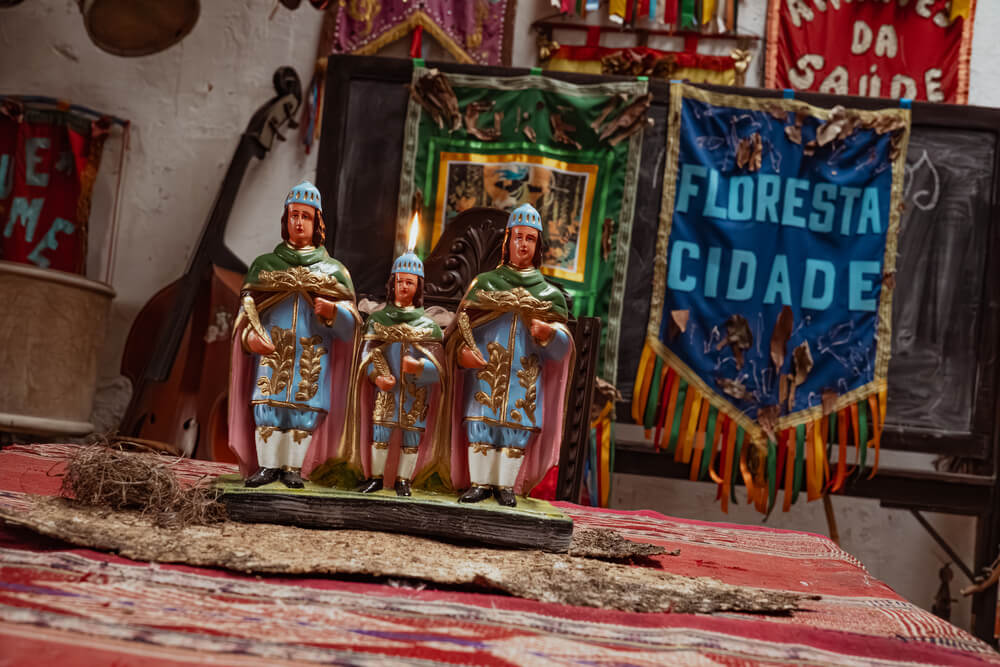
Forest City is the name of the extension, research, and teaching program I coordinate at FAU/UFRJ [Department of Urbanism and Architecture at Federal University of Rio de Janeiro]. It was born here at the Casa [homebase] of the Companhia de Mystérios e Novidades [Company of Mysteries and Novelites], a base which is also our home. We are fortunate because it is an enchanted Casa of affective encounters. It is a network-house, in the sense of an indigenous network, not a digital one. It is a network [T.N rede in Portuguese can mean network, web, hammock] that embraces, sways, and makes us dream.
Here, in today’s conversation circle, I find that I am experiencing worlds that have been and are being organically woven together, ones that are both planned and beyond what we had planned. For example, Forest City collaborates with Instituto Mesa and Casa Resistências, organizations that independently came together without our mediation. The same happened with Sandra Benites, Fabio Scarano, and others. These are webs of connections that sway and touch each other, sometimes here, sometimes there, nurturing collective dreams and enchanted practices that go far beyond this conversation circle, today’s date, this house, and even beyond the world of humans.
The word I am bringing to the circle today is forest. Rather than speaking from an etymological perspective, I am more interested in talking about the experience of “being-forest” that we engage with through cooperation. It is perhaps more correct to say “being-forest-city” because we are born in the city and not in the forest. We start from this hybrid. Underpinning this idea of “being forest” are notions of network-web-hammocks that sway, biomes made up of territories and bodies, and of metamorphoses. These underpinnings also uphold relations with other beings and worlds. The arts, ecology, and indigenous and Afro-Brazilian worlds teach us to repair our way of inhabiting the planet and to metamorphose our crafts.
So, here, I’d like to tell the story of Iemanjá’s Crown. This crown is a 9m² bamboo gazebo that houses the Company’s sound and lighting table that you can see above the bathroom. We built this structure in collaboration with a network that includes research groups, quilombos [maroon communities], bamboo specialists, and students who got their hands dirty in the mangroves of Guanabara Bay and worked on the construction here at Casa de Mystérios e Novidades.
We took the bamboo to be treated in the waters of Guanabara Bay in the grounds of the Quilombo do Feital in Magé. More than a technique [for treated wood], we opened our eyes and ears to an architecture that could itself be enchanted and that might establish a dialogue with Guanabara Bay. Then, we let ourselves be carried away by the ritual processions, which are key to the practice of the Company. This ancestral practice of communication and enchantment of life is a tool for dialogue with other worlds. We, from Floresta Cidade [Forest City], have experienced these monthly rituals for years, learning to engage with a city through its vital force, its energy, and not just its physical form. The processions build cities, often invisible, upon the layers of colonialist history that are still so visible in the port region of Rio de Janeiro. There are many colonial layers, but there are also ancestral ones, from the indigenous life that preceded colonization, and from the countless processions, groups, events, sambas, terreiros [T.N Afrobrazilian communal, spiritual and cultural spaces], festivals, and so many other practices that exist and confront the numerous forms of colonization. There is a struggle.
We held a procession at the Quilombal de Feital farm to submerge the bamboo in the Bay for 40 days. I remember us laughing at the strangeness of holding a procession “apparently” for no one—only under the watchful gaze of the farm’s cows. But the procession was rather an offering to the water, to ancestral memory, to the enchanted beings of the territory, and to Iemanjá – the goddess of the sea – and also one of the most present stilt figures in over 40 years of the Company’s processions. The construction of Imenja’s Crown was for her. The Casa de Mystérios e Novidades belongs to her. This simple gazebo intended to house a sound and lighting table became something much bigger. It became a building-as-an-offering, a way to encounter the Bay, a collage of worlds brought together by the desire to repair the Earth.
Guanabara Bay worked its magic with the bamboo: it replaced the bamboo’s sap with saltwater. Termites and borers seek sap, but ignore seawater. So we not only managed to ensure a 100% ecological treatment, but also, in the process we were able to establish an affective relationship with the Bay. We asked her for permission – the water, the mountains, and the ecosystems – and recognized the Bay as a feminine and ancestral force. The Bay not only treated the bamboo, but also imbued our offering with her energy, integrating her vital power as part of our construction. The Yoruba people call this vital force axé. To think that Guanabara Bay participated and blessed our building, incorporating her axé into the bamboo, provokes a metamorphosis in how we think about architecture.
To think of space that is, at once a body-house-collective-city-cosmos can be a way that we can imagine collaboration not only with humans, a kind of swaying of network-web-hammocks as a way of “being-city”, or as a way of planting and foresting the city with enchanted relations.
- Iazana Guizzo
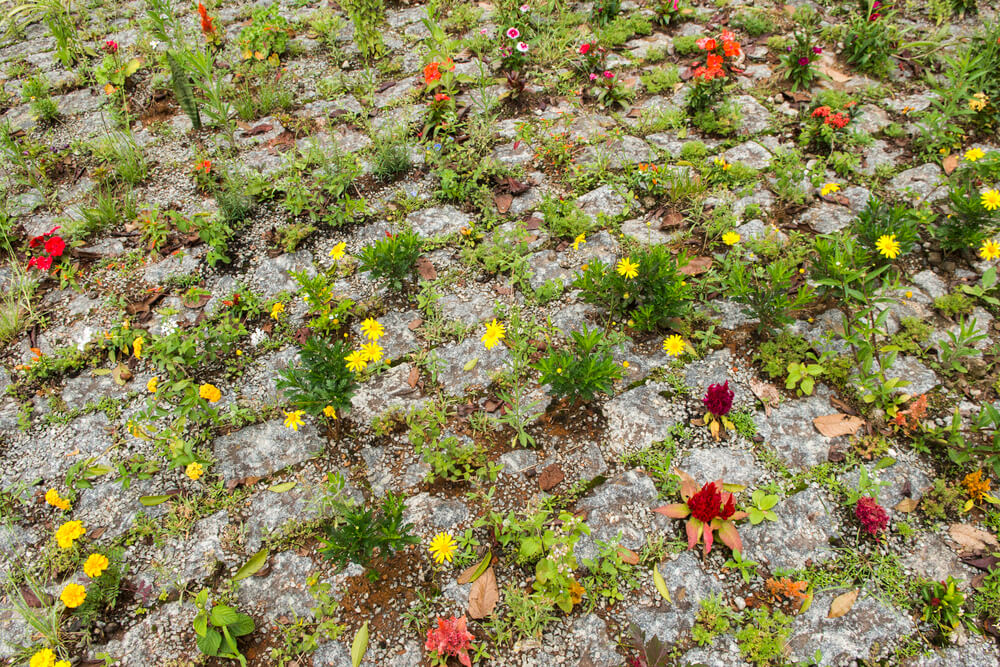
Ground
Abyss, shelter, action, collection, affection, agent, agora, village, foundation, food, target, ancestry, anthropogenesis, anchor, support, appropriation, storage, architecture, archive, assembly, settlement, attention, grounding, activity, axé (spiritual energy), alert, base, common good, cradle, mouth, play, head, heat, bed, layer, walk, path, field, corner, caress, house, catalyst, center, enclosure, sky, cycle, city, thing, patchwork quilt, collective, sharing, compost, common, condition, conductor, conflict, confluence, knowledge, contact, contestation, compound, community, continuity, consumption, control, coordinates, body, correspondence, cosmos, quota, zero quota, daily life, grave, creed, growth, care, cultivation, cult, culture, cure, dance, discharge, unload, outcome, destiny, dimension, dynamics, rights, availability, device, dispute, divinity, document, domination, domain, pain, ecosystem, axis, element, enchantment, encounter, crossroads, enigma, enrooting, storyline, teaching, human being, entity, between, surrender, episteme, balance, scale, hiding place, space, status, stock, extract, ethos, expansibility, expectation, experience, extension, extraction, faith, wound, festivity, filter, end, firmness, source, force, crack, border, foundation, background, future, Gaia, genesis, swing, greatness, gravity, guide, inhabit, heterogeneity, history, horizon, humility, idea, identity, imaginary, impact, impulse, index, childhood, infrastructure, initiation, inspiration, installation, intimacy, invention, game, home, ballast, latency, law, bed, freedom, limit, line, lineage, place, struggle, mother, magic, map, sea, mark, matter, raw material, constructive material, motherhood, matrix, mediation, means, middle, memory, commodity, metabolism, metamorphosis, mine, mythology, death, movement, multitude, multiplicity, world, wall, negotiation, level, muteness, occupation, organism, orientation, origin, landscape, stage, palimpsest, lightning rod, wall, sharing, patrimony, pavement, paving, step, foot, pedogenesis, pedosphere, skin, weight, floor, plane, contact plane, plane of intensities, planting, platform, plateau, plural, powder, power, poetry, polysemy, politics, possession, possibility, posture, potency, landing, practice, daily practice, precondition, pre-existence, present, principle, symbolic production, process, projection, project, property, protection, provider, plumb line, fall, shallow, trace, crack, receptivity, resource, record, repository, rest, reserve, resilience, residue, resistance, reverence, resonance, prayer, rite, root, knowledge, flavor, sacredness, blood, secret, security, meaning, grave, culture, living being, symbiosis, symbol, simplicity, system, survival, sole, solidarity, solidity, sound, substance, noun, substrate, sinkhole, surface, support, dirt, sustenance, tabula rasa, carpet, time, earth, land, terrain, territory, roof, work, transformation, transmission, transversality, everything, use, ebb and flow, value, womb, vertigo, trace, vector, vibration, life, bond, worldview, people, zone, zone of tension.
- Words shared by collaborators in the series of online meetings and subsequent publication Sentidos do Chão [Meanings of the Ground]organized by Ana Luiza Nobre and Caio Calafate in 2022.²⁶ Ana Luiza Nobre brought this list to the conversation circle “Art and Health at the Ground Level,” on November 5, 2025, through an audio recording of the voice of the artist Carla Guagliardi reading the words.
Guardians of Knowledge
My name is Brenda Vitória. I felt something very strong when I walked in here into this Casa de Mystérios e Novidades. I started to think about the stories and histories of this place. It’s my first time here. So I ask permission from those who came before me. I step on this ground slowly. My point of reference is the complex of favelas that is Maré where each favela has its own essence and experience. Talking about favelas is very important to me because favelas are spaces of potential, of knowledge building, of culture and memory. Being a predominantly Black territory, we are constantly being violated in many different ways. We have to constantly change our codes and build new survival strategies. Yet, the favelas are also spaces for the production of knowledge and from that perspective, in 2025, together with Ana [Luiza Nobre] and a wonderful team, I created a project called Maré que Cura [Maré that Cures] a cartography of plants and ancestral knowledge and practices in Maré.
Maré was a mangrove area, historically inhabited by indigenous populations, such as the Tupinambá. There’s a lot of untold history and a lot of history that has been stolen. How can we value and reclaim the history of this territory, its practices and knowledge? When we talk about healing practices within these territories, I understand healing as something that is both spiritual and ancestral. There are various healing practices. The body is a healing practice. How can we integrate these popular and ancestral knowledges within what we understand about health? How can we bring the territory, a grounding in the earth, this contact with nature and make it part of our understanding, something with which we have lost due to colonization? How can we bring [the knowledges] present in the territories of favelas, peripheries, quilombos, and villages to strengthen this discussion? Through mapping these know-hows Maré que cura aims to acknowledge people that we are calling guardians of knowledge, those who cultivate plants for medicinal or spiritual use within Maré. We want to both understand and help support these guardians and their incredibly rich and important knowledges. We want to value these practices because when we talk about people from favelas, there’s often an issue of intellectual self-esteem. A person can develop incredible work, but they don’t grasp the impact, the potential of that work for the territory and also for the city. How does this also connect to culture? When we talk about the practice and cultivation of these plants, this production is also cultural, it is passed down from generation to generation. So, we started with the idea to map these practices little by little. After identifying various people, we held a meeting on October 4th, 2025, that brought everyone together to understand how these practices take place within the territory and how we can strengthen them through our actions and reinforce their narratives, so that these knowledges can be part of what we understand as care practices.
So far we have mapped the knowledges and practices of 15 guardians. They call themselves guardians. They see the term “master” as something academic. They even brought up that academia has come in and stolen their knowledge. This reminds me again of what [Afrobrazilian author and activist] Nego Bispo says, that we already know these practices and we enter academia to learn the names of things that we already know, that we’ve already learned in our territory. So, they don’t want to be called masters, they see themselves as guardians of knowledge, of these practices. We had this super beautiful meeting. Now, we are in the second stage of the project and are putting together what we are calling a favela cartography. We see this as a counter-narrative. Often the term “favelado” [T.N someone from the favela in Portuguese] is used pejoratively, as if it were something bad or violent. We are interested in showing that there are [other narratives], that being from the favela can be full of potential. This favela cartography is emerging from this land that is Maré. Also part of this is the creation of a kind of primer that brings together these references and can contribute to reinforcing these practices as a matter of public health and public policy, not only in Maré, but also in the city of Rio de Janeiro. In this project we are interested in learning how to mix culture, ancestry, territory, land, potential, and different knowledges.
- Brenda Vitória
Hendu
I’m going to talk a little about this concept of hendu [Guarani for listening]. Actually, there are really three concepts that connect: hendu, tembiapó, and teko. Indigenous people differ from Westerners in their way of understanding and interpreting the world. [Let me start with teko]. So what is teko? Teko is an individual body and tekoa is a collective or several bodies. Teko is the body’s way of living, being, and seeing the world but it is never fully formed, it is, rather, in constant movement, something to be transformed throughout our existence. When necessary, we may need to move, let’s say, as a dancing body, in a kind of dodging manner. A dance of sidestepping. To be in the world, to be in it as part of a collective, it is necessary to listen, to comprehend, and to understand the other. That’s why indigenous people have many conversation circles like this. Meetings of sidestepping and listening. Sometimes it takes hours, right? For us, it’s another political way, so-to-speak, of resolving community issues.
In our Guarani language, there is no gender. This has to do with teko, because gender becoming is through teko’s movements. Tekoa is this process in a collective form. Hendu is about being attentive, about the care we must have for the other. A way of feeling for/with and understanding the other. Because in our understanding, a being, the word, our word, is not just a word. It is knowledge. Spirits are also corporal. Speaking of the concrete body, the body is our flesh. We call it Mother Earth, Nhandesy Eté, which is our true Mother. Why? Because for us Guarani, the world is organized in layers. In Guarani cosmology, they say that there are great [seas of] water below and above. Above, the second layer, would be the Earth. But the Earth is not the Earth as we imagine it. It is a body, a feminine body. The third layer, which would be the sky, is the air we breathe which is the divinity of men. But we understand that both the feminine and the masculine, and all these elements of nature, are one. As if they were all together.
We have both masculine and feminine bodies at the same time. Because our breath, which represents the divinity of men, which is air, is our breath and which also has to do with our spirit. It’s complex, but I’m trying to explain it! This is why we have hendu. Hendu means that we feel something in our flesh. It’s different when I say “to listen” in Portuguese, where listening is something that we do as if we only listened with our ears, as if only my ear has the function of listening. In fact, no. For us, listening is hendu, it is complete, we listen and feel in our bodies. Feeling is the same thing as listening. Feeling also has to do with the question of listening. That’s why it’s very important, when we talk about art and knowledge, that we discuss our wisdom without the Earth. Because she is both a part of and she is the whole, but many times, I hear people talking about culture and nature as if they were separate. No. It is our own body. We are nature. We are the territory. We are the spirit.
Here we are building tekoa, that is a territory built through listening, understanding, and negotiation. We live through this negotiation with the other. Not everyone is the same. So, this requires a lot of listening. But listening with feeling. It’s not just listening with your ears. It’s listening and also feeling the pain that the other sometimes feels. That’s why we Indigenous people, in general, always fight for the issue of territory. Because we know that it is also our bodies that are being wounded. Especially the female body. I recently defended in my doctoral thesis a call for women to reclaim our bodies as mothers. When I say mother, I’m not talking about a mother who gave birth to a child. I’m talking about women needing to reclaim these bodies of ours that have always been violated by Western issues and patriarchy. I’m not just talking about one human body. I’m talking about all of them. I make this call to women so that we are all united, in fact, to resist this destruction, this violence against our bodies, as territory, as land, as mothers.
- Sandra Benites

I can be who I am
Guilherme [Vergara] gifted my word to me by reminding me of a phrase that speaks to a stellar moment in my past. Within the trajectory of my life, there is an absolutely key moment: the encounter with [the choreographer and dancer] Graciela Figueroa, who is my teacher forever and always. I’m from the interior of Minas Gerais, so that also speaks a lot about my way of being in the world. Through Graciela, the way she dances and moves in the world, I understood that I can be who I am. Even though I was 17 years old and didn’t exactly know what that meant… Many years later, I found a card I had written to Graciela and on the card it said I can be who I am. It was a photo of Mick Jagger, whom I still associate very much with Graciela, his beauty, irreverence, madness. At the time I didn’t have the courage to send it to her, but later I found the card and this written statement and now, I can say it was truly a stellar moment, a moment of openness, of expansion. This encounter also involved the Companhia de Mystérios e Novidades and Lígia [Veiga – artistic director of the Company] and the [dance collective known as] Coringa Group [formed by Graciela Figueroa] of which Lígia was also part.
The Coringa Group was a dance group created in the 1970s. I first met the group when I was still living in Minas Gerais. I was studying modern dance there, and Graciela was putting together and directing a show with this group. When I saw her way of working and of dancing, I looked at it and said: “that’s what I want to do!!!” This way of dancing! This was what made me come to Rio. The Coringa Group was absolutely revolutionary and new. Everything was an event. It was a unique dance group. Lígia was part of that group and we crossed paths at that time. Then she left, traveled, and I continued working with Coringa. Some years passed, and at a Rio Aberto meeting²⁷ in Mexico, Lígia and I met again. Rio Aberto is a school of human development through movement, through the body. I feel that it is this body, this listening that feels [remembering Sandra and hendu]. This resonates very much with the work I do, which is based on an idea of working through/with the body. It is a kind of holistic listening, this listening to the body, this sensitive listening, as we’re saying here. So, in re-meeting Lígia, I brought together my experience of Grupo Coringa and Rio Aberto, and came to Companhia de Mystérios. My role here is corporal preparation – to prepare and practice the body for the Company’s processions and street theater, and more than anything, to prepare for the collective. Because Rio Aberto has this mark of the collectivity, the group, the tribe. This tribal body, this body that belongs, this body that affects, that is affected, that is formed through encounters and disencounters.
Coincidentally or not, a meeting of Rio Aberto and the Rio Aberto School will take place in Rio de Janeiro at the end of October 2025. Rio Aberto exists as a school in many places around the world, in various countries.²⁸ In our upcoming meeting we will offer 40 workshops to the public free of charge, taught by different instructors from eight different countries. It’s a very important moment to recover and bring this work back to Rio, a work that already existed here and indeed was born here as a result of the meeting of Coringa with Maria Adela, the Argentine creator of the Rio Aberto system. After 20 years and the recent death of Maria Adela, Rio Aberto has been gradually dissolving. In short, everyone began to work independently, although always based on Rio Aberto practices. Now we are bringing a group of practitioners together again. Laura [Pozzana] who is also here today, is also involved. It’s a joy that you are here. Everyone is invited to get to know and participate in this meeting and this new moment. I think it’s a work that combines everything we’re talking about here, it’s about group dynamics, about a sensitive body, and a body that listens.
- Marília Felipe
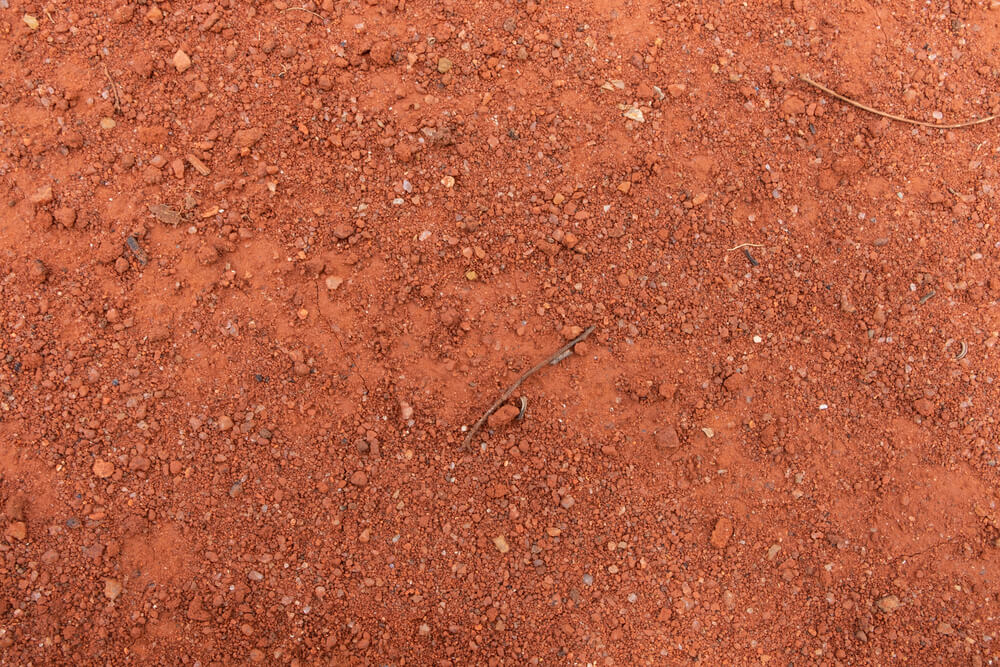
Landguages (neologism)
- A set of language forms created through the interrelationship between territory, climate, and body. Different from the idea of “language” as an abstract system, “landguages” designates modes of expression shaped by the material conditions of a landscape—its aridity or humidity, its ecological rhythms, its wind, soil, and water regimes.
- In the context of the research project Dehydrated Landguages,²⁹ the term refers to languages that emerge from territories undergoing aridification, such as the Brazilian Sertão³⁰ [semi-arid region in the country’s Northeast] and the semi-arid landscapes of California. These are languages marked by economy, dryness, and formal reduction, in which the environment directly influences rhythm, syntax, and imagination.
- The concept proposes thinking about language not only as a human production, but as a relational field between humans and more-than-humans, in which landscapes, soils, plants, animals, and atmospheres participate in the production of meaning.
- An etymological play between “land” and “languages” that suggests that each territory speaks—and that learning to listen to these voices is also a way of re-energizing our ways of perceiving the world.
- Jorge Menna Barreto
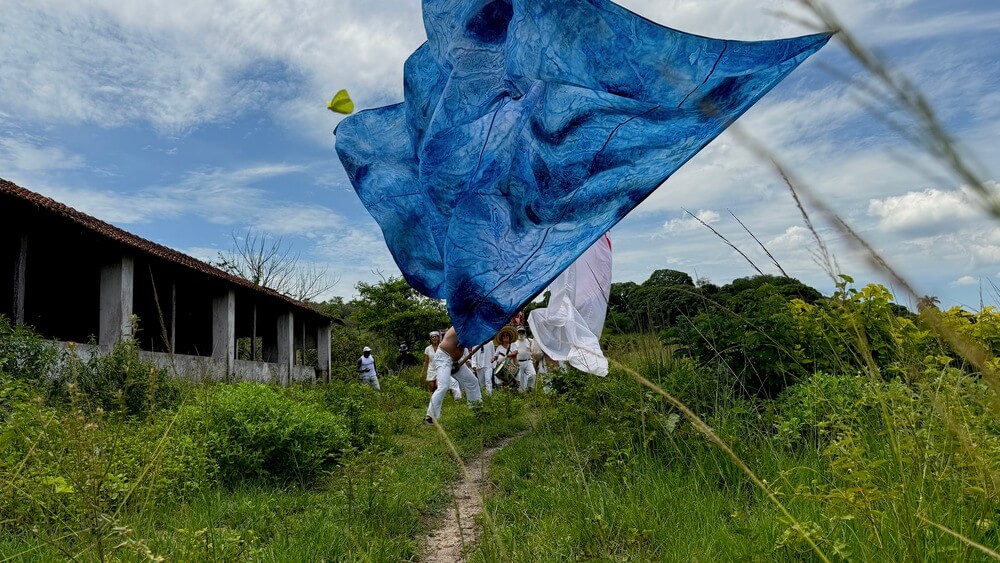
Mycelium and mystery
Our work on the short film about the Company [Companhia de Mystérios e Novidades] was greatly enhanced through something I discovered while I was making it, which I later found being called the Metabolic Museum.³¹ The film concept and the way it’s being produced is related to beehives. Like all collective things, it’s a mycelium, where various things intersect and potentialize each other and unfold into others. There are I believe no coincidences, we are together in this collective, in this vibration, in this energy. So that’s it, the word for me is mycelium and mystery. It is a mystery. It’s the lady of time.
- Cesar Oiticica Filho
Patience
For my master’s degree in Visual Arts at UFRJ [Federal University of Rio de Janeiro], my advisor was Berta Ribeiro. She understood that the art and aesthetics of the indigenous communities she researched were entirely linked to the everyday, to memory, and to social life. Studying how they referred to the production they made, which we call aesthetics, Berta said: “There is no word for it. Among indigenous people, there is no such thing as an artist. But everyone knows those who express themselves more clearly, who execute an object better. It doesn’t exist, but everyone knows.”
In the introduction to her 1989 book, Indigenous Art, Visual Language, Berta emphasized that what we call “art” permeates all spheres of life for Brazilian indigenous peoples and reflects a “desire for aesthetic enjoyment and communication through a visual language.”
As Lúcia Hussak van Velthem, Bianca Luiza Freire de Castro França, and José Ribamar Bessa Freire comment in their article honoring the author’s centenary, “Berta Gleizer Ribeiro and the Arts of Amazonian Lives,” published online in the Curt Nimuendajú Digital Library, “what is being emphasized is that ritual activity, based on its symbolic and aesthetic content, shapes and communicates a personal, social, and ethnic identity of the individual, and is expressed as a language.”
I find this very interesting, and, in relation to what was said earlier by others in this conversation circle, we live in a complex and difficult period, in which almost everything has a narcissistic dimension, geared towards individual interests. Yet, there is also a great willingness to build networks, to engage in collaborative activities, and to embrace the collective dimension of artistic creation.
So, taking all this into consideration, I think my word for Revista Mesa is patience. Because you have to have a lot of patience to seek out people, talk to them, and organize projects. What I want to highlight here is the active dimension that is also encompassed by the word “patience,” that emphasizes the idea of active resistance.I also believe there isn’t one single word. It’s a summation. Thinking about this glossary, the words here will provide inspiration, spur reflection, but even with that, it won’t be conclusive because often existing words aren’t enough. But we trust that among the participants in the community involved in this project, “everyone knows.” So I’ll leave you with the word patience. And congratulations, because it’s incredible, the magazine gains substance with each new edition; it’s an honor, a source of pride, and good to know that Guilherme and Jessica are there in this daily struggle.
- Angela Mascelani
Radio Choreography
This ground, this Casa [home and base] of the Company [de Mystérios e Novidades] is a place where I feel very welcome. I am a collaborator of the Casa and have already had the pleasure of participating in some of the Company’s shows. My contribution to Mesa is an edited text based on a transcription of a conference roundtable that was held at UFF [Federal Fluminense University] in which I participated with Tania Rivera and Caroline Valansi [Carol] about our experience working inside Talavera Bruce women’s prison. The Body, Gesture, Affect Project is currently on hold, but for about a year and a half, starting in 2023, we worked approximately every week in the prison with two specific groups: one known as “High Security” (women who had committed heinous crimes) and the other comprising pregnant women. The project had this desire to do corporal work with the inmates, to create some contact, some approximation with these bodies that are deprived of space. We wanted to bring this possibility of thinking about space within that place, of thinking about the body, and of listening.
I am a dancer and have training in Ballet, Modern Dance, and the Angel Vianna School and College. I have been working with dance for 30 years. When I spoke with Tania, I suggested that we bring some objects that could serve as devices for sensitizing and listening to those bodies. So, we started this work, which was very beautiful, bringing tennis balls to sensitize the skin, to awaken the skin, to those bodies that were so lacking in energy. Together with them, we discovered other objects that we could use as listening and sensitization devices. We also had the participation of some students from the Dance courses at UFRJ [Federal University of Rio de Janeiro], where I am a professor, and from the Graduate Program in Contemporary Studies of the Arts at UFF [Federal Fluminense University], like Carol, who brought many interesting materials, papers, and fabrics. We faced the challenge of how to bring a sense of weight, to awaken the skin and the back, to activate that body in its most three-dimensional sense. So, our text in the magazine reflects the questions that we were dealing with as we were working in this context as well as several concepts we were developing and it was here that the idea of ”choreolistening” emerged.
Simultaneously to this project, I was also working with another dancer here in Rio de Janeiro, Laura Samy. We were awarded a grant from Funarte [Brazilian National Art Foundation] to develop a project in another prison in Rio called Oscar Stevenson. We did an artistic intervention there, proposing recordings in order to develop what we call radiochoreography, that is, a kind of artistic device developed during the pandemic to structure a choreography made up of voice, sound, noises, and music in the form of dance, but without images. A dance to listen to, not to see. Inside the prison we can’t enter with cell phones, we can’t enter with anything, but we managed to get in with a recorder. The materials were all thoroughly searched. Sometimes they let us in, sometimes they didn’t. Entering the prison was very complex. At Oscar Stevenson we managed to hold five meetings and make recordings inside the prison. Laura and I created a piece of radiochoreography that we called Aparte, in partnership with Rodrigo Maré, who is also a collaborator here with Casa de Mystérios, a wonderful musician. We spent five weeks going to the prison every Monday, arriving at nine in the morning and leaving at five in the afternoon. We proposed thoughts, stories, movements, and recorded this material. Then we created this radiochoreography, which was how we brought this experience of being with them and their voices into this other relational dynamic.
Unlike Talavera Bruce, Oscar Stevenson prison is very cramped. The room where we worked is next to a group of cells, so the sound was pure noise: constant and very aggressive. Within this diffuse and violent sound environment, we inserted some words and texts that were created along with the prisoners. All of this is what is in Aparte. We brought many images, showed videos of some choreographies, and proposed writing exercises; in this way, we wove and created stories. Inside, we discovered a woman who had a very strong relationship with writing, who had written several books, so she facilitated readings of some important texts that we used throughout the practice of assembling the radiochoreography. This connects to the idea of ”choreolistening,” proposed by Tania. It’s an approach related to a form of communication through listening to bodies that may not have this openness beforehand. It requires regular work, despite many ups and downs, where we can create some points of access to these bodies deprived of space and life, and to be able to touch that body. We thought there would be strong resistance, but we came to understand that they greatly enjoyed us touching their bodies. One day we suggested that they walk with their eyes closed, holding each other’s hands—a simple practice, but one that had a great impact on their bodies and their presence. So, radiochoreography is this circumscription of thinking about a kind of choreography that takes place in terms of a sensing body, through a new relationship with space, understanding a space that is deprived of space as a space of creation, another way of making art, or of being there, artistically coexisting.
- Alice Poppe
Reparation
“I don’t know how to do justice.”
Stella do Patrocínio
I ask Stella’s permission to share, through her words, some of what politically motivates us at the Bispo do Rosario Museum. My name is Diana Kolker, I have been responsible for the institution’s political-pedagogical project since 2017. It was from this place of responsibility that I found myself called upon by Stella do Patrocínio’s falatório [chatter].³² Listening to it raised issues that directly impacted the museum’s political project.
The Bispo do Rosario Museum is located in the Juliano Moreira Colony in Rio de Janeiro, where one of the largest psychiatric complexes in the country once operated and which today houses the Juliano Moreira Municipal Institute of Health Assistance (IMAS JM). It is no coincidence that the museum was founded during the years of expansion of the Anti-Asylum Movement and the political reopening that followed the end of Brazil’s dictatorship (1964-1986). Initially the museum was named the Nise da Silveira Museum [after the pioneering psychiatrist] and in 2001, the year of the Psychiatric Reform Law, it was renamed the Bispo do Rosario Museum of Contemporary Art, adopting the name of the artist/author whose production comprises the main collection in its holdings, made during Bispo’s internment between 1939 and 1989. The museum is responsible for the safekeeping of Bispo do Rosario’s work and that of other individuals who were institutionalized in that context. Stella do Patrocínio was forcibly interned by the State in 1962 and transferred to Colônia Juliano Moreira [Juliano Moreira Colony /Asylum] in 1966, where she remained until her death in 1991. It was in that context that the audio recordings that we now call the falatório, as Stella herself named them, were made. Beginning in 2013, the museum has embraced an understanding that, beyond the safekeeping and exhibition of its material collection, it also has a great responsibility toward the history and memories of the former asylum that extends to the production of new ethical and aesthetic practices in the fields of health, art, and education.
We approach this memory critically, not to glorify or romanticize the past, since we understand the asylum as an act of state violence. We need to know this past so that it is not repeated. Society and the state must recognize the wrong that has been done and engage with a clinical-political practice of symbolic reparation.
For a long time, the museum did not have access to the audio recordings of the falatório, so being able to now engage with these audios, together with this new generation of researchers, has proven to be very important in bringing this listening to a public and institutional sphere. Listening to these researchers, we have found ourselves facing a set of questions. What are the ethical tensions that listening to Stella’s falatório impose on the museum and the IMAS Juliano Moreira? How should we listen to Stella? What do we do with this listening? How do we position ourselves in relation to the falatório without reenacting the violence that Stella denounces? Is it possible to achieve justice?
A fundamental starting point is that the institution must distrust itself. This distrust is important as a means to avoid, or at least reduce, the repetition of certain forms of violence. There is no possibility of reparation, nor of justice for Stella. “The debt is unpayable,” as Denise Ferreira da Silva says. But there is, indeed, a responsibility—in the sense of sustaining a desire for reparation. So, over the course of several years, this is what spurred us to carry out a series of actions as part of a movement that attempts, in some way, to approach something that can be called justice in relation to Stella’s story.
In 2020, Jessica Gogan mobilized the “Constellation” group, an initiative that brought together people who were involved in the Free Creation Workshop in the 1980s at the Juliano Moreira Colony [that prompted the recording of the falatório]. Anna Carolina Vicentini Zacharias, Tania Rivera, Diane Lima, Jota Mombaça, myself, and the former director of the Bispo do Rosario Museum, Raquel Fernandes, also participated in this initiative. In 2021, we held a study group with curator Diane Lima and philosopher Denise Ferreira da Silva, that brought a group of artists together in a study group format for critical listening, dialogue, and resonance.
In 2022, we held the exhibition Stella do Patrocínio, mostrar que não estou sozinha, que tem muitas iguais, semelhantes a mim e diferentes [show that I am not alone, that there are many like me, similar to me and different],³³ which, in addition to the original audio recordings of the falatório, featured the work of contemporary artists who were invited to listen to the falatório and produce new works.³⁴ It was in the context of the exhibition that we held the event “Listening Rehearsal: The Falatório of Stella do Patrocínio” with Anna Carolina Vincenti Zacharias, Sara Ramos, and Natasha Felix.³⁵
In the most recent exhibition organized by the museum’s new curatorial team, marking the centenary of the Juliano Moreira Colony in 2024, Stella’s narrative was one of the main methodological references for the curatorial project and related events, and beyond that, it is an ongoing guide for the curatorial, political and pedagogical conception of the institution.
We don’t know how to do justice either, Stella, but we’re trying.
- Diana Kolker

percebi, lembrar é um esforço. Lembrar é força ou contraforça?
[I Promised I Would Not Forget You and So, I Realized Remembering
is an Effort. Is Remembering an Effort or Countereffort?] 2025. Collage, embroidery, and
acrylic. Photo: Alex Motta / Bispo do Rosario Museum
Rewriting
My name is Taísa Vitória. I am an artist and educator at the Bispo do Rosario Museum. I started working at the museum at the time of Stella do Patrocínio’s exhibition in 2022.³⁶ Stella’s falatório³⁷ [chatter] taught me about the story of the Colonia [Juliano Moreira Colony former psychiatric asylum], about what it was like, who she was, and everything she went through there. But, also, it suggests things about what she went through outside, that is, before her life in the asylum. It’s an exhausting listening experience, because it’s harsh, there’s a lot of suffering in the falatório.
After the exhibition in 2022 I left the museum, but subsequently returned in 2024. At the same time, the new curatorial team was developing the exhibition 100 Anos da Colônia [100 Years of the Colony]. It was in this context that the opportunity arose to participate in the exhibition with one of my collage pieces, which is the artistic language I mainly work with. I have a research process that involves making contact with and working in an institution’s archive, reading and collecting observation records of women who were interned there – medical records, prescriptions, anamnesis – gathering a little bit of everything. One of the criteria I used to look at these records was the date of birth of the women in my family. I do this because, knowing the history of the Juliana Moreira Colony, but also that of other asylums, I always have a feeling that it could have been me if it were in another era. So, I had this feeling and wanted to think about my work [for the exhibition] from this perspective. Doing these pieces, I come across many histories, justifications and non-justifications, missing stories and data, absences, voids, and gaps. [In one of these immersions] there was one woman’s story I came across. I promised myself I wouldn’t forget her name but, I did forget, yet while I was producing the work, I still remembered. It was a series of collages where I also incorporated writing. In the end, I called the series Eu não vou te esquecer [I Will Not Forget You] (2024) because of that commitment. Then, a year later, there was a new exhibition at the museum, Regresso ao Sertão [Return to the Sertão]³⁸ and I received another invitation to participate as an artist. So I decided to continue with this series. I forgot that woman’s name, but not her story.
There’s another point: I’m an educator. I work with a wide variety of groups in exhibitions at the Bispo Rosario Museum. Young people who often don’t understand and don’t want to read. I remember a group of children doing a word search activity. We gave them words or names as prompts to explore the galleries. One of the groups picked up the name Stella do Patrocínio. In their search, they found the image of Stella pictured with a tin can and an audio of Stella’s falatório. So they asked: “Is this Stella’s art?” I had to think on my feet and to talk about what Stella’s art was. Because [generally] we talk about artistic languages that are primarily visual. So, what does it mean to listen first as art? If Stella has an art, her art is the falatório. So, let’s listen. But how to access that? I don’t know if “accessible” is the best word in the sense that something is or isn’t available, it’s more like to make it tangible, to give it form and to think and play with the forms. Then I remembered a project that [the researcher] Sara [Ramos] did taking Stella’s phrases and wheatpasting them in various places in the city. Here, Stella could be seen in many places, using different formats. So, I started thinking, based on these formats, about how I could make this tangible.
As an artist, I think I have this poetic license to create and experiment with different formats. So I thought of an exercise involving writing on very small postcards. It also made sense to me to draw on the stories of the women of my family, of my life. [In relation to the new series I was making I thought that they] needed more space, physical space, size, they needed to appear for themselves. So this new series is called Eu prometi não te esquecer e assim, percebi, lembrar é um esforço. Lembrar é força ou contraforça? [I Promised Not to Forget You and So, I Realized, Remembering is an effort. Is Remembering an Effort or Countereffort?] (2025). [This “remembering” may mean a gesture of] rescuing, like how Anna [Carolina Vicentini Zacharias] found those photos of Stella before entering the asylum and made those available to us. In the photo we see Stella as a young woman, outside the asylum. So, I included these images in my collage work with various faces of Black women. I see my experience as situated in another time period. To think about Stella now is a thinking-with the references that researchers such as Anna, Sara and the museum’s pedagogical policy have built. It is a path that has allowed me to arrive here and to make contact with Stella and the falatório, a path that is (re)mediated by this space, by the museum, by this tension. So that’s it. My word is rewriting. Rewriting.
- Taísa Vitória
Resistances
Resistances –yes in the plural–is a key word that I think represents a good part of the struggles of the left in the country at the moment as well as for women and favela populations. To situate these resistances, I”m going to talk about the trajectory of Casa Resistências [House/home of Resistances – cultural center and shelter for LGBT women in the Maré favela]. It all started with a desire: to dream, to live, to love women, to love the favela. The Lesbian Resistance Collective of Maré incorporates in its very name the strength of the movement on which the ground of Maré was built, constructed by migrants on the edge of the waters of Guanabara Bay.³⁹ We greet the land with reverence and shape the waters in the feminine. The strength of women, of lesbians, of heterosexuals, of the friendship between women in the heart of the favela, a glimpse of past and future demands passage. From 2017 to the present day, this is the trajectory of Casa Resistências, built at the crossroads of Vila do Pinheiro, Complexo da Maré, it is filled with the joy and freedom of the favela territory. It can be seen as a great quilombo [maroon settlement]. Casa Resistências is the first shelter in a favela dedicated to welcoming LGBT women. It’s been eight years of struggle. We’ve served over 1,500 women. At the same time, it’s been eight years of confronting state necropolitics and lesbophobia. During this time, we’ve also faced a total of 218 police operations. We lost Marielle Franco⁴⁰ as one of our own, but at the same time, we gained forces that tirelessly fight alongside us for the guarantee of life for lesbian women in the favelas. During this time, we’ve also received many accolades for our work, important medals that have enhanced the struggle, but most importantly, has brought us many friends not only in Rio de Janeiro and in Brazil, but also, around the world – in the USA, Germany, Portugal, and so on. Every link in this chain matters.
Emicida [Brazilian rapper], please forgive me, but I say with great joy that I am not the only representative of my dream on Earth. With great joy I see the strength of many paths coming together as part of a favela resistance. Each visitor to Casa Resistências over our eight year history contributed their best. Iazana [Guizzo, architect, professor at UFRJ and coordinator of the Floresta Cidade extension project], who is here today as part of this conversation circle, was responsible for the design of our first house. Her student, along with her guidance, was responsible for the design of our second house. When we received you [Jessica] and Susan [Thomson, artist-in-residence for the 7th issue of Revista Mesa], it was a day of maximum joy for the favela. It was just before one of Brazil’s World Cup matches. I am so happy that you met us at that moment, where [you could feel] the joy that is our radicalism, our way of being, our strength.
Our shelter has already provided housing for over 180 women. A large portion of these women were not from the Complexo da Maré. So, today we exist as a beacon, even being based in a favela, not only for our territory, but for others too. This shows the power of the waters. For us this intertwining of water and land as territory and as territorial body is very important. The Complexo da Maré was built in the 1940s by migrants from Brazil’s Northeast who came to work and build Avenida Brasil [central artery and expressway connecting the center of Rio de Janeiro to industrial suburbs and the West Zone]. For me, this is the ultimate symbolism of Exu [Afrobrazilian deity of movement]. You migrate from one territory and you come to build more crossroads on another. The men built Avenida Brasil but the women built the territory. [The first houses were built on stilts]. Our women leveled the [swampy] ground later. In the late 1950s and 60s, came the process of “vira-laje,” [literally slab turning] which was a community process of pouring concrete slabs for masonry houses that was done at night because in the morning everyone was building the expressway. At night everyone was home and everyone helped, children, adults, but everything was organized by the women.
The Complexo da Maré has that energy. Not that men aren’t important, but the centrality of its struggles belongs to women. When we look at confronting state violence, survival, and all forms of resistance, women’s hands are there. I am very happy to inhabit this space, to be able to greet Mother Earth but also to greet Nanã, to greet Iemanjá who governs our waters, to greet Oxum. [Nanã, Iemanjã and Oxum are Afrobrazilian deities]. I will conclude by using this moment here today to say that our radical defense of the anti-asylum struggle, a hallmark of resistance work, does not allow me to end without acknowledging Palestine and Gaza. Truth for Palestine, freedom for all inhabitants of the Earth. Greetings from the favela.
- Dayana Gusmão
Respect
As a newcomer here at Casa Resistências, I think what comes to mind is not only welcoming and care but also the word respect. Because it’s a place where I feel safe. It’s a very special place. It’s always very welcoming, there’s an exchange of ideas, you can talk freely and where I can teach yoga to everyone. It’s very good and it’s also great to have here now, the trans boys, thanks to Day’s [Gusmão, coordinator of Casa Resistências] encouragement. So, that’s it, respect. For me, there’s a lot of respect.
- Maria Carolina
Roda
Many words come to mind, but I”ll choose roda. [T.N roda means wheel, but also refers to a conversation circle or a gathering of musicians as in a “roda de samba”]. I think this image of the roda is an image that grounds the magazine, where processes always end up in a roda. I think that this helps us to believe in other forms of collectivity. It’s very interesting how Carla [Santana, artist whose visual essay is also featured in 7th issue of Revista Mesa] brought to our discussion the idea of collectivity, from the perspective of anthills or bee’s nests, that is, collectivity in its many forms. This makes me think about our vanity and our narcissism that it’s not in the other, but within us, and we always have to work on ourselves internally to embrace this environment of collectivity, so I think that, in short, my word is roda – the roda roda – [T.N rodar means to turn] the wheel / the conversation circle turns.
- Lucas Van de Beuque
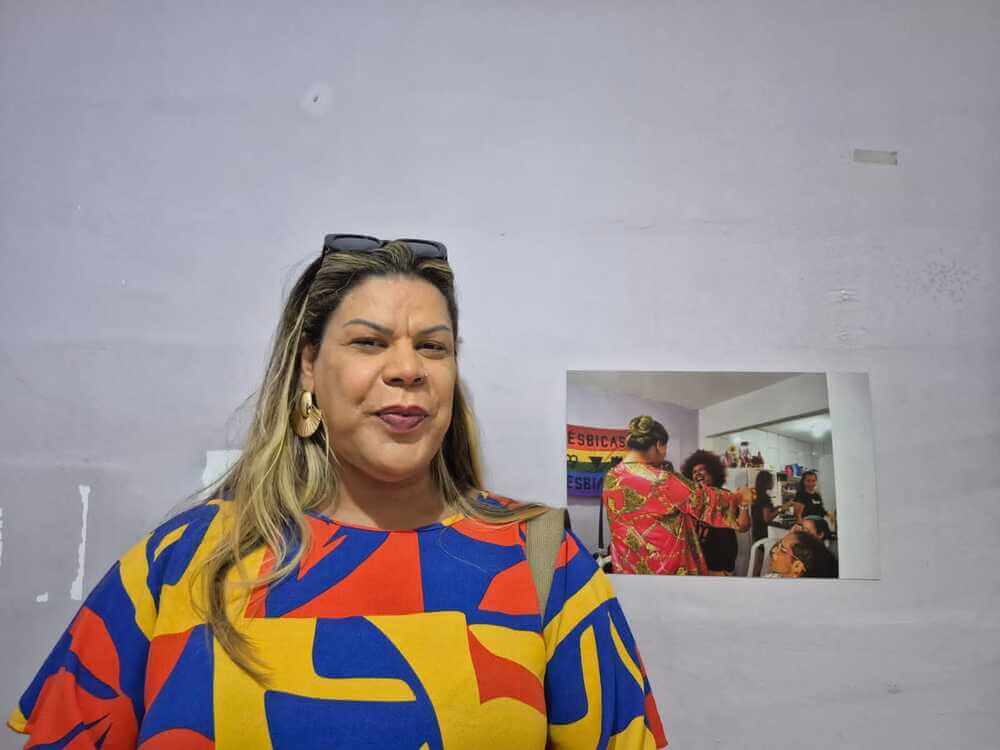
Safety
I see the world here [at Casa Resistências] as offering safety. The word of God is always on my mind. Because I think this is a space where I feel safe. I want to thank Camila [Felippe] who has always supported all the trans girls here and Day [Gusmão] for this lesbian movement and opening it up to trans people. We are women, but there are still those who won’t accept trans people. I know that it has been challenging for Day to welcome trans women into this house; it’s not only me, there have been other boys too, who participated in some of the courses here. I totally bought into this and have and will continue to learn a lot from it. I will try very hard to do that. Safety is in multiplying what you are seeing. It’s a multiplier, it teaches people, because sometimes we don’t know what’s happening and you go through things that you don’t know how to handle. Having a safe place [especially] for us LGBT people is the most important thing. It’s a place where you can come, you can stay, you can do anything. Nobody will say anything, everyone just continues. [There’s none of that] stop that crazy woman and put her in a home, please! Do you know what I mean? It’s that kind of safety that we want, to have our first experience in safety. People from the favela can now go and count on houses like these. Having a place that welcomes us, where we can come, we are welcomed, where we can come back, and come back, and come back, and leave, and come back, that’s very important to us. Thank you very much, Day, and to everyone who is here. This photo is the most beautiful one here! [Lohana says laughing as she points to her portrait in the exhibition of photos at the Casa Resistências that was presented in a small exhibition on November 8th, 2025 along with a conversation circle and is featured in the visual essay “What is this Ground on Which I Step” in the 7th issue of Revista Mesa].
- Lohana Karla
Sea breeze
Sea breeze is the salty mist carried by the wind from the waves of the sea along the coast. It corrodes metals. It oxidizes coastal structures. In local slang, sea breeze signifies laziiiiinesssssssss…
In between the cracks, a world opened up. A long-held desire to get to know the mysteries of the Casa de Mystérios e Novidades made things feel familiar when I walked into the ocean-like house. A conversation circle like the movement of the tides. I understood that the stilts are impulses to breathe out of the water. The smell of the sea air entered from the front and found me in the open spaces of the house. It was there that I understood; I realized it was a kind of (re)encounter with people who could be my people from long ago. Almost like a known, imagined place. The house-body, the ground-heart.
The smell again… The sea is when the salt seasons the veins. It’s mother/sea. [T.N. m(ãe)ar in Portuguese; mother= mãe and sea= mar]
The sea has a body. The body is in a trance in the water. In the abyssal depths, those who emit their own light make darkness their home. In the Dead Sea, people don’t sink. The sea heals. I heal, you heal. Yeye Omo Eja, Mother Whose Children Are Fish. The sea breeze is the sensual perfume of seaweed, it reaches us wherever we are. It invades us. We let it. The sea will always be an invitation. The world has opened itself to celebration.
- Danielle Pena
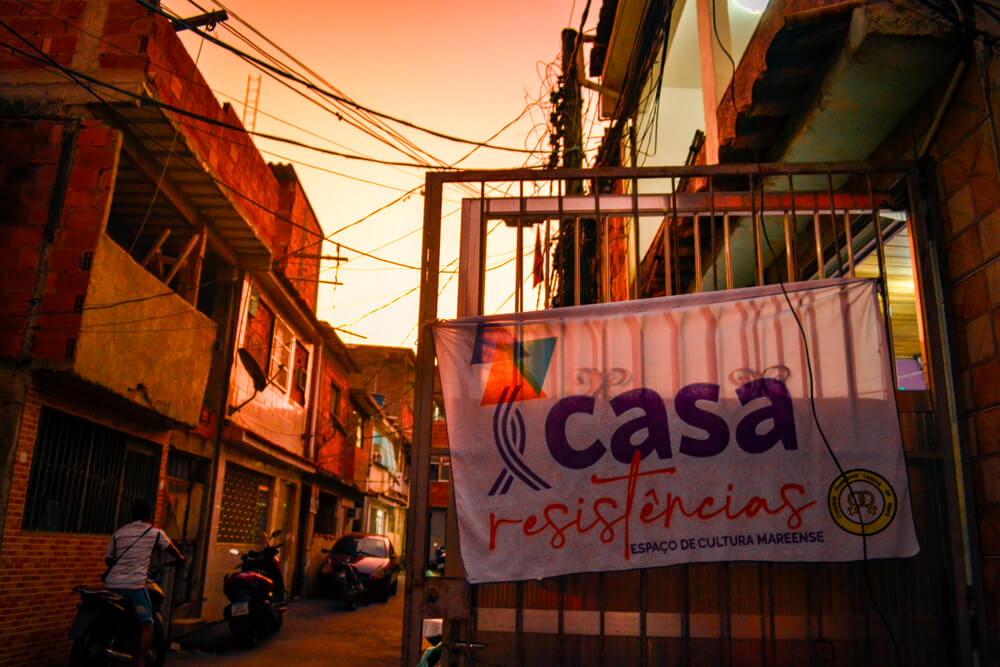
Sunset
Thinking about all that’s happened, I can’t believe how symbolic that photo is! [Dayana is referring to the affectionate photo of her and Camila Felippe at the opening of the Casa Resistências – one of twenty images featured in the visual essay on the Casa “What is the Ground on Which I Step?” in the 7th issue of Revista Mesa and featured in a small exhibition held at the Casa on November 8th, 2025].⁴¹
To think that we managed to build a place of respite at the crossroads of the world, you know? In the midst of so many attacks, we managed to build a space where one can rest in the company of the other. It’s not that we don’t disagree, we disagree from time to time, things get heated between us, but I think we’ve developed a place where disagreement is possible and natural.
When I look at this photo, I immediately think back to 2017, when we founded the [Lesbian Resistance] collective. It was five girls with a dream: to have a safe space to talk about lesbianism in the favela. There we were hanging out in the square with a cooler, you know? We never thought we’d have our own space because we didn’t have any money. And, damn, we have a space, you know? And it’s a space that belongs to everyone. For me, that’s really cool. It took a lot of struggle; we know the hardships we went through to get here, and we paid some prices for our freedom.
But the photo that really gets to me is the one taken at sunset [photo of the Casa’s entrance with their banner taken at sunset that opens the visual essay]. Because first of all, the Orixá [Afrobrazilian deity] that has always guided me is Iansã, and she is known as the “mother of sunset” characterized by transformative strength. Second, because for us who are from the favela, we have to recalculate our route every sunset. We don’t have the right, people from the favela don’t have the right to plan. Because we don’t know if we’ll wake up and there’ll be a police operation, meaning that we’ll have to postpone the support group for that day, that we’ll have to postpone our date, the hangout we had planned, you know? And then, suddenly, we’re in a house that’s ours. In a country that doesn’t have funding for the lesbian agenda of Black women from favelas we’re in a space that’s totally ours. You know? We built a space that’s much more than the fruit of the dream of five girls in 2017. Because today it’s not just a party space, a place to go on a date with a girl. It’s a space where we can offer shelter to girls who see the Casa as an escape from death. They use the Casa as a route to life. To be able to come here, make a stop at the crossroads, recover, follow their path, learn a profession. A crossroads of life. Whether they return or not, that’s okay, you know. So, I can’t find the words, but I’m left with this feeling of a sunset. The possibility of growing old, the possibility of maturing, the possibility of planning, of organizing, of coming together, of being able to disagree, of being able to fight, of being able to reorganize ourselves here. To know that when we fight, it means going back, apologizing, realigning, reorganizing, readjusting the route, and knowing that this is a space where women from the favela will have the right that has historically been denied to us, which is the right to make mistakes.
- Dayana Gusmão
Swinging Body
I am speaking on behalf of a group that carried out a two-year project at the Talavera Bruce women’s penitentiary in Rio de Janeiro, entitled Body, Gesture, Affect.⁴² The objective was to work with the inmates through engaging the body. We worked with two distinct groups: one of pregnant women and another known as “High Security”. The pregnant women did not form a fixed group, as some arrived at the penitentiary already pregnant, while others discovered their pregnancy after entering. After giving birth, they were sent to the maternity ward, or occasionally managed to leave during the process. Those from the “Security” group were women who had committed heinous crimes and were kept in protected cells within the prison itself. The pregnant women were often a very devitalized group, with very tired, overburdened bodies. Imagine being pregnant inside a prison! Those in the “Security” group, did not participate in the social life of the penitentiary and, so, lived in great isolation. Unlike the pregnant women, this group arrived with a great desire to participate.
For our work at the prison we were not able to bring anything: no cell phones, no music, no objects. We had to work with what we had: our bodies, memories, desires, voices, with the space that was given to us that day.
Working with the inmates, one thing that really caught my attention, something that frequently occurs in museums too, was the posture of walking with your hands behind your back. It seems that, in certain institutions, whether artistic or penitentiary, the body already adopts, on its own, a posture of restraint. We are afraid to expand, to create. Our intention was to activate, via the body, some kind of memory, some gesture capable of evoking something, both for the inmates and for ourselves. It was a very interesting process. Participation varied greatly: sometimes there were many, at others, very few. But over time we managed to have a more continuous group.
For a long time, I had the feeling that the work wasn’t progressing, until we began to understand that it extended beyond our presence. We went every two weeks and, through this exchange, we realized that in the weeks we weren’t there, of their own accord, if they so desired, they would create their own kind of choreographies. Because they lacked material resources, they always returned to the body itself, their own and that of whom they were with. This relationship also extended to their cell space, for example, they would count how many steps fit in the cell and create choreographies, or bring gestures that had appeared during the week. They began to develop their own way of thinking and when faced with a disturbing feeling, they resorted to a corporal movement as a form of relief, of breathing.
It was in this process, in dialogue with this work at the prison, that I began to develop the concept of the swinging body. Something I had been thinking about for years, but it was during my master’s degree [and this prison experience] that I was able to develop it further. It had previously emerged as part of my research on eroticism and street cinemas that became pornographic cinemas. In the prison context, it gained a new layer of meaning. It’s about thinking of the body as a potential in transit: a living, desiring body, available to move, to take risks, and to transform itself in the encounter with the other. The term is a play on the word “transar” [to have sex], and “transitar” [to be in transit]: sex as transit. It’s not just about sexuality, but about the vitality that permeates daily life and ways of being together, shifting the pleasure from the logic restricted to sex and consumption, to an understanding of it as presence and creative force. In this sense, the concept also became a way of thinking about how it is possible, starting from one’s own body, to overcome walls, whether physical, symbolic or invisible, that make us withdraw, put our hands behind our backs and avoid sharing. The idea was to create that space as a space of health. A drop of health [in that context] but still significant.
The project stopped due to a lack of institutional support which prevented us from maintaining regular visits. We lost the consistency that this type of work essentially depends on. It’s necessary to create bonds, to cultivate what I would call a body of trust. It’s a shame. I was very sad to [end our work, especially] realizing that small drops really do make a difference. Even if only for an hour, it was wonderful that this swinging body could emerge, in the form of a gesture, a dance, a song, memories. We were there to be together, composing this great body that was the Body, Gesture, Affect project.
- Caroline Valansi
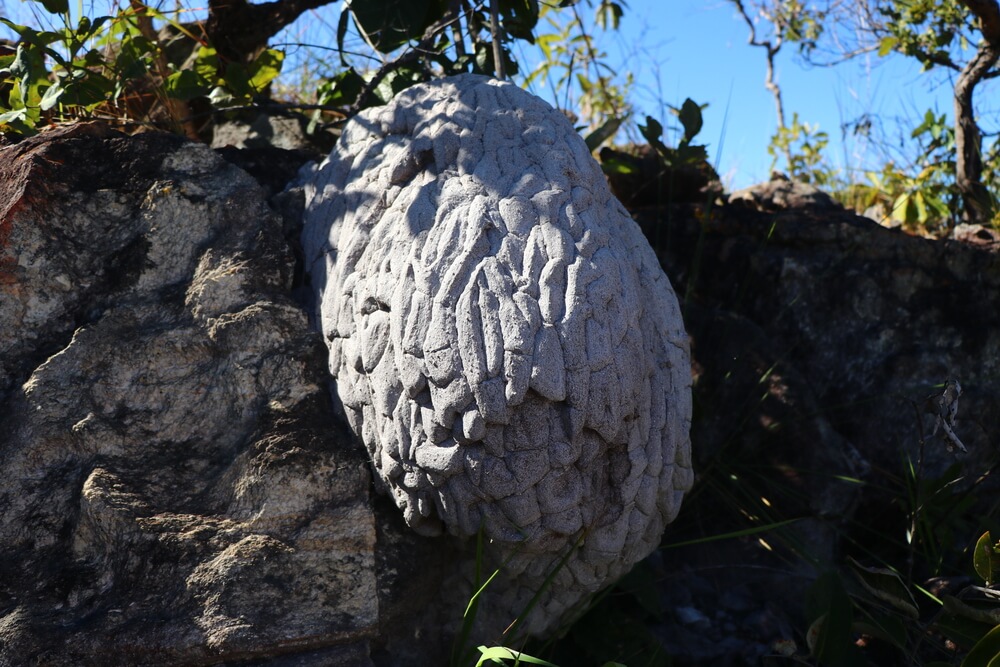
Technologies of the Earth
My name is Carla Santana. I was invited to contribute a visual essay to Revista Mesa based on my experience at the Sertão Negro art residency program – an initiative conceived by the artist Dalton Paula and Ceiça Ferreira. Sertão Negro is located in Goiânia. I inaugurated their residency program in 2023. Today, in 2025, Sertão Negro has already expanded in many ways. Politically and artistically it is a utopian idea. As I said in my essay, I arrived there with the mentality of a seed, and left with thoughts the size of a jatobá tree, thinking about my artistic production in its most varied and multidisciplinary ways.
I had chosen the element of earth as the focal point of my practice and research, and in the Sertão Negro region I had the experience of visiting the Kalunga Quilombo, located in Caldo Alcante, in the Chapada dos Veadeiros. Dalton encouraged me and gave me the confidence to begin the process of collecting earth samples as materials. Until then, although I already did not work with industrially produced pigments, I didn’t yet have this practice of collection. With Dalton and Ceiça guiding me through the territory, I began gathering these materials. With that, my work expanded to this way of thinking, not only about the material itself, but also about the territory. When I do these collections, someone always comes along, someone is there beside me who encourages me to do the collections: “look at this color,” “how beautiful,” “take it.” So there’s this relationship, and my little pots have the name of the territory, but also the name of the person who leads me to this material.
One element that fascinated me was observing the homes/houses animals made for themselves. It was almost shocking to see the condominium-like giant termite mounds. I was already engaged with a process of sculptural research involving clay and ceramics, and I kept thinking about the technology of these animals and insects in transforming nature and how this technology is linked to an idea of subsistence. How can human beings begin to set up and create their own technologies by observing nature and these animals and their technologies. So, I started to make this connection between termite mounds and vernacular architecture. When I went to the Kalunga community, [this relationship with nature] was visible, because all the houses were made of bamboo. There were those giant termite mounds and bamboo houses, [so I could see] how elements were transformed for subsistence.
My initial research involved observing these dwellings and noticing their collective work. The termite mound, but not just the termite mound, also the beehive, the wasp nest, are collective bodies. Everyone there is committed to building the home. So, I arrived at Sertão Negro wanting to research this. Dalton encouraged me to reflect on where the thinking about the land is within this community. Ceiça helped me a lot in this reflection as well. I realized I was in agriculture. The quilombola seeds are very important to the tradition of that community. Every year they replant bean and rice seeds. I saw how the land for them is linked to this idea of agriculture, of the continuation and perpetuation of the seeds and the quilombola roots.
This led me to research my own family. My grandparents were farmers. So, there’s also this dimension of research that is opening yourself up to the world and to your inner universe. So, upon returning from that residency, I went through my family’s archives and memoirs and created a series of paintings called Das mãos dos meus avós se plantava tudo que se come [From the hands of my grandparents, everything was planted and eaten] (2023). It’s an ode to the memory of the Black people who planted all the principal Brazilian foods that we consume to this day. So, in this series I paint corn, cassava, bananas, which are food staples, and how the Black population is the driving force behind all this ancestry and this basis of subsistence. So, my research was about thinking about this place of existence, how culture is this perpetuation of existence, whether in homes or in food. So I inaugurated this process in my work of collecting and compiling pigments from the places I visit and from the observation of nature. Because, every place is unique. Each place gives me colors and materials that are unique. So my word is technologies of the earth.
- Carla Santana
Territory
I thank Mesa Institute and the Companhia dos Mystérios e Novidades for hosting this event and especially Casa Resistências for the work that we are concluding and launching today with great pride. My name is Suellen Cloud. I was born in one of the favelas of the Complexo da Maré, in the little houses of Tijolândia. My journey began when I took to the streets. When I got involved with activist movements, I realized that it was possible to unite with other people through ideas. This happened when I lost a job, had some mental health problems, crises, and ended up on the street working as a prostitute. I got involved with movements like Puta Da Vida⁴³ and started going to some film club sessions at night. That was in 2017, when I first encountered Favela Cineclube, which operates here in the port region of the city, which started in Providência favela and today is based here in Morro do Pinto favela. It was this bridge between this movement in the Complexo da Maré and the port region that allowed me to circulate throughout Rio de Janeiro, both the territory of the city and the territory of Maré itself. So, I began to understand the construction of Maré, this history of the construction of Maré that emerged through the movement of women. I needed to go to the streets to live in the favela. Depending on the context and the family you live with, there is a certain imprisonment there because you sometimes have, through your upbringing, a limited view of your own territory without being able to see its true potential. That’s what happened to me and these experiences brought me back to represent my territory.
So, I think my key word today is territory. Getting to know my territory, its inner workings and construction, was important. But it was necessary for me to be in the streets, to be part of street movements, so that I could get to know it. From that, I started thinking about political parties, social movements, NGOs, but I was still very lost, not knowing how I could be useful. It was then, in 2023, that I attended the popular photography school, Imagens do Povo [Peoples Images], based at the Observatório de Favelas [Favela Observatory], an NGO in Maré. I invite you to check it out too. There you can learn about the theory of the photographer Ripper, who started circulating in Maré in the 1950s and 60s, during its construction. He has important photographs from the time of the construction of Maré, Avenida Brasil [main artery and expressway into the city of Rio], and Linha Vermelha [expressway]. Ripper promoted this concept of what he called “goodwill” photography, where the photographer constructs their imagery through feeling and listening to people. I see it as a process of constructing my photography through feeling the movements and struggles of each one of us, what mobilizes each of us and our agendas. This feeling is very important for me to understand before clicking, before taking a photograph.
It has been an important journey. So, Imagens do Povo’s invitation to photograph Casa Resistências and its LGBT community, perfectly aligned with my experience in the streets. Now, in recent months, I’ve been following Casa Resistências more closely, but I knew about the struggles and movement of the Casa even when it didn’t physically exist. I’ve always been there. It’s interesting to hear Dayana [Gusmão, coordinator of Casa Resistências] bring up the data, but I think that data is underreported because before the Casa Resistências physically existed, its project already had that sense of home. I myself have benefited from and been assisted by several of the Casa’s projects that highlight exactly this movement of awareness, especially for women in favelas. This empowerment is about movement. Casa Resistências has always been active in promoting this movement of the woman’s body, of comings and goings, and I’ve done several projects related to this movement. Looking at the images, you’ll better understand what I wanted to convey about the energy and the welcoming atmosphere at the Casa, something that goes beyond the numbers. The welcoming is face-to-face, the welcoming is about “let’s do this together,” and that’s why it was so important at this moment.
- Suellen Cloud
Vivência (Lived Experience)
The films and the presentations [from the Revista MESA shown at the December 13th event at Tropigalpão] portray a lot of everyday life that is beautiful. I liked that within the ordinary there is a bit of the extraordinary. The artists position themselves [as if] on the outside of ordinary aspects of reality. So, I find the whole process of registering this [reality] very interesting. Thinking about the films we saw featuring the Company [Companhia de Mystérios e Novidades] and the artist Ze Bezerra, the filmmakers went to where the art is being created and were able to see a little through the artist’s eyes, because it’s about putting the artist’s perspective into the film, not other points of view. I just left high school, so the question of who is speaking and the place from which they speak is very much present for me. Being here, soon to be going to university, I am thinking a lot about the places from which we speak. I think it’s very important to put into perspective who is thinking [and speaking] in order to define a little of what you are going to think. Because there is also collectivity in thought and the creation of works; works are made collectively and ideas are built collectively. I find these experiences and immersions very interesting; to both really see and live the experience of that reality. So, I thought I would bring the word vivência [lived experience]⁴⁴ to this conversation circle.
- Eloah Van de Beuque
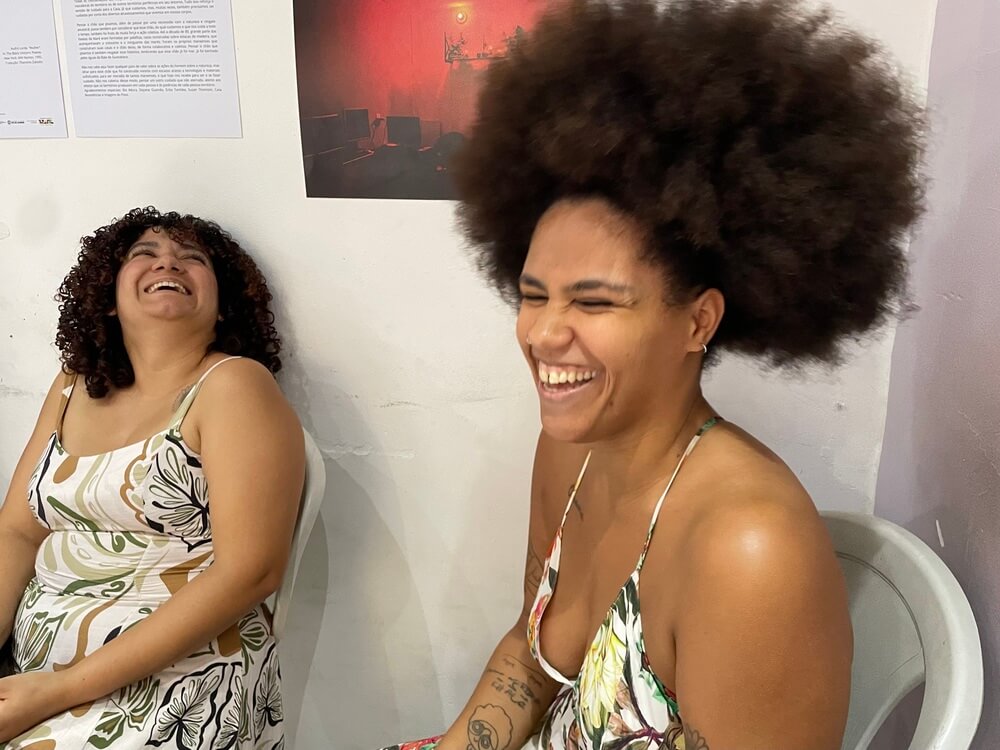
Welcoming
My name is Camila Felippe and I am vice-coordinator of Casa Resistências. Looking at the photos it’s impossible not to remember how we started and where we are now.⁴⁵ [Camila is referring to an exhibition of the visual essay “What is this Ground on Which I Step?” featuring photos of the Casa and its community in the 7th issue of the magazine and presented at the Casa together with a conversation circle on November 8th, 2025]. We’ve gone through so much transformation! It feels like, I don’t know, 10 years have passed! Not only physically, but I think we’ve grown as a collective. We managed to construct our own space and now we’re in a moment where we can breathe easier and be stronger together.
If I were to think of just one word, for me it’s welcoming. I think the Casa manages to be that a lot. Whoever arrives here really feels very welcomed. And when they leave they always say, “I want to come back.” We fulfill our role when these women manage to feel like they belong and are welcomed here. Jessica [Gogan] talked about “acuerpar,”⁴⁶ [a kind of aggregation of bodies in solidarity]. We, women, have a lot of that. We always manage to have this unity, this affection, this care that we have for each other, especially lesbian women. We know that it’s only us that will take care of us. We participate in the Black movement, in the LGBTQIA+ movement, in all the movements, but when it comes to the LGBT agenda, it’s only us for us. So, I think we also have a lot of strength.
Wow, I think that since we’re here at the Casa on a piece of land in the Maré favela, we also have to remember that this land was once the sea, that this place was once bathed by the waters of Guanabara Bay. That’s what women are, that force of nature, the water that carries us, that at the same time can be calm, but in the blink of an eye comes with the force of a current, so I think the Casa has that force. I can only thank you for choosing us. At a time when I think we didn’t even realize we needed it. So, for me, the most beautiful photo is this one! [Pointing to her portrait with Dayana Gusmão and addressing Dayana]. I’m always thinking together with you. I learn with you every day. Of course, nobody is perfect, but I think I’m always in this place of defending and being on your side, because you will always defend me and be on my side, regardless of what the other person says, that’s so very commendable. So, I think it’s about being grateful, enjoying this moment, and thanking everyone who is and has been involved in the Casa. It’s also a moment to admire. I think art brings this reflective moment, allowing us to look at ourselves and others in a different way.
- Camilla Felipe
***
Program Launch
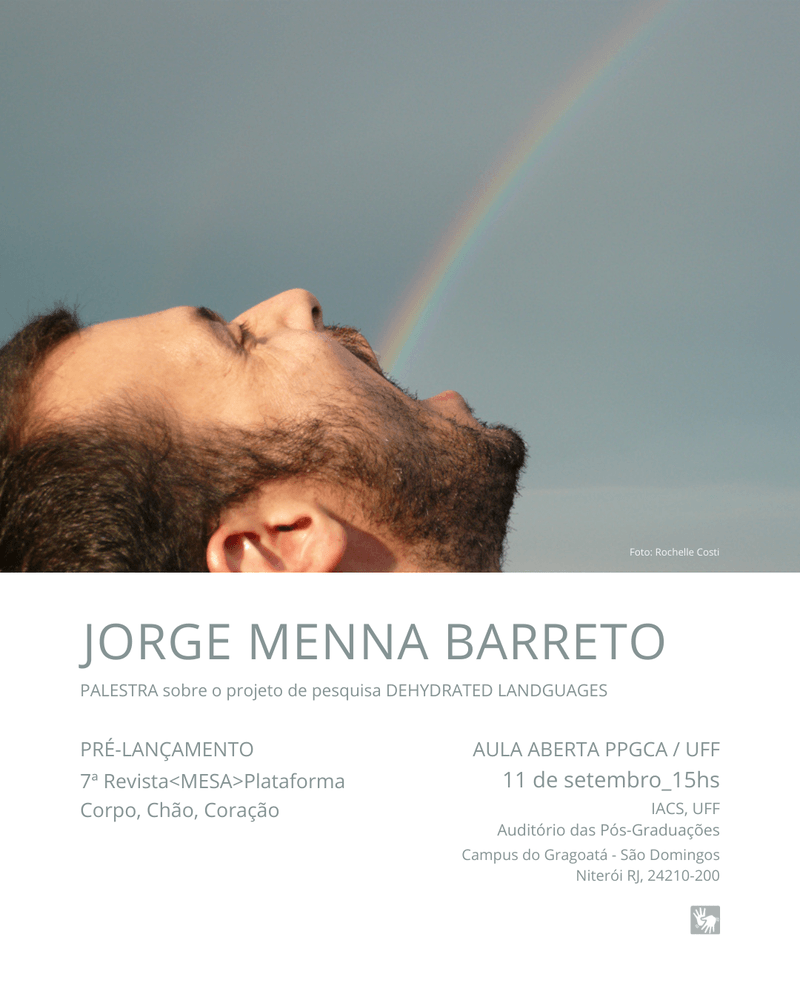
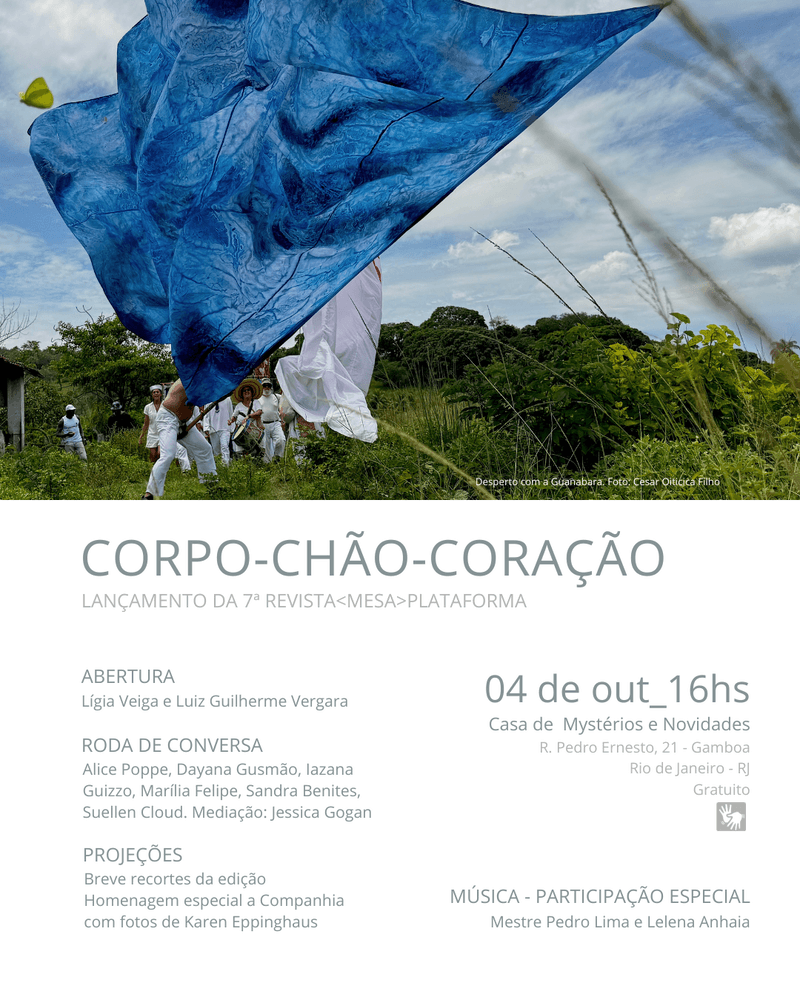
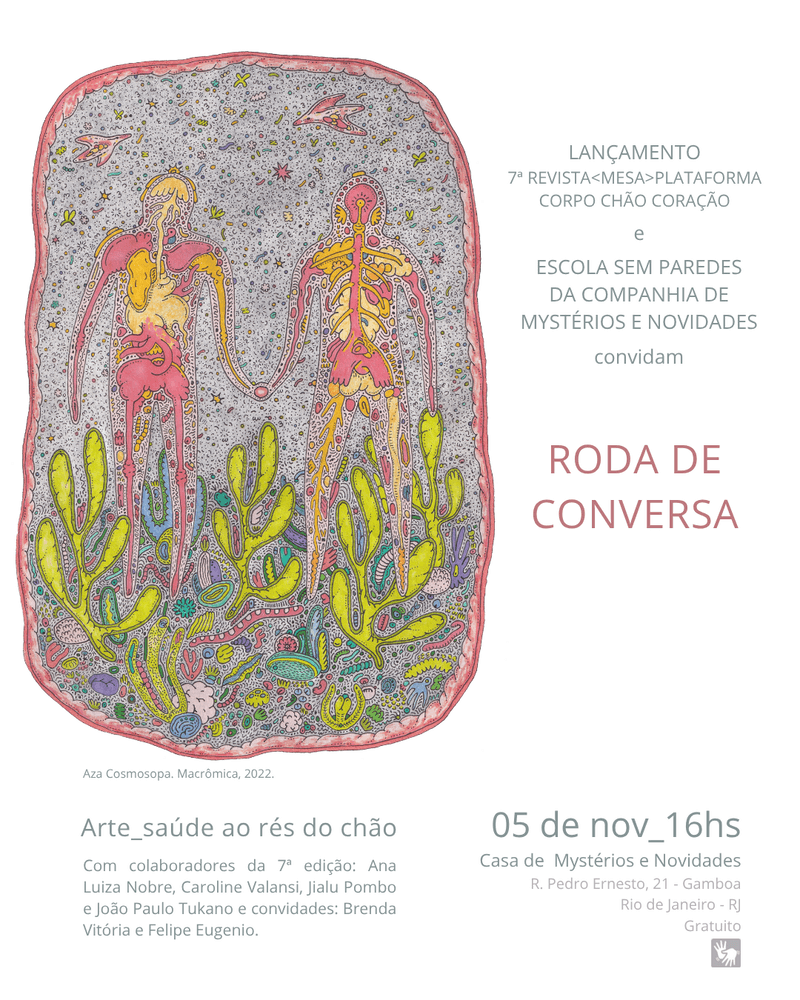
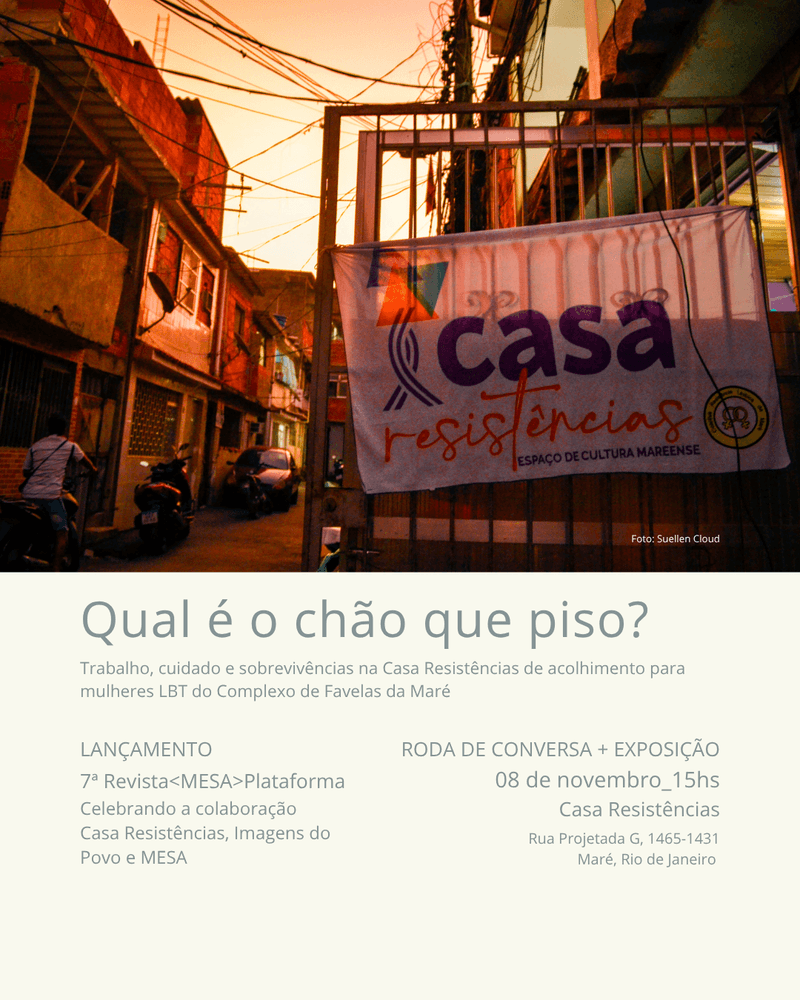
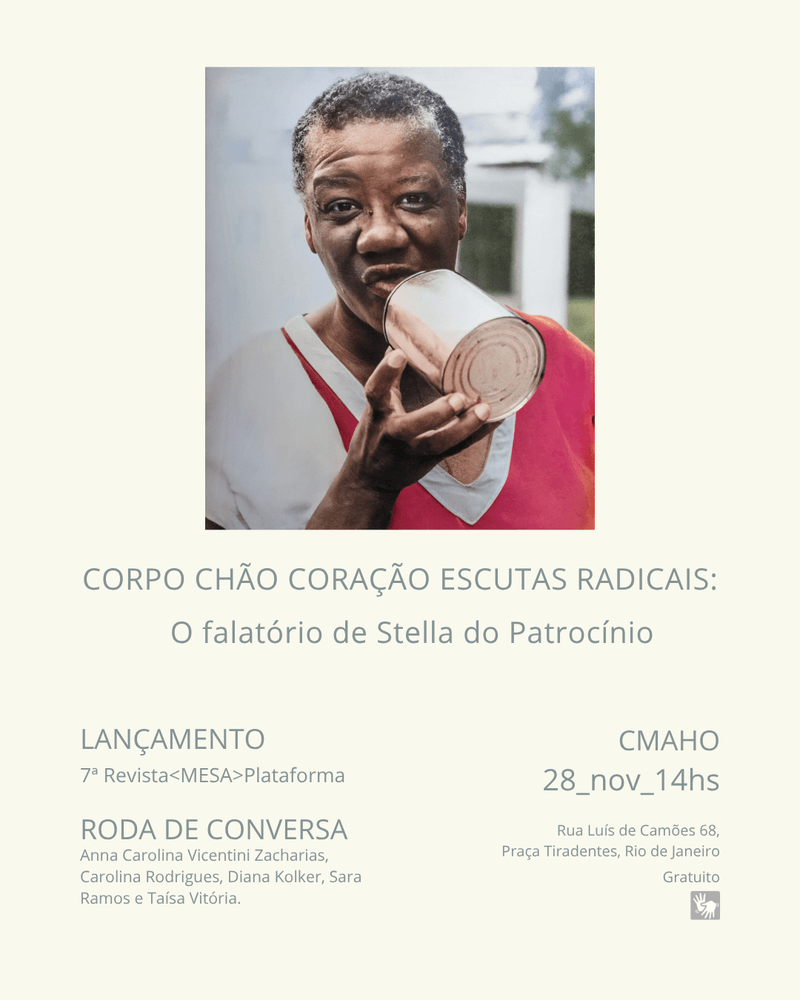
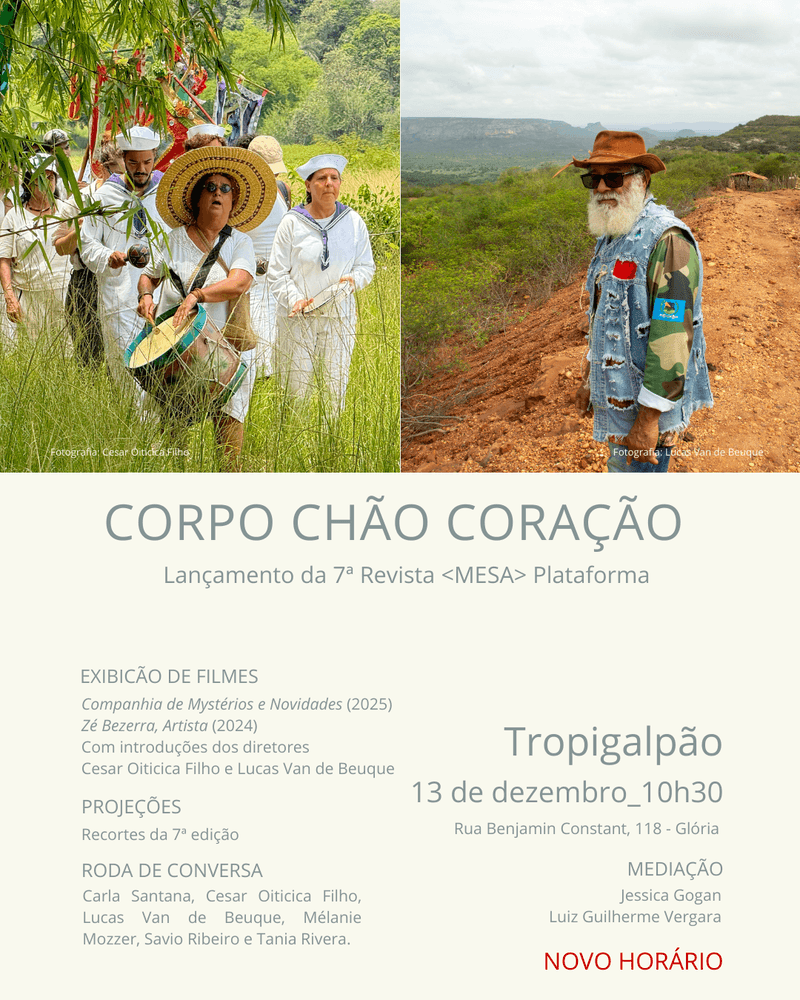
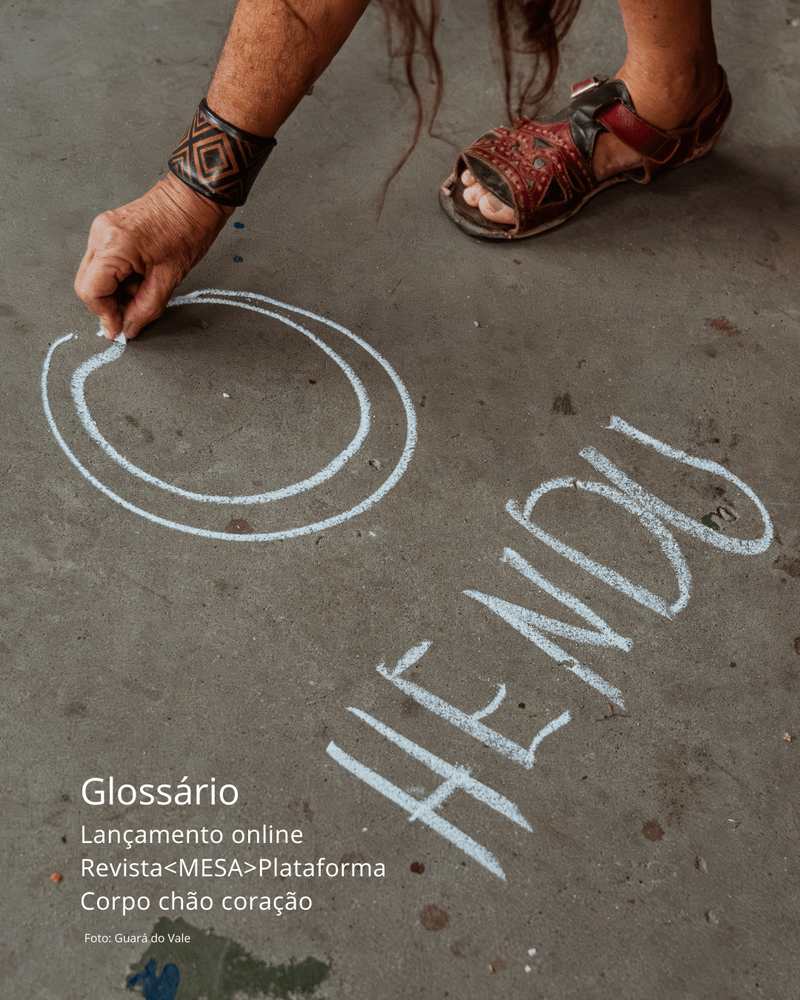
***
Authors
Alice Poppe
Maria Alice Poppe is an artist and dancer who investigates the body and its poetic-political relationships with the ground, weight, and gravity from a hybrid perspective of dance and somatic education drawing on Angel Vianna’s methodology. She has a PhD in Performing Arts from UNIRIO and is a professor of dance at UFRJ. Alice has performed in many contemporary dance productions in Brazil. Her latest work, Celeste, choreographed by Marcia Milhazes, premiered at Palco Carioca at Dança em Trânsito 2025.
Anna Carolina Vicentini Zacharias
Anna Carolina Vicentini Zacharias is an artisan, educator, and researcher. She is currently doing doctoral research in the program of Literary Theory and History at the Institute of Language Studies at the State University of Campinas (UNICAMP). She holds a master’s degree from the same institute and is the author of Stella do Patrocínio, ou o retorno de quem sempre esteve aqui (Stella do Patrocínio or the return of who has always been here), 2023.
Ana Luiza Nobre
Ana Luiza Nobre is an architect, historian and professor in the Department of Architecture and Urbanism at PUC– Rio and coauthor of Atlas do Chão (atlasdochao.org)
Angela Mascelani
Anthropologist, writer, art director. She holds a PhD in Anthropology, IFCS/UFRJ (2001). Publications include: O Mundo da Arte Popular Brasileira (Ed. Mauad, 2002); Caminhos da Arte Popular: O Vale do Jequitinhonha (Museu Casa do Pontal, 2008), “L’art populaire au Brésil et le musée Casa do Pontal” (Brésil(s) Sciences Humaines et Sociales, 2021) among many others. Co-directed the films Juazeiro do Norte, Ceará: arte, fé e festa (2014) with Lucas Van de Beuque and Artistas Cazumbas, winner of the Pierre Verger Award, also with Lucas Van de Beuque and Moana Van de Beuque (2019). Curator of several popular art exhibitions and director and curator of the Museu do Pontal since 1996. Conceived, along with Lucas Van de Beuque, the institution’s new headquarters, inaugurated in 2021.
Brenda Vitória
A favela resident, environmental educator, and researcher. She holds a bachelor’s degree in Science and Ecology from the Federal University of Rio de Janeiro (UFRJ) and is currently pursuing a graduate degree in Urban and Regional Planning at IPPUR/UFRJ. She works on environmental issues together with civil society organizations focusing on questions of race, gender, and territory.
Camilla Felippe
Camilla Felippe is a Black, lesbian woman living in Maré. She is an undergraduate student in Dentistry (UERJ) with a focus on public health and public policy. She is founder of LAPERG-UERJ and vice-coordinator of Casa Resistências.
Carla Santana
Carla Santana‘s work traverses her own body as a social body, bringing into view the historical, material, and cultural layers that constitute it. By understanding the earth in its different material and sensitive layers, the artist organizes compositions permeated by the notions of home, shelter, and communal space. Among her recent solo exhibitions are: “morada, alimento e autoteoria” (housing, food, and self-theory) (Quadra, São Paulo, 2023) and “Poros e acúmulos” (Pores and accumulations) (Carpintaria, Rio de Janeiro, 2022). Among her group exhibitions, exhibitions at institutions such as MAC Niterói (2025), Inclusartiz (2024), Auroras (SP 2022), and Tanya Bonakdar (New York, 2021). A graduate of the Federal Fluminense University (UFF), she first entered the artistic world through theater. She is a multilingual artist and also a co-founder and organizer of the national Trovoa movement.
Carolina Rodrigues
Carolina Rodrigues is an art historian (EBA/UFRJ) and curator. She holds a master’s degree in Visual Arts from PPGAV/UFRJ, and is a researcher at the Center for Anthropology, Heritage and Arts/CNPq. Currently she is the chief curator of the Bispo do Rosario Museum where she addresses issues related to the frontiers of the art system, ethnic-racial relations, territoriality, and gender.
Caroline Valansi
Caroline Valansi is a visual artist and works at the intersections of art, education, and mental health. She holds a Master’s degree in Contemporary Art Studies from UFF (Federal Fluminense University) and investigates creation and collaborative experiences, currently primarily with the collective Ateliê entreaberto (Open studio of the in-between). Her work addresses corporeality, desire, and pleasure, proposing art as a tool for sensitive transformation. Her works have been presented at the Havana Biennial and are part of the collections of the Museum of Art of Rio, MAM Rio, and the IMS Institute.
Cesar Oiticica Filho
Artist, filmmaker and curator, Cesar Oiticia Filho has a degree in journalism. He directed the film Hélio Oiticica winning the Caligari and Fipresci Prizes at the Berlinale, the Rio Festival and FILAF in Perpignam, France. Together with Fernando Cocchiarale he curated the exhibition Hélio Oiticica: Museu é o Mundo (Museum is the World) 2010. He has worked as curator of the HO [Hélio Oiticica] Project since 1997 and as artistic director of the Hélio Oiticica Municipal Center since 2021. Together with Evandro Salles he started the parade event Parada 7 in 2022. He has participated in the Havana Biennial (2015) and the Biennial of Moving Image (2014). He has published books about Hélio Oiticica and Mário Pedrosa. His most recent exhibitions are: Quantum Spaces and Quantum Intervention held in 2024 and 2025.
Danielle Pena
Danielle is from Mesquita. A child of Muriqui, her feet are on the ground among chickens and goats. She is an Ekede of a Jeje Mahi terreiro in Vilar dos Teles. She is an atelierista, writer, and art educator. Currently, she works as an art workshop facilitator for the NGO Mestres da Obra, in addition to working on health promotion projects with Fiocruz. She continues to develop her personal projects in her studio and wherever she may be living.
Dayana Gusmão
Dayana Gusmão is a social worker. She graduated from UFRJ with a specialty in gender and diversity studies in education from NEppDH UFRJ. She has a master’s degree and doctorate in social memory from UNIRIO. She is the founder of the Lesbian Resistance Collective of Maré (2017) and Casa Resistências (2022).
Diana Kolker
Diana Kolker Carneiro da Cunha (Rio de Janeiro, 1983) is an educator and curator. She holds an undergraduate degree in history (PUCRS), specialty certificate in artistic pedagogy (UFRGS), and a master’s in Contemporary Studies of the Arts (UFF). Since 2017, she has been coordinating the artistic and pedagogic project at the Museu Bispo do Rosario Arte Contemporânea, where she also participates in curating exhibitions.
Eloah Van de Beuque
Eloah Van de Beuque finished high school in 2025 and was accepted to UFRJ (Federal University of Rio de Janeiro) to study art history. She draws and also works on other related crafts as hobbies. She recently participated in an internship at the Pan-American Transatlantic Bloco – an artist-run Carnival street party block – , where she helped with its production. At her former school, Sá Pereira, she also participated in literary discussions, debating social, political, and structural issues.
Erika Tambke
Erika Tambke is a photographer, curator, teacher, and researcher. She holds a PhD from the School of Communication/UFRJ and a Master’s degree in Visual Culture (Birkbeck/University of London). She works as a photographer, curator, and professor. She was part of the coordination team of FotoRio (2020-25) and was the general coordinator of the Imagens do Povo/Observatório de Favelas Program from 2023 to 2025. She participates in the Favela em Foco and Fotografia Periferia e Memória collectives.
Felipe Eugenio
Felipe Eugenio is an editor, historian, and public health expert. At Fiocruz, where he has worked for 15 years with action based research, he seeks to strengthen popular insurgencies through literary experiments, such as the Brazilian Periphery of Literature and Artistic Residencies – where he developed the concept of Favelofagia (a term coined by the Favela movement).
Iazana Guizzo
Iazana Guizzo is an architect and urban planner. She is the coordinator of the project Floresta Cidade [Forest City] an outreach, teaching and research project at the Department of Architecture (FAU) at UFRJ, where she is also a professor. She has a PhD in urban planning, a master’s degree in psychology and a degree in contemporary ballet. The regeneration of cities in the face of climate urgency, community participation, interspecific life and Afro-Amerindian cosmoperceptions are topics of her research interest. She works in the fields of architecture, urban planning, and art and has collaborated with Companhia de Mystérios e Novidades since 2020.
Jialu Pombo
Jialu Pombo is a trans and neurodivergent artist-researcher. They hold a Master’s degree in Visual Arts (UFRJ) and a PhD in Clinical Psychology (PUC/SP). They research movement, subjectivity and the body, the relationship between creative processes and care practices, sensory experiences, the creation of languages that enhance dissident experiences, and accessibility in the arts. They work with photography, collage, text, sewing, and actions. Since 2010, they have participated in exhibitions, residencies, and taught workshops at institutions such as Parque Lage, Terra Una, and Sesc. They also work with activist organizations.
João Paulo Lima Barreto (Tukano)
João Paulo Lima Barreto is a member of the indigenous peoples Yepamahsã (Tukano) people, born in the village of São Domingos, in the municipality of São Gabriel da Cachoeira, Amazonas. He holds a degree in Philosophy and a PhD in Social Anthropology from the Federal University of Amazonas. He is a researcher at the Center for Studies on the Indigenous Amazon (NEAI). He is also a founder of the Bahserikowi Center for Indigenous Medicine. He is also a coordinator of the Rede Unida [National Health Network Indigenous] Peoples’ Forum. He is a professor and a consultant.
Jorge Menna Barreto
Jorge Menna Barreto‘s practice explores site-specificity as a constantly evolving relationship between art, ecology, and language. His work stems from a deep listening of materials, stories, and landscapes, fostering collaborations with diverse knowledge and communities. Jorge is a professor in the art department at the University of California, Santa Cruz, where he teaches the master’s program in environmental art and social practice. He is also a collaborating professor in the graduate arts program at UERJ (Rio de Janeiro State University). For more information: @jmennabarreto and https://jorggemennabarreto.com/
Kimberly Veiga
Kimberly Veiga is a public health psychologist and psychodramatist. She is the Reception Coordinator at Casa Resistências and a researcher of territorialities and intersectionalities. Contact: @kimberlyveiga.psi
Lohana Karla
Trans woman activist and founder of the Trans Institute of Favelas.
Lucas Van de Beuque
Lucas Van de Beuque is the executive director of the Pontal Museum. Together with Angela Mascelani, he created the new Pontal Museum, which opened in 2021. He is a professor at Candido Mendes in their MBA program in Museum Management. A photographer, curator, and filmmaker, his research focuses on artists and masters of popular culture. He co-directed the films Juazeiro do Norte, Ceará: arte fé e festa (2014), Artistas Cazumbas (2019) and Zé Bezerra, Artista (2024). He was co-curator for the exhibitions “Festas, sambas e outros Carnavais” (Sesc Casa Verde, SP, 2023 and CCBA, PA, 2024) featuring works by Mestre Vital, “Roxinha uma vida de novela” (Pontal Museum, 2023) and “José Bezerra e os artistas do vale do Catimbau” (Pontal Museum, 2024). He was also the photographer for the book Caminhos da Arte Popular: o Vale do Jequitinhonha (2009) by Angela Mascelani.
Maria Carolina
Engineer, lesbian, and yoga instructor.
Marília Felipe
Marília Felippe is a performer of dance and theatre and a body educator with a degree in physical education from UFMG and in psychocorporal therapy from the Rio Abierto Foundation (School of Human Development) and trained in dance with Graciela Figueroa and Grupo Coringa. For 12 years (1988 to 2000), she directed the Coringa Rio Aberto, which was then a representative of the Rio Abierto Foundation (“para el dessarollo armonico del hombre” www.rio abierto.ar). She is a teaching instructor of the same system, which aims to contribute to human development through psychocorporal techniques where the movement of vital energy is the pillar and starting point for the development of work. For 25 years, she has been a member of the Grande Companhia Brasileira de Mystérios e Novidades, a theater and popular opera collective (www.ciademysterios.com ) and coordinates the activities of the Casa de Mystérios, a cultural facility located in the port area of Rio.
Sandra Benites
Sandra Benites is the Director of Visual Arts at FUNARTE. [National Brazilian Foundation of the Arts]. She is an educator, researcher, and curator. She is a descendant of the Guarani Nhandewa people. She holds a Master’s degree in Social Anthropology from the Museu Nacional-UFRJ and is a PhD candidate in the same program. Her research and work have focused on the particularities of the arts and lives of indigenous communities, pointing to the need for counter-colonial changes in institutions, museums, and exhibitions, and the care for the particularities of different peoples, ethnicities, and cultures. She was the curator of the exhibition Dja guata Porã | Rio De Janeiro Indígena at the Museu de Arte do Rio de Janeiro (2017) and also part of the curatorial team of the Museu das Culturas Indígenas which opened in São Paulo in 2022.
Sara Ramos
Sara Ramos is a researcher, editor, translator and poet from Tocantins. She holds a master’s in comparative literature from UNILA. She has a lot of respect for words, whether spoken, written or embodied. She lives in Rio de Janeiro and is the author of Pequeno manual da fúria (2022).
Suellen Cloud
Suellen Cloud Atlas is a photographer, film club member, and cultural producer focused on working in the peripheries. A graduate of the Imagens do Povo School of Popular Photography, she works in the Maré region as media director for Real Maré Futebol Clube and also in the Port Zone with the Favela Cineclube project. She currently dedicates herself to photographic research, based on “fotografia do bem querer” (good will photography), seeking the visual and conceptual humanization of the favela and peripheral territories. Contact: @suellencloud
Taisa Vitória
She is an educator and multilingual visual artist, focusing on collage and painting. She holds a master’s degree in Sociology and Anthropology (PPGSA/UFRJ) and a bachelor’s degree in Social Sciences from UFRJ. She works as an educator at the Bispo do Rosario Museum. She participated in the exhibitions Regresso ao Sertão (2025) and 100 Anos da Colônia Juliano Moreira (2024) at the Bispo do Rosario Museum, Crônicas Cariocas at the Rio Art Museum (2021), and Arte como trabalho (2021).
Tania Rivera
Tania Rivera is an essayist, psychoanalyst, curator, and professor in the art department at the Fluminense Federal University (UFF). She is also part of the Postgraduate Program in Psychoanalytic Theory at the Federal University of Rio de Janeiro (UFRJ). Her recent publications include Lugares de delírio: arte e expressão, louca e política (N – 1 editions/SESC, 2023) and Psicanálise antropofágica: Identidade, gênero, arte (Artes & Ecos, 2020).
1 https://imagensdopovo.org.br/
2 T.N.. While afeto (Portuguese) and affection (English) are often used as direct translations, there are cultural and linguistic differences. Afeto suggests deeper emotional warmth and has a more frequent usage in Brazilian Portuguese, whereas affection in English is often perceived as more restricted or formal. Afeto can also be translated as affect related to Spinoza’s understanding of affect (affectus) and that of contemporary affect theories pointing to how feelings and their mental ideas, can increase or diminish the body’s power to act. Afeto is fundamental to the caring and ethical construction of community life. To suggest these meanings afeto has been translated as affect(ion).
3 https://institutomesa.org/revistamesa/edicoes/7/jialu-pombo/?lang=en
4 T.N “pedir licença” or to ask permission in Brazilian Portuguese is both a polite form of asking questions or intervening in a debate and a culturally sensitive way of expressing care for the other – those present and absent, both contemporary and historical figures impacted by colonial and capitalist violence and extractivism. In this context, it is a respectful means of acknowledging Stella as a person and the systemic racism and inhumane conditions from which the falatório emerged.
5 A full translation of the falatório [chatter] has recently been published and is available in PDF format. See: Marlon Miguel and Iracema Dulley eds. Stella do Patrocínio: Falatório/Chatter, translated by Regina Alfarano (Berlin: ICI Berlin Press, 2025) https://press.ici-berlin.org/catalogue/doi/10.37050/ci-35 (April 2026)
6 To access the audio recordings of the falatório in Portuguese: https://museubispodorosario.com/stella-do-patrocinio-memorias/ For an English translation see the aforementioned book edited by Marlon Miguel and Iracema Dulley eds. Stella do Patrocínio: Falatório/Chatter.
7 See Anna Carolina Vicentini Zacharias, Stella do Patrocínio ou o retorno de quem sempre esteve aqui (Rio de Janeiro: Telha, 2024) and the dialogue in this edition of Revista Mesa “Ensaios de escuta: O falatório de Stella do Patrocínio. https://institutomesa.org/revistamesa/edicoes/7/listening-rehearsal-essay/?lang=en
8 T.N. Casa de Mystérios e Novidades where the conversation circle was held is located in the port region of Rio de Janeiro, also known as little Africa and formerly the largest slave port in the Americas. See also footnote 4.
9 https://www.atlasdochao.org/
10 https://www.atlasdochao.org/wp-content/uploads/2021/10/sentidos-do-chao_ebook_final.pdf
11 T.N. Sentido in Portuguese can be translated simultaneously as meaning, sense and direction rendering a more synthesized notion of meaning-sense-direction and of understanding-feeling-movement as commensurate with the groundedness being invoked.
12 See the word Ground in this glossary.
13 https://institutomesa.org/revistamesa/edicoes/7/body-gesture-affect/?lang=en
14 https://institutomesa.org/revistamesa/edicoes/7/casa-resistencias/?lang=en
15 The falatório [chatter] is a series of tape recordings of the voice and pronouncements of psychiatric intern Stella do Patrocínio made in the late 1980s by the artist Carla Guagliardi as part of an art workshop offered at the institution which Stella herself called falatório. For more information see the dialogue “Listening rehearsals: The Falatório of Stella do Patrocínio” in this issue of the Revista. https://institutomesa.org/revistamesa/edicoes/7/listening-rehearsal-essay/?lang=en Also in this glossary see Anna Carolina Vicentini Zacharias entry “continuity”, Sara Ramos “experimentation, Diana Kolker “reparation” and Taísa Vitória “rewriting.”
16 To access Stella do Patrocínio’s audio recordings: https://museubispodorosario.com/stella-do-patrocinio-memorias/ and for more information about the exhibition: https://museubispodorosario.com/eventos/stella-do-patrocinio/ For an English translation see the aforementioned book edited by Marlon Miguel and Iracema Dulley eds. Stella do Patrocínio: Falatório/Chatter.
17 See footnote 14.
18 Ramo’s dissertation included the audio files of the falatório as part of its online to its publication in the UNILA institutional repository: Ramos, Sara Martins. Stella do Patrocínio: between the letter and the black throat of flesh. Master’s Dissertation. Postgraduate Program in Comparative Literature. Federal University of Latin American Integration, Foz do Iguaçu, 2022. Available at: https://dspace.unila.edu.br/handle/123456789/6465;jsessionid=7500013A50BF0043E118C067ACA0384E Accessed in: February 2026.
19 Stella do Patrocínio’s audio recordings can also be accessed at: https://museubispodorosario.com/stella-do-patrocinio-memorias/ and for an English translation see aforementioned book by: Marlon Miguel and Iracema Dulley eds. Stella do Patrocínio: Falatório/Chatter.
20 Ramos notes that she is drawing from an idea of “experimentation” developed by Paulo Henriques Britto in his discussion of aesthetic experimentation as distinct from scientific Cartensianism where limitations and rules are encountered and broken more based on the artist following their intuition than any kind of rational experimentation. Paulo Henriques Britto, “O fim de um paradigma” in Célia Pedrosa, Tania Dias, Flora Süssekind eds., Crítica e valor: uma homenagem a Silviano Santiago (Rio de Janeiro: Fundação Casa de Rui Barbosa, 2014), 219-229.
21 T.N. Favelaphagy is coined after the term “anthropophagy” or cannibalism made famous by the Brazilian modernist writer Oswald de Andrade and his “Anthrophophagic Manifesto” (1923) that drew analogies between the practices of cannibalism and the cultural practices of Brazilian writers necessary to “eat” and redigest, absorb and reinvent colonial influences and literary traditions.
22 T.N Inspired by Julio Cortázar’s Cronopias and Famas (First published in Spanish in 1962) this practice uses play and walking to subvert everyday perspectives, break stereotypes, and reveal new insights into social life.
23 https://favelofagia.com/obra/cha-de-dentro/
24 T.N. The expression in Brazilian Portuguese “carne de pescoço” literally meaning “neck meat” also means someone or something is difficult or hard work, coming from the idea that neck meat is the toughest, most fibrous, and therefore takes longer to masticate and digest.
25 For more information see the visual essay GUIZZO, Iazana and OITICICA FILHO, Cesar. “Awakening in Guanabara: a conversation, a procession, a crown for Iemanjá” https://institutomesa.org/revistamesa/edicoes/7/portfolio/ensaio-iazana/
26 https://www.atlasdochao.org/wp-content/uploads/2021/10/sentidos-do-chao_ebook_final.pdf
27 https://www.rioabertorio.com.br/
28 https://rioabierto.org/en/home/
29 For more information: https://institutomesa.org/revistamesa/edicoes/7/jorge-menna-barreto/?lang=en
30 T.N. Sertão refers to the semiarid region in northeastern Brazil, comprising parts of the states of Alagoas, Bahia, Pernambuco, Paraíba, Rio Grande do Norte, Ceará, Maranhão, Piauí, Sergipe, and Minas Gerais. The word also refers in general to Brazil’s hinterlands similar to the Australian outback.
31 The idea of a “Metabolic Museum” was developed by researcher Clémentine Deliss as a conceptual model to reimagine museums as “laboratories” for remediating, reinterpreting, and activating ethnographical and historical collections. Rather than static displays the museum is to function as a living organism often featuring symposiums, lectures on decolonization and artistic interventions. For more information https://mm-u.online/metabolic-museum-university-mm-u/ (Accessed April 2026)
32 See footnote 14 for a brief overview of the falatório.. For more information see the dialogue “Rehearsal of Listening: The Falatório of Stella do Patrocínio” in this issue of the magazine https://institutomesa.org/revistamesa/edicoes/7/listening-rehearsal-essay/?lang=en and also the other Glossary entries: Continuity, Experimentation, Denunciation and Rewriting.
33 https://museubispodorosario.com/eventos/stella-do-patrocinio/
34 https://museubispodorosario.com/stella-do-patrocinio-memorias/
35 https://institutomesa.org/revistamesa/edicoes/7/listening-rehearsal-essay/?lang=en
36 https://museubispodorosario.com/eventos/stella-do-patrocinio/
37 See footnote 14 for a brief overview of the falatório. For more information see the dialogue “Listening Rehearsal/Essay: The Falatório of Stella do Patrocínio” in this issue of the magazine https://institutomesa.org/revistamesa/edicoes/7/listening-rehearsal-essay/?lang=en and also the other Glossary entries: Continuity, Experimentation, Denunciation and Reparation.
38 https://museubispodorosario.com/eventos/regresso-ao-sertao/
39 Complexo de Maré [Literally Tide Complex] often just called Maré is the name of a complex of sixteen favelas built over mangroves and swamp areas in Rio de Janeiro’s northern suburbs on the margins of the city’s Guanabara Bay in the 1940s. Maré now has more than 150,000 residents.
40 Marielle Franco (1979-2018) was an Afrobrazilian sociologist, Rio de Janeiro city councillor, and human rights activist, who actively advocated for housing rights for favela residents. Openly gay, she defended women’s and LGBT rights and worked against systemic racism. Tragically, she was brutally assassinated along with her driver Anderson Gomes in 2018 by a hit ordered by militia with support of corrupt police officers and representatives of Brazil’s right wing, prompting mass protests. She swiftly became a symbol of radical resistance.
41 https://institutomesa.org/revistamesa/edicoes/7/casa-resistencias/?lang=en
42 https://institutomesa.org/revistamesa/edicoes/7/body-gesture-affect/?lang=en
43 T.N Puta in Portuguese means both prostitute and mad the name is a pun on Prostitute of Life and Mad at Life.
44 T.N. ‘Vivência’ is commonly translated as ‘experience’ or ‘lived experience’. Suggesting a notion of something experienced full and lived ‘livingness’, the term conveys a vital sense of being in the moment, an openness that allows one to really be present and feel an experience.
45 https://institutomesa.org/revistamesa/edicoes/7/casa-resistencias/?lang=en
46 Acuerpar is a concept/word of the Guatemalan feminist activist Lorena Cabnal. She makes a verb with the word “corpo” meaning “ body” as in “acorpar” literally to aggregate bodies, suggesting a way to be in solidarity, to be present, to bring bodies together.
