

 Photo essay: Cesar Oiticica Filho.




Awakening with Guanabara Bay:
a conversation, a procession, a crown for Iemanjá
Cesar Oiticica Filho (Photography)
Iazana Guizzo (text)
January 2025, a sunny day in the backshores of Guanabara Bay. We walked along the cracks of a collapsing world. Tall grasses scratched our legs. Between groves of bamboo and mangrove on the Iriri River, our imagination traveled to an ancestral future where it might be possible to converse with long-existing entities, such as mountains or ranges of them in different waters. Our songs echoed a collective desire to welcome life and to practice less functional, accumulative, and violent worlds.
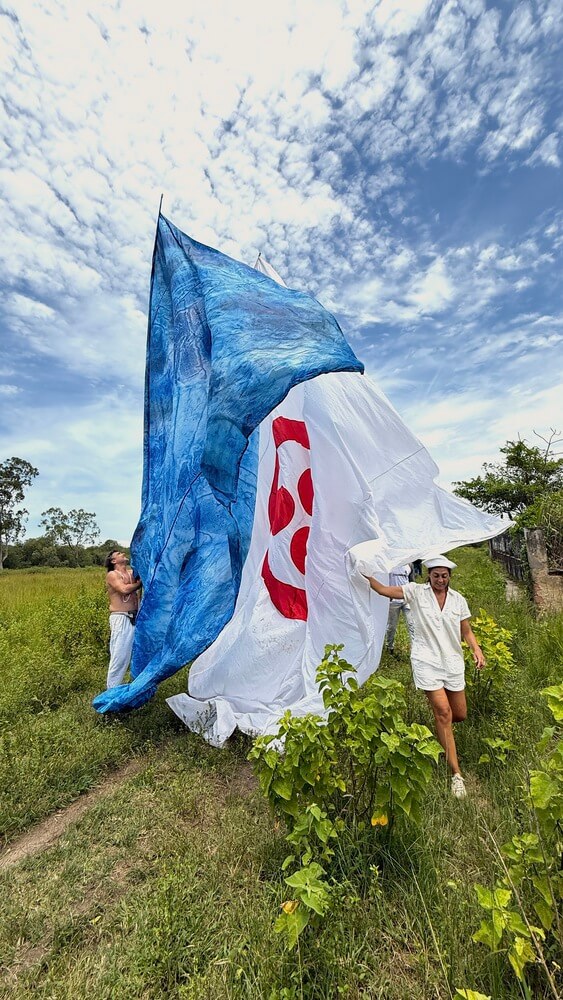
We were on an old farm in the municipality of Magé. Sailor musicians waved two huge banners and several standards, participants in white robes with bamboo poles over six meters long lined up in a procession of approximately thirty people. We were seeking a connection with the immense and exuberant Guanabara Bay. As Caetano Veloso sings, we were “blind from seeing it so much, from having it as a star, what is a beautiful thing.” We formed a procession, “a masquerade; [a] simple cry [announcing] that the king is naked, but [we] awaken because everything falls silent in the face of the fact that the king is more beautiful naked.”1 We awaken by seeking to live what is plain for all to see, yet, absurdly denied, the existence of Guanabara Bay as an entity.
We effectively awoke during the procession, perhaps, with the same intensity with which the few local cows looked at us. With this gesture, we were seeking a metamorphosis in ourselves through an encounter and an invitation. We were completely committed to inviting the immense Guanabara Bay to participate with us in a small and simple bamboo construction that Floresta Cidade (Forest City) had agreed to do with the Grande Companhia Brasileira de Mystérios e Novidades. The street theater and public art company is on the other side of the bay, sixty-three kilometers away from where we were, in the Port Region of Rio de Janeiro. Fifty-seven kilometers away from that same point, on one of the islands in the bay, is the School of Architecture and Urbanism of the Federal University of Rio de Janeiro, of which Floresta Cidade is a part, as an outreach, educational and research project. These connections and our collaborations created the possibility of embracing Guanabara Bay, promoting an encounter between our hearts and the Bay’s.2
During the procession, we saluted life, joy, nature, music, the colors of the banners, Brazilian popular culture, the Banner of Peace,3 and another banner that we named the Banner of Water.4 We saluted Guanabara itself as a vital force that we wanted to connect with. We wanted to create a relationship of co-invention and, in doing so, honor change as a form of creation.5 We hoped, in some small way, to belong to the ancestral narratives of this Bay, that means “lake of milk” in the cosmogony of the Dessana/Tucano indigenous people.6 For these peoples, it was in this “lake” that, embarking in the canoe of transformation, humanity arrived on planet Earth. We were also inspired by Tupi-Guarani indigenous peoples’ etymology, a language spoken in at least eighty-four villages of the Tupinambá Guanabara before Portuguese colonization. Guanabara would have meant “sea’s bosom,” with “guana” meaning bosom, cove, bay, hollow, and “pará” meaning sea, large river or something similar to the sea.7
We were walking in one of the Guanabara Bay’s coves, near a place called Barão de Iriri. There are no historical records indicating the actual existence of a baron, but the Barão do Iriri Beach was a busy port in the 18th and 19th centuries with large farms. After 1831, with the prohibition of the transatlantic slave trade, the backshores of Guanabara Bay became important entry points for the clandestine slave trade.8 The first sugar mills were also located in Guanabara Bay during the early days of colonization in Brazil, in the 16th century (1584),9 when the region had navigable rivers and fertile soil. Furthermore, Iriri, in Tupi-Guarani, means shell, which refers to the Sambaquis – [ancient prehistoric archaelogical sites found along the Brazilian coast consisting of] mounds of shells used for human burials, artefacts, and the remains of marine and terrestrial fauna.10 This indicates the presence of Sambaqui peoples in the region, nomadic or semi-nomadic peoples who preceded the Tupinambá in their occupation of the Bay.11
By seeking to dialogue with mountains and seas as entities, through processions and offerings, time stretches and the beauty and nightmare of Guanabara become more evident. Fragments of stories are like clues that make us walk with more intensity and respect. We were in a procession, singing, on one of these farms in the Bay, under the constant threat of not being welcome because we seemed to be part of a non-Christian cult and because of a local dispute over territory, which remains alive in the bodies of those who inhabit this place. The mountains bear witness to the same/other stories of violence and non-linear time unfolds in the landscape as we walked through the grass. “The [colonial] nightmare happened, happens, will happen… and I will go and love the blue, the purple and the yellow. And between my going and the sun’s, a hoop, a link:” it seems the procession is being narrated by Veloso’s song “Estrangeiro”(Foreigner), from 1989.
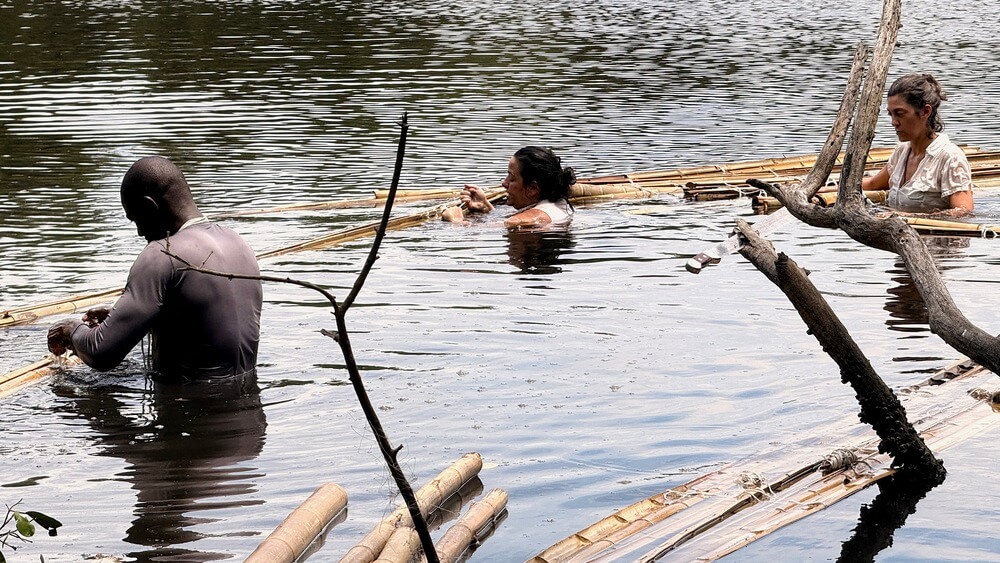
This procession would not have been possible without our partnership with Quilombo do Feital, a community of remaining quilombolas [maroon communities and individuals] organized after the abolition of slavery in 1888 and the permanent home to families of former slaves in the area. Recognized 130 years later, in 2018, as the heir to this resistance and cultural preservation, the community has made their living by fishing, crabbing, planting, and crafts and today develops community-based tourism activities, all the while their territory is still in dispute. They were pushed out and removed “outside the gate” in one of the successive sales of the farm. The old Fazenda do Feital (Feital Estate Farm) was a large property with a documented use of slave labor beginning in 1740.12 It was in the apparent ruins of this farm that we continued in procession to the banks of the Iriri River mangrove, where we submerged the bamboo.
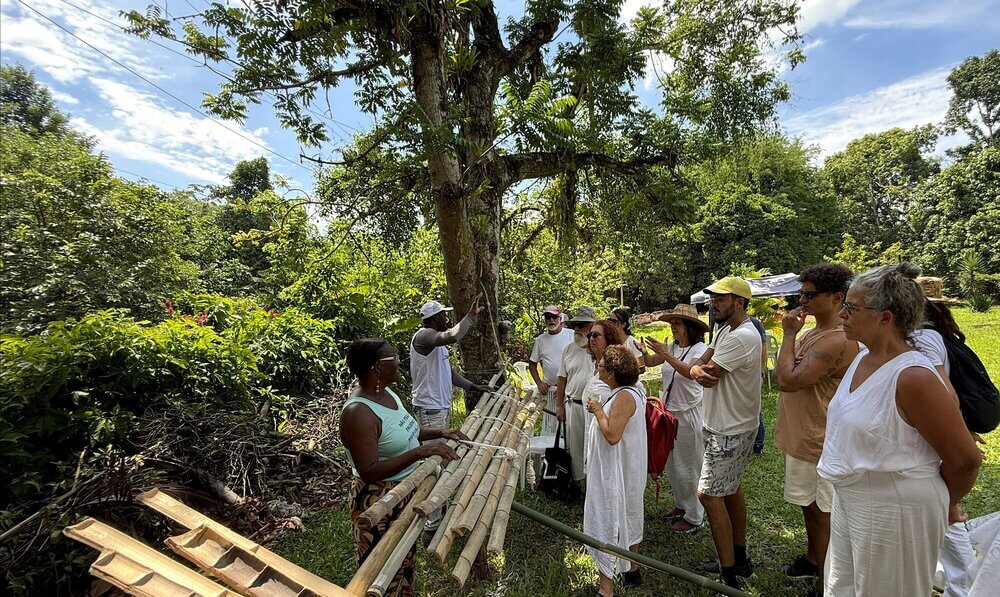
The Quilombo do Feital is a community that serves as a gateway to the communication we sought with the Bay. They seemed to have embarked on the Tucano/Dessana transformation canoe through which humanity would become more connected with Guanabara. Love, respect and generosity could be felt in the relationships we experienced. The quilombo was to be directly involved in the development of an ancestral technology for the ecological treatment of bamboo, that would be used in the gazebo [to be built at the Grande Companhia’s home base]. Before the day of the procession, we visited the quilombo several times to define locations, routes, and systems for fixing the poles. We paid attention to the force of the tides, particularly the Tupinambá fishing traps and corrals,13 still widely used today by the fishing communities of the Bay. Drawing inspiration from these enclosures, we collectively developed an “ancestral innovation” technology14 to fix the bamboo to the bottom of the Iriri River.
When the procession reached the mangrove swamp, we continued with our banners raised high – with the standards featuring the phrases “the earth has a heart and breathes”, “come water me mother” and “forest city”, together with images of the Orishas [deities in Afro-Brazilian religions] Iansã [warrior goddess], Oxóssi [god of hunting], Iemanjá [goddess of the sea] and Nanã [goddess of wisdom and primordial water and earth]. The Banner of Peace and our Banner of Water were being bravely unfurled and wielded.15 Our throats sang at full blast: “(…) are flowers Nanã, are flowers (…)”, “(…) in the waves of the sea, where she stays, my mermaid (…).” Then, at a distance we saw the immense figures of Iemanjá and Our Lady of Navigators and Nanã, who walked through the mangrove swamp as if she did not notice us. We asked these goddesses for permission and, with great respect, took the opportunity to thank everything that nature has offered, offers and will offer us, daily, so that we can be alive. This is how we were finally able to fulfill a long-awaited dream for Guanabara to participate in our simple 9m² gazebo construction for the Casa de Mystérios [Companhia “home” name]. A great design challenge, the project is called “Coroa de Iemanjá” (Iemanjá’s Crown); a small bamboo roof that has been in development since 2023, without financial resources through community and student involvement, educational workshops, and the collaboration of some professionals.
If I were to explain the details of what we are seeking permission to do, it might be the following: “Mother Guanabara, we are doing this because Floresta Cidade (Forest City) was invited by the Grande Companhia de Mystérios e Novidades to build a small roof over the bathrooms at the company’s home base. It will house the light table during shows on the stage/terreiro [term for land or territory used for Afro-Brazilian rituals and gatherings]. This is how we plan to compensate for our use of the space. For years, we have used the Casa de Mystérios for our monthly meetings and other Floresta Cidade activities.” And, as if to help Mother Guanabara recall [the Companhia’s home base]:16 “it’s that magical house in Gamboa filled with costumes, stilts, and standards, at the beginning of its left bank, from where processions depart every month. You know, the university does not have the resources and our outreach project created this collaboration so that we can meet at night, when the university is closed and students are available.”
Guanabara Bay understood that through this process we wanted to learn about ecological, communal, and interspecies constructions, and that Floresta Cidade had the challenge of building in a place of learning about popular culture, a place of enchanted life, processions, and immaterial spaces. Now, a roof, even a small one, in Casa de Mystérios could not be either a purely functional gazebo or an aesthetic one. We had to take a leap and depart from the architectural compositions we were accustomed to making. We had to create something enchanted. Something similar to what we felt, vibrating in our bodies, in the five years of our partnership between street theater, public art, and architecture, landscaping, and urbanism.
We took a breath while the goddesses swayed to the rhythm of the waters, giving us signs of understanding. That was when we finally got to around to explaining why we were evoking them on that sunny morning. The path created for this enchanted architecture did not reside in a particular form or technique but in the connection with ancestral traditions. We were reclaiming17our communication with nature, rites, and songs.18 We want to establish a conversation between our construction and the landscape. [That morning it was] with Iemanjá, Iara [water nymph] or the Our Lady of Navigators as in Brazilian popular culture. Evoking water goddesses is a beautiful, collective, and joyful way of remembering that we inhabit a planet of interdependent lives and live in sacred places not because we believe in some religion, but because what surrounds us is absolutely vital.19 Understanding a cosmic way of living and that our life depends on other beings, was what we were aiming for with this small constructive, educational, and communal gesture. Not doing this would mean understanding our life as separate from others, which is perhaps one of the reasons for the serious climate crisis we face, if we choose to use a more scientific language that is palatable to hegemonic truth systems.
After this conversation with Guanabara Bay, we began unloading the bamboo from the truck that accompanied the procession.20 Hand in hand, we carried the bamboo through the mangrove swamp to where they would enter the Bay. Few were brave enough to go into the water to secure the bamboo, a task that took hours and proved to be more difficult than expected. Guanabara Bay had agreed to exchange the bamboo sap for brackish water, and promised to care for them for forty days at the bottom of the river. Borers and termites do not like the taste of brackish water, but they appreciate the sap, so by making this exchange, the wood is naturally treated without the use of chemicals.
The lunch scheduled for after the procession at the quilombo restaurant had to wait while our bellies growled and the sun grew even hotter. When the time was right, beyond our control, we returned to the quilombo and enjoyed a lunch fit for goddesses. It was as delicious as the breakfast we had had upon arrival. We ate while learning how to weave bamboo using the technology of the corral. The Grande Companhia de Mystérios e Novidade made our arrival at the Quilombo do Feital a very beautiful encounter, with music, tributes, and joy, as if we were re-meeting after a long time apart.
A re-encounter and a profound awakening. Through a crack in a hostile world, a transformative building or “crown” is born; a conversation, an offering, a technology, an architecture. After all, what might it mean to build in a land that “has a heart and breathes”?21 Perhaps by encountering the entity of Guanabara Bay and making of our craft an offering to her, establishing with these beings – who are scriptures of the universe – “a hoop, a link”.
***
Cesar Oiticica Filho
Artist, filmmaker and curator, Cesar Oiticia Filho has a degree in journalism. He directed the film Hélio Oiticica winning the Caligari and Fipresci Prizes at the Berlinale, the Rio Festival and FILAF in Perpignam, France. Together with Fernando Cocchiarale he curated the exhibition Hélio Oiticica: Museu é o Mundo (Museum is the World) 2010. He has worked as curator of the HO [Hélio Oiticica] Project since 1997 and as artistic director of the Hélio Oiticica Municipal Center since 2021. Together with Evandro Salles he started the parade event Parada 7 in 2022. He has participated in the Havana Biennial (2015) and the Biennial of Moving Image (2014). He has published books about Hélio Oiticica and Mário Pedrosa. His most recent exhibitions are: Quantum Spaces and Quantum Intervention held in 2024 and 2025.
Iazana Guizzo
Iazana Guizzo is an architect and urban planner. She is the coordinator of the project Floresta Cidade [Forest City] an outreach, teaching and research project at the Department of Architecture (FAU) at UFRJ, where she is also a professor. She has a PhD in urban planning, a master’s degree in psychology and a degree in contemporary ballet. The regeneration of cities in the face of climate urgency, community participation, interspecific life and Afro-Amerindian cosmoperceptions are topics of her research interest. She works in the fields of architecture, urban planning, and art and has collaborated with Companhia de Mystérios e Novidades since 2020.
1 Lyrics from Caetano Veloso’s song “Estrangeiro” (Foreigner), 1989.
2 This interconnectedness is even more pronounced when we include the collaboration with the Graduate Program in Contemporary Studies of the Arts (PPGCA) at Federal Fluminense University (UFF) located in Niterói, 52km from where we were, on the other side of the Guanabara Bay. Researchers from PPGCA and the Urban Studies Laboratory LEU-PROURB-UFRJ also participated in the procession.
3 The Banner of Peace, associated with the Pact of Peace (1935), also recognized as the Banner of the Mother of the World, was created and promulgated by a Russian couple – Nicholas Roerich (1874-1947), artist, philosopher, archaeologist, writer and lawyer, and Helena Roerich (1879-1955), spiritual leader, writer and feminist activist – as part of a planetary vision of a Living Ethics and activism for peace and spiritual pan-human unity. For more information see “Conversation Circle: Schools without Walls: Arts, Sciences and Spiritualities as Living Histories” in this magazine.
4 The flag, here called Água(Water), was created by the artist Otávio Avancini for the theatrical show Férias, by Drica Moraes, and was previously used at the Iemanjá festival in Rio de Janeiro, on February 2nd, 2025 in Arpoador.
5 I use “agency” here drawing on the different meanings proposed by Isabelle Stengers and Deleuze and Guattari. The encounter with the other is understood as the creation of self and world. An assemblage transforms the body into one who is assemblaged, changing their affects, perceptions, and actions by creating a different arrangement of the self, based on what the other provokes. It is the understanding of a world in constant movement, composed of heterogeneous elements that form ideas and mutable bodies. This is different from understanding a body as the sum of its constituent parts. Agency is understood as an invention, a new arrangement drawing on encounters, a third body that changes all its parts, which characterizes creation as the force of an agency.
6 Jaime Diakara, Rio de Janeiro: o Lago de Leite (Selvagem: ciclo de estudos sobre a vida, 2021) Available: https://selvagemciclo.com.br/wp-content/uploads/2021/01/CADERNO14_JAIMEDIAKARA.pdf Accessed August 2025.
7 Teodoro Sampaio, The Tupi in National Geography (Salvador: Livraria Progresso Editora, 1901 and later editions).
8 Leslie Bethell, A abolição do tráfico de escravos no Brasil: Grã-Bretanha, Brasil e a questão do tráfico de escravos, 1807-1869 (Rio de Janeiro: Paz e Terra, 1976).
9 Father Anchieta, in 1584, already mentioned the existence of “countless farms inland and three sugar mills” in the region, and in the following years, 120 sugar mills were recorded around Guanabara Bay, showing the importance of sugar for local development. In: Maurício de Almeida Abreu, “Um quebra-cabeça (quase) resolvido: os engenhos da capitania do Rio de Janeiro, séculos XVI e XVII,” Scripta Nova: revista electrónica de geografía y ciencias sociales, Barcelona, X, v. 218, 2006.
10 PLT Andrade. Sambaquis on the coast of Rio de Janeiro: a look at the pre-colonial landscape. Doctoral Thesis in Archaeology, National Museum/UFRJ, 2018
11 The sambaquieiros were different nomadic or semi-nomadic indigenous groups, who did not practice agriculture or domestication of animals and inhabited the Brazilian coast from 4,000 to 1,800 years BP (Before Present) which has as reference of the year 1950 AD, an approximate date of the radiocarbon technique used to date ancient organic matter. It is equivalent to 2,050 BC and 150 AD.
12 Jose de Souza Azevedo Pizarro e Araújo. Historical Memoirs of Rio de Janeiro and the Provinces Annexed to the Jurisdiction of the Viceroy of the State of Brazil. Originally published in 1820 (and reissued in 1945). Specific information about the Chapel of Our Lady of Nazareth on the farm of Manuel Ferreira Feital can be found in volume 3, pages 156-157, as referenced in genealogical research on the Feital family. https://familiafeital.blog.br/arvore/790.html
13 According to the artist researcher Gabi Bandeira, coordinator and founder of the project aGradim with fisherman communities in São Gonçalo, who accompanied us on the day of the procession.
14 A term from Yakuy Tupinambá, a partner of Floresta Cidade in the Ancestral Innovation Laboratory project, from the Tupinambá of Olivença, southern Bahia.
15 The work of the artist Otávio Avancini, a constant partner in the Companhia de Mystérios processions.
16 In recent years, the Company has been developing a procession/performance entitled Alto da Guanabara (Height of Guanabara) which also encourages us to engage in this process of dialogue with the Bay.
17 The term “retomada” here translated as reclaiming has been used widely by the indigenous movement in Brazil.
18 Before the existence of Floresta Cidade, Terceira Margem, arquiteturas e singularidades (Third Margin Architecture and Singularities), a studio also conceived by Iazana Guizzo, already had a partnership with Companhia de Mystérios e Novidades and was in the process of articulating the construction of a community library in Amapá together with popular songs.
19 Marcelo Gleiser, O despertar do universo consciente: um manifesto para o futuro da humanidade(Rio de Janeiro: Record, 2024)
20 The truck was loaned by the production company Guerrilha da Paz, another great partner of Floresta Cidade and Companhia de Mystérios e Novidades, fundamental to carrying out this work.
21 Yanomami concept of place.
