

A School without Walls: Living Histories of the Arts, Sciences & Spiritualities
Anna Dantes, Fabio Scarano, Guilherme Vergara, Iazana Guizzo, Lígia Veiga, Mãe Sara, Márcia Brandao, Sandra Benites
As long as the arts, sciences, and spiritualities are compartmentalized and walled off from one another, whether as a result of social exclusion, gender biases or racial prejudices, and contaminated by a pandemic of extermination that threatens the diversity of beliefs, knowledges, and flavors of life, we will be under the dominion of the capitalist culture of violence and local and planetary ecocide. Countering this violence and its compartmentalization is the Banner of Peace, around which a discussion group gathered on a Sunday in December, 2024. The Banner of Peace, a symbol of the Pact of Peace (1935), also recognized as the Banner of the Mother of the World, was created and promulgated by a Russian couple — Nicholas Roerich (1874-1947), artist, philosopher, archaeologist, writer, and lawyer and Helena Roerich (1879-1955), spiritual leader, writer, and feminist activist — as part of a planetary vision of a Living Ethics and activism for peace and spiritual pan-human unity. In its embrace of connectivity, openness, and the plurality of the arts, sciences, and spiritualities, the Banner provided the “body-ground-heart” for this encounter. It also acted as a call for a textile work of listening to different voices and for an education based on life practices, stories, rites, and both enchanted and difficult times. The conversation focused on ways of teaching that embrace experience, freedom, and life – a school without walls. Even if only through the cracks of a given and hostile world, these schools without walls insist on the nurturing of bodies to be free.
– Guilherme Vergara
The event took place on December 8, 2024 at the Casa de Mystérios e Novidades (home and headquarters of the Grande Companhia Brasileira de Mistérios e Novidade) and was transcribed, edited, and revised with the participants in the first half of 2025. Photography by Jessica Gogan.
***
Lígia Veiga[artistic director of Grande Companhia Brasileira de Mystérios e Novidades, playing the conch shell]
Hello there everyone, we are about to start our conversation circle.
This circle is very important. It is a great joy to have you all here, to have these conversation circles, and to be with people who are close to the heart of this house/home that is Casa de Mystérios. I would like to start with a little something that I just received: a very special gift, the Rubaiyat. These are poems by Omar Khayyam. I have had a cold and have been in bed for the past few days, and my friend gave me this and I opened it to this page. I think it resonates with what we are trying to do today:
Sit down and drink, that you will be happier than Mahmud.
Listen to the melodies that exhale from the lovers’ harps: they are
the true psalms of David.
Don’t delve into the past, do not probe the future.
Let your thoughts not go beyond the present moment:
this is the secret of peace!1
It has everything to do with us now, doesn’t it?
[People clapping]
My apologies, as I have a bad cold, I’m not going to speak or moderate but I will be here listening. Iazana [Guizzo] and [Guilherme] Vergara will mediate the conversation.
Guilherme Vergara
Good afternoon, everyone. First of all, I would like to thank Lígia [Viega] and Marília [Felipe] and the Casa de Mysterios e Novidades for hosting us here today for this special magnetic occasion. An encounter that brings together a group of “magnetic” people for this conversation circle: Iazana Guizzo, Fabio Scarano, Anna Dantes, Sandra Benites, Mãe Sara and Marcia Brandão.
What brings us together today also involves this Banner of Peace. Displayed here on the ground like another magnet to guide our conversation. This Neolithic symbol, this ancestral symbol has a relationship that is perhaps part of a destiny, a becoming, a mission for this planet.

What this represents is the plural unity of the arts, sciences, and spiritualities that could also be called a school without walls. What is this school without walls? Today we have eight very special people who will each explore this question. Each one will bring aspects of their life experience to think about the possibility of synthesizing the plurality of the arts, sciences, and spiritualities.
Last year we held a conversation circle here at the Casa de Mystérios that included a presentation of the history of Helena Roerich, a feminist, activist and spiritualist who was the wife and partner of the Russian artist Nicholas Roerich. Together they mobilized different world leaders around the Banner and Pact of Peace in the 1930s. At this encounter I read a short text by Helena Roerich. Few people know her, but it is so important to bring to light the Living Ethics that informed and continues to inform the symbol of the Banner of Peace to the present day. Given that there is so much talk about the ancestral future, we need to connect with several ancestors and several futures.2
For our school without walls today, I will only read this short excerpt here, which I hope will inspire this conversation circle today from the book Heart (1932) from the Living Ethics Agni Yoga series and then I will give the floor to Iazana.
1. To behold with the eyes of the heart; to listen with the ears of the heart to the roar of the world; to peer into the future with the comprehension of the heart; to remember the cumulations of the past through the heart; thus, must one impetuously advance upon the path of ascent. Creativeness encompasses the fiery potentiality, and is impregnated with the sacred fire of the heart. Therefore, upon the path to the Hierarchy, upon the path of Great Service, upon the path of Communion, synthesis is the one luminous path of the heart. How can the manifested rays be radiated if the flame is not affirmed in the heart? It is precisely the quality of the magnet that is inherent in the heart.3

I always speak of Lígia Veiga and her work as a magnetized heart, like so many hearts present here. People who have a burning heart are vibrant and are magnets of attraction.
The highest creativeness is imbued with this great law. Hence, each consummation, each union, each great cosmic unification is achieved through the flame of the heart. By what means can the foundation of the great steps be laid? Verily, only through the heart. Thus, the arcs of consciousness are fused by the flame of the heart.4
So, I hope that this practice of a school without walls is a shift from the domination of the intellect toward a reconfiguration of the meanings of the arts-sciences-spiritualities and toward an education through the magnetized heart.
Iazana Guizzo
I would also like to thank everyone for being here this summer Sunday, given the heat, and the call of the beach and football! We are here to encounter and be with one another. I remember that last year we spoke of how good it was to be together. The speakers gathered here today already know each other and have been exchanging ideas for some time now. This is not the kind of encounter where one speaks quickly and leaves. We all care about the people who will be speaking; they are doing important work, cooperating with each other, listening to each other, trying to maintain an alliance of affection, being open to what is provoked, and practicing coexistence beyond a quick meeting at a conference table. So, this is an opportunity for us to weave and strengthen bonds.
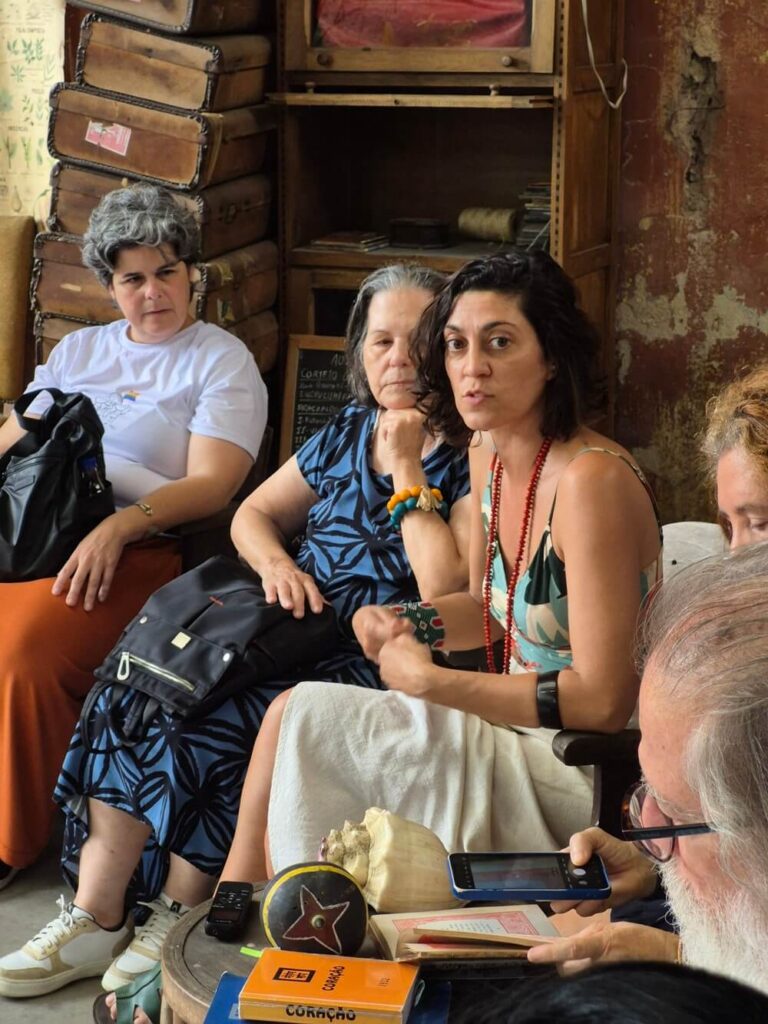
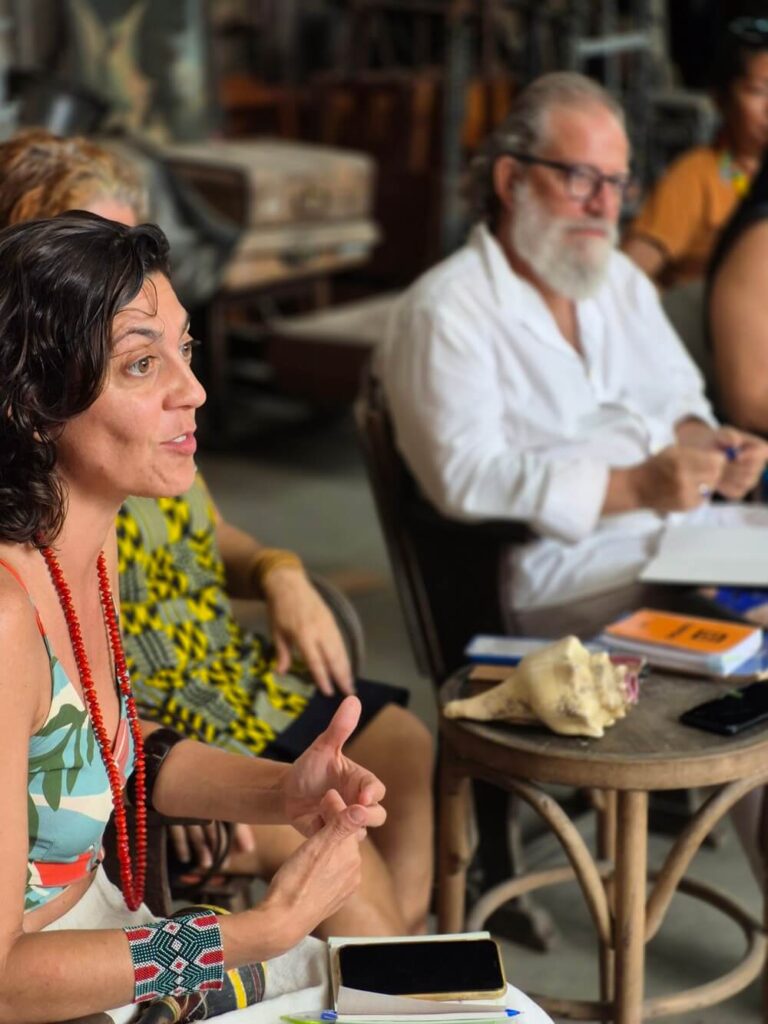
Firstly, I want to say that this conversation doesn’t start or end in this circle. It’s rather about expanding, exchanging, and strengthening this network of hearts, as Vergara says. The idea is for each person to talk about practices that are already happening and what we can learn from each other’s experiences. Rather than extended presentations, we proposed that each person speak for eight minutes. I will be the guardian of time. So, I’m going to mark the beginning of each speech by shaking a maraca, as I learned from native peoples. After six minutes have gone by, I will do this [shakes the maraca softly], so the person knows that there are two minutes left, and when the agreed eight minutes are up, I’m going to shake it twice, to confirm that the eight minutes are up.
Lígia
I think it’s also good to mention that these eight minutes have to do with infinity – eight is the figure of infinity – because, I think the conversations will intertwine, we’re in a circle. This is not about presentations and speeches but rather weaving a cosmic embroidery here among us.
Iazana
There are also quite a lot of speakers. Bodies have limits. The eight minutes is more of a guide than a set-in-stone thing. Just so we remember we are a collective and need to respect everyone’s time, as what we have to exchange is infinite. So, I think it’s more in that sense. It’s not a set-in-stone thing, but rather, a guide.
Guilherme
We could go in alphabetical order by first name? Or by last name?
[general laughter]
Iazana
The last time we did something crazy. We put speaker names in a hat and did a draw.
Anna Dantes
But perhaps now we might invite someone to start. Maybe Mãe Sara would like to start?
Mãe Sara
Guys, this is going to take two minutes. Because most people here know my story. For me, it’s easier to answer questions. I often have difficulty speaking, giving talks.
Guilherme
I have a question: Do you have any experience or sense of where this confluence of art, science, and spirituality occurs in your work and how this unfolds?
Mãe Sara
It’s all mixed up together. That’s just the way it is!
Ok so, people call me Mãe Sara (Mother Sara). I became everyone’s mother. I’m the leader of a community of Umbanda [a religious movement drawing on Afro-Brazilian, indigenous, Catholic and Spiritist traditions]. We are not far from here, on Sacadura Cabral street, right next to Pedra do Sal.

I’ve always had a hard time speaking in public. But, since you asked about art, science, and spirituality, I’ll say that for me they’re all mixed together. I don’t really talk about religion, but I do talk about spirituality. They are very different things. I have a hard time speaking, also because it creates a lot of controversy. Our community is very open. We’re there to study, to understand. I position myself more as an experiencer than as a leader, because I’m experiencing things as they happen, the movements that happen inside us. Also, I too don’t know what a lot of the things that happen are and I keep saying: “What’s going on here? Let’s learn together, let’s look, let’s find out together.”
So, it’s more of a school. I say it’s more of an initiatory school for everyone to learn together and it brings spirituality and science together with art. I ended up becoming a kind of cultural producer, out of spiritual necessity. One thing led to another. Based on what I was learning and seeing happen, I had this need to show who we are, why we are that way.
I’m a Virgo and I’m a skeptic. I feel like I live a crazy paradox, because I don’t believe in religion, I really don’t. I say that religion is a social gathering for people of the same culture, the same language, to talk about God. It’s from there that we’ll reach spirituality. It was from this understanding that I started to study, research, and look for answers. Nothing explained the incorporations of disembodied spirits. Nothing explained what those phenomena were, until I came to understand quantum physics, metaphysics, which, my goodness, have definite foundations. But not everyone has access to this information. But people who go to the terreiro [spiritual and cultural ground and meeting place in Afro-Brazilian culture] need to be attended to, to be guided. So, this is how we proceed toward spirituality, we go through religion. There’s no way we can get there other than through the talk of science, quantum physics, and metaphysics. So, we’re going to get there, through this path of spirituality, which leads to art, which leads to science. How do people access this in their daily lives? It is as if we are a kind of open agriculture of stories. We facilitate the telling of stories, because everything is hidden.
No one tells us the story of our ancestry. We don’t know this history, and we end up, that is us black people, somewhat, no, a lot, without a sense of identity. Where do we look for our references? Here, art offers a means of showing this in a way that is not academic. Now, I’m very happy, because science and academia want to show this, they want to talk about it. How long did it take for this to happen? Now is the time. So, however I can, with all the difficulties I have, however I can contribute to this, I will, because, for me, it was very difficult to understand, to find my identity. It was very difficult. There is suffering, people. There is suffering. We don’t really know where we come from or what the things that are presented to us mean, whether it is in school or in religion. We see that things don’t seem to fit together. Damn it, they don’t fit!

But that’s it. I’m very happy because it’s not easy, we don’t have an identity and we don’t know our history even to place ourselves in today’s world. We need to know where we came from. Where did I come from? So, really, I’m very happy with this movement to encounter our ancestry, our history. Look, starting with me was great!
Guilherme
Thank you very much, Mãe Sara. Today there is so much fragmentation, we tend to divide much more than we unite because we do not know from where we have come. So now, I propose that Fabio Scarano continues the cosmic embroidery that Lígia mentioned earlier. Mãe Sara has already shown us how a center for spiritualist and spiritual studies leads us to quantum physics. So, we have Fabio Scarano here to continue this intuitive journey. Thank you very much.
Fabio Scarano
It is an honor and a pleasure to be here. It is always a delight to be in Casa de Mystérios. I am Fabio Scarano. My background is mainly in botany. For a long period in my life, I worked with plants from a scientific perspective. My situation has many similarities to your story. I come from an Italian family. My great-grandmother was born on the day of Saint Francis of Assisi. My grandfather’s name was Francisco and I was also born on the day of Saint Francis of Assisi. So, this was very important in my upbringing which was a religious, Catholic upbringing, from a Franciscan perspective. But as a restless young man, I wanted to be sure of things and I followed the path of science. Little did I know that the job of a scientist is to deal with uncertainty.

In addition to my religious background and scientific training, I had a strong connection with art, especially cinema, which has always fascinated me. Perhaps because of the rigors of the scientific establishment, for a long time I thought there were three Fabios that should not mix: the scientist Fabio, the spiritual Fabio, and the art-loving Fabio. I did not mix, or at least tried not to mix, these Fabios, which I believed was important for my practice in science.
When I was working with plants, one of the species that I studied was unusual in that it was more active at night than during the day. So, I spent a lot of time with these plants at night. Being surrounded by vegetation at night, often alone, makes us think, feel and notice things that are not very obvious in our urban daily life. I realized that science… Blaise Pascal said this… science can explain, at most, 10% of things. The other 90% is in the realm of mystery and of the sacred and science cannot explain it. It was around this time that I met Anna Dantes here, who has been an important person in bringing these three Fabios together.
This coming together is a relatively recent phenomenon, probably 10 or 15 years ago. I always thank Anna for giving me this opportunity. It also came a lot from the opportunity to work with different indigenous peoples and to engage in dialogue with different colleagues from the art world. It’s a process that now brings me to the Museum of Tomorrow where I’ve been working for two years as a curator. The theme of the future interests me because of my work with plants as well. One thing I noticed about plants, since they don’t move, is that they are attentive. The fact that they don’t move gives them an expanded capacity for attention, and this attention also has a lot to do with memory. Although attention is related to the present, it activates our memory, which is more connected to the past. Everything that is alive has attention and memory. It also has a third capacity, which is anticipation. Anticipation is how attention and memory interact to create images of the future. Since the future doesn’t exist and it only exists in our imagination, attention and memory are fundamental for us to anticipate effectively. Today, I think that human beings have a low attention span, very little memory of the world, and therefore we are very poor at anticipating things. Science has made great strides in this direction. In the past I worked on climate change and scenarios projecting the future, and I can say that today, scientific projections are getting better and better. But it doesn’t do much good. We’ve been talking about climate change for 40 years, yet globally we end up breaking the record for greenhouse gas emissions every year. So, there is a disconnect between understanding and action, which, to me, has to do with a lack of feeling.
It’s as if we see all these phenomena on television, on a screen, and we think it won’t happen, at least not to us, until it does. I believe that science needs art and spirituality, just as art and spirituality need science. I believe that the dialogue between these different forms of interpreting reality will improve our anticipatory capacity because both art and spirituality (whether religious or not) allow us to feel, perhaps more immediately than science does. One of the beauties of science is that it is free from dogma. In the light of scientific methods of testing, anything can happen. However, human beings are not free from dogma. So, the supposed objectivity and impartiality that science might have as a result of such a method, we humans do not have. So, it encounters a clear limit. It is just a way of interpreting reality. It’s a way of interpreting reality that, thanks to the way it was and often still is used, gets confused with progress. So, it eventually erases memories.

We are a society, a modern society, that has no attention span due to the speed of life and constant communications. Our attention span is low and we have no memory of the world because a lot of memories have been erased, both human and non-human. I keep remembering my relationship with my grandmother. My grandmother used to medicinally treat us with plants. I remember about three or four plants, but I don’t remember them all. My father, too, only remembers one or two. Not much time has passed since then, you know? So, within a narrow range of years, we end up losing our memory. What can we say about so many memories of so many people that have been erased throughout history? But I believe that, even if we don’t remember them, these memories are somewhere. We have to try to expand our field of memory, as well as pay attention to the world again. I think we recover this attention a lot through contact with others, with nature, being here, embracing it. This places us on the land, grounds us as-it-were, doesn’t it? With memory and attention, we can anticipate better. The very imagining of desirable futures leads us to act, an imagining which is not about hopefully waiting for something, but rather, about being in a state of hopefulness,5 as Paulo Freire said, where one anticipates and acts. This is where my time with plants has helped me a lot, and with my dear Anna [Dantes] too, in this long process of bringing the three Fabios together.
Anna Dantes
It is a gift to begin a discussion of schools without walls by starting with spirituality. Spirituality has no walls.
Mãe Sara
That’s true, absolutely true.
Anna Dantes
It’s beautiful, isn’t it?
Mãe Sara
I was moved by what Fabio said.
Anna Dantes
Yes indeed, he raised very interesting points!
So, for those who don’t know me, my name is Anna Dantes. Dantes is not my real last name. I began working with memory when I was nineteen after starting to work in a used bookstore. It was the best way I could find to start my life. The name of the bookstore was Dantes. Little by little, I became identified with that name. All my work has been very much linked to memory, drawing on the world of books and plants. Plants, starting with my grandmother who spoke to plants.

There are many things that we might call magic or mysteries that have been the greatest school in my life. After high school, I didn’t go to university. I was very anxious about the issue of university, about academia. I got pregnant very early and life led me to this relationship of listening, of words, of reading, and of understanding the world based on the readings that I was doing inside my bookstore. I became an editor and worked for many years with indigenous people, the Huni Kuin people in particular. That was in 2011. Starting in 2018, we inaugurated a project called “Selvagem Ciclo de Estudos Sobre a Vida” (Wilderness Cycle of Studies on Life), which is a project, a school without walls, that connects art, spirituality, and science.
In discussion groups, special research cycles, and publications, anyone who wants to can access this material, which is completely available and free of charge. There is a very strong collaborative network. We have a community that works with translation, with text preparation, and a large education group that is bringing this content into schools. Material never previously accessible including content drawing on ancestral memories, other languages, and texts in Guarani that have been translated by these groups. This is all part of the research cycles. In short, it is a universe. It is as if it were a university, but rather, a pluriversity. Here a person might enter via a subject like invisible beings and then reach another subject like the regeneration of Gaia, where they will also encounter a cycle about dreams. This year we published this “Ciclo Sobre o Sol” (Cycle About the Sun) about various narratives of the sun.
That being said, I place myself here within this school without walls, this practice of a school without walls, because Selvagem does not have a home location. Selvagem occupies places, it travels with its banners, just like the Companhia. It can happen at MAM [the Museum of Modern Art in Rio de Janeiro], at the Jardim Botânico [Botanical Gardens] Theater, it can be online, it can be in a university room, in a garden, with children, people of all ages, academic people or non-academic people, etc. It is very versatile, very flexible, it has the strength to adapt to models and contexts.
So, having said that, I think I would like to talk a little about this illiteracy of spirituality, which for me, I think, is increasingly a great void that this sick society is experiencing. Many people end up taking medication and never consider the possibility that they may have some issue that they can work on spiritually. This society often has an issue of discomfort in relation to how gender is accepted and yet often does not ask itself about how, for example, it could be a jaguar, it could be a butterfly, beyond the possibility of being a woman or man. I think that, for example, in relation to the Botafogo football team [the team that was playing the day of the conversation], I was much more of a boy than a girl, because my father did not have a son and I was the boy who would go to Maracanã with him wearing a Botafogo shirt and stand there with the flag. So, I was a tomboy in my childhood and I think that we are more trans than we imagine. Everything moves through everything, all the time. We are being crisscrossed. Our cells are not just human, 52% of our cells are from other beings who are here and may want to drink a beer right now! I am not the me that I think I am, I am a composition. So, Selvagem is very much about this possibility and about considering the question of existence and that it is urgent to listen to the world differently. A listening that is often done in silence, a listening that is done with what we call intuition. How we are going to act, what we are going to choose. This means we are immersed in relational politics all the time.
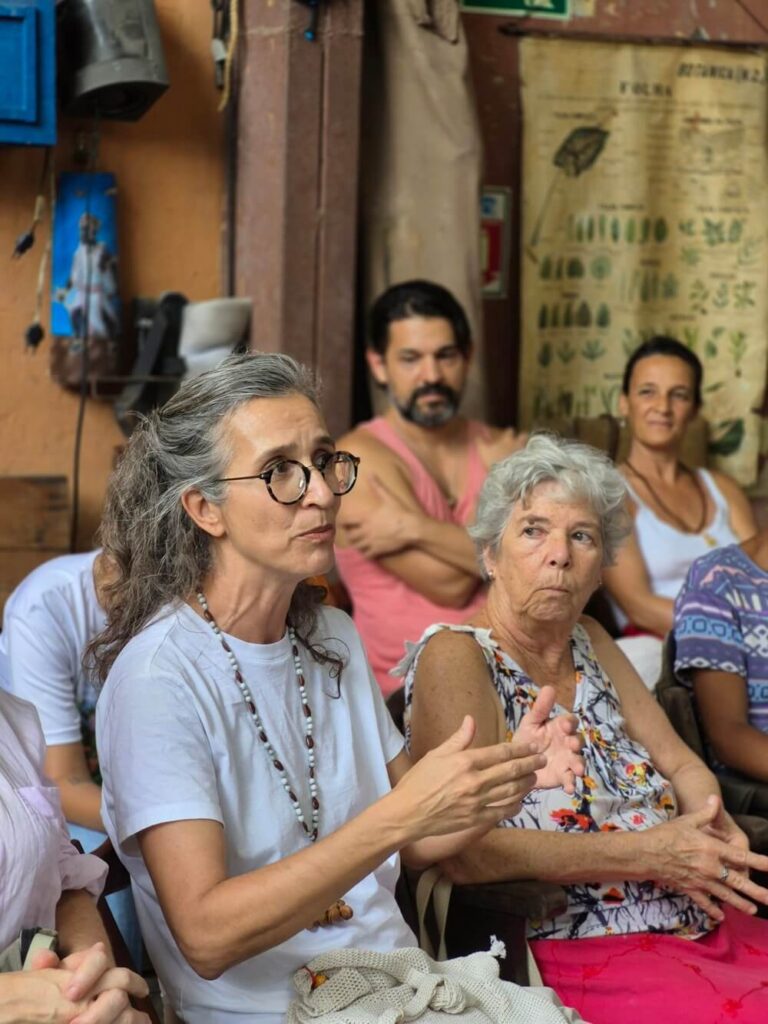
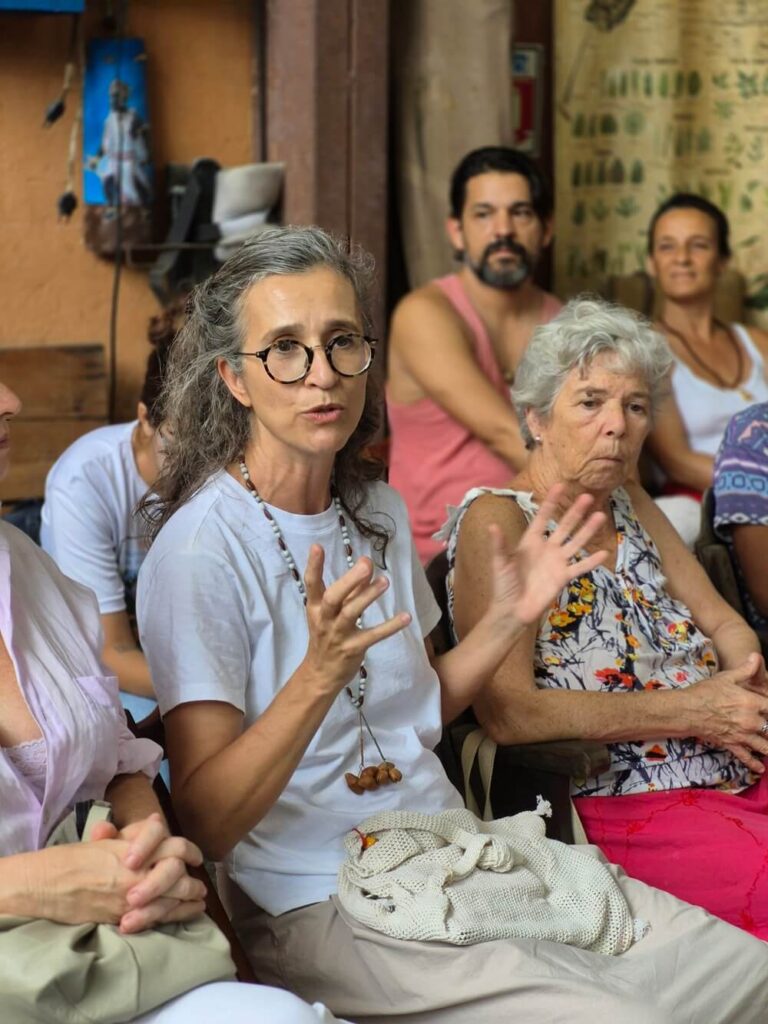
Another issue is that of protection. We need to work on our protection, that is knowing what your protective weapons are, and understanding whether you have permission to do certain things. This is something that Selvagem is very respectful of. We only do something, we only enter into it, if there is this permission. This permission, sometimes, is painful, it is not easy, because it involves another type of dialogue that is not always with humans. This is rarely talked about in our lives, I think that this is very rarely brought up, not in schools, not in family relationships, these things are not said. I think Selvagem tries to create a context for a school without walls, so that this listening to the invisible can be increasingly part of such schools and that we can count more and more on our trust, because I think that trust in this is fundamental, trust in the biosphere. Many times, when we are working, people say, it’s important to do this, memory is important. The question is to what extent is this being exercised? Are you practicing this? Do you trust that there is a connection between everything and that decisions will start to come together? And are you able to see this?
So, I think it is a form of literacy, something that needs to be more in circulation, especially because we’re in a very dangerous moment in the world, and maybe this change in consciousness will have to accelerate. It’s already accelerated, but in a very crazy way. So, I think these are issues that I would like to bring to this school without walls.
I would also love to talk about, you know, another thing that comes up…hold on a minute… [gesturing to Iazana who is shaking the maracá indicating that 8 minutes is up]. It’s a really crazy thing that I think about a lot, which is games. I think that if we think about the history of mining and all these spirits that were kept in the earth in very deep layers and that are being released, they are animated and they are in our hands. They are guiding a lot of things and nowadays, they are digital. I think that the issue of cell phones and computers and games and this world that is animated and that has an agency over us and that has control over us, is spiritual too. So, the interpretation of what is spiritual also does not only fit in certain predetermined categories. I think that doctrine is very important to enable you to deal with this functionality. If you don’t have a mother, you know, someone who comes and talks with you, who can mediate this interpretation, it is much more dangerous. But, at the same time, this functionality and this continuous flow of information is very broad. That’s it to start with.
Iazana
So, to follow on, what I thought of sharing is precisely a question of the body.
The time of the body, of experience, and of a self-metamorphosis brought about by education is increasingly averse to a world connected to cell phones and schools that assert their walls.
I would like to talk about the body in conjunction with the experience of Floresta Cidade (Forest City) [extension, teaching and research project of the Faculty of Architecture and Urbanism (FAU) at the Rio de Janeiro Federal University (UFRJ)] that I coordinate and that currently has 40 students, in addition to others who participate in courses.
I believe that we practice deconstructing school walls. Education has walls, the university has many walls, of various types, and Floresta Cidade’s practice is to deconstruct these walls to create direct relationships with life. This gesture of removing walls, removing things that are perhaps excessive in our educational spaces, is not only present in the outreach activities with partner territories, but also in the classroom itself of the Floresta Cidade disciplines within FAU.
For our regular classes at FAU, we use a room that while it still literally has walls, at least we do not have desk chairs. We use an empty room that we enter only with our own body and without shoes. We leave everything else outside, including our cell phones. So, this gesture of a classroom with only a wooden floor and an incense burner, something that would be more likely to be found in a dance course at UFRJ, is a strange gesture in architecture. This gesture alone, this image alone, creates confusion within the faculty. They have already moved the Floresta Cidade project room four times. Every new semester, I feel the threat of losing the possibility of the empty room. This happens in the context of a huge building that, in my opinion, may even have an error of scale, despite the excellence of the architect who designed it, and the good will of some colleagues to try to solve the problem of the existence of the empty room in architecture.
The FAU UFRJ building, the JMM, was built as a work of modern architecture that has beautiful and strong aspects, but is limited to a historical moment that no longer fits with our contemporaneity, in my opinion. Of course, many things still fit, everything is multiple, but this architecture points to clear limits and current problems, such as the excessive use of concrete, the creation of spaces that are too large, the belief in the State as a producer of social equality through public facilities and social housing, just to name a few. The gesture of the empty room generates discomfort, perhaps because it highlights the existence of unconventional teaching methods within the university. This is not easy to sustain as a professor and the most sensitive point of this unconventional gesture is precisely the body. Activating the body, activating feelings, lighting incense, permeating the room with ancestral technologies, bringing different plants, herbs, enthusiasms, challenges, and other cosmologies as well as connecting with, as Fabio brought up today, spirituality or non-religious virtuality, among other things cause estrangement amidst the hegemonic way of thinking about the design of built environments.

All of this is not well-regarded, perhaps it is even seen as a threat to what has been done for years, but why is it so problematic? I keep thinking that on the one hand, it could be the defense of a territory known as architecture, even though the foundations of the world are changing dramatically due to the climate emergency. On the other hand, perhaps it is the very symptom of the absence of the body in education that has worsened in recent years. It seems that bodies are increasingly unavailable to experience and to encounter what is different. This is noticeable throughout the university, including among students, who are increasingly rushed, lacking in time, and divided between their cell phones and the classroom. All of this, all of these walls seem to be averse to the experience capable of transformation, the one that connects with feeling and creates availability for relationships with others, human or not, and consequently for self-transformation.
So, there is a struggle there, when working with the body in an empty room at FAU. There is an affirmation of knowing life, of the body as part of the Earth, of the connection with feeling and with the present, which are often found in “so-called spiritual” places, such as meditation practices, for example. The body in an architecture school usually does not walk barefoot, does not sit or lie on the floor, does not try to listen to the heart. Even though there still are drawing classes, which I understand as a form of resistance by the faculty. Anyway, I learn from dance, theater, yoga, the Tupinambá, the Baniwa, Candomblé, and samba to feel, to live the experience of feeling with the body, with the heart, of listening to the signals that nature emits all the time, of understanding that the territory is very much alive and can, and indeed, at times, wants to, communicate with us.
So, feeling the life that pulses in a space and the interplay of things that happen on a project site, realizing how all of this affects your own body is a very valuable exercise for those who intend to carry out architectural projects in a collapsing world. This exercise can be fundamental for the regeneration of human habitation on earth. It can also contribute to recovering a poetic architecture, often forgotten due to the detriment of functions and models, or even an architecture capable of acting in a human habitation more connected to ecosystems.
But it seems to me that it is increasingly difficult for the body to enter the time of experience. This is what I wanted to bring up here as a question. Breaking down walls is not just about leaving the university, via outreach projects, research, actions, but also, about exploring other ways of understanding time, worlds, and experiences. Breaking down walls, removing tables and walls from the classroom, experiencing Tupinambá territory is about seeking a mutation, a metamorphosis of oneself. And this is always criticized because it calls into question what has been done. I can talk about reforesting the city, but how do I talk about it? With data and articles? When I cover the students’ bodies with leaves, when we go out on the street with our faces painted with clay and Parangolestas[after Hélio Oticica’s Parangolé capes and standards] with the Companhia [de Mystérios e Novidades], when I talk about spirituality linked to traditional spaces, this they determine as place of non-architecture. But, in my opinion, it is precisely this breaking down of walls that is the device that allows us to incorporate other times and access the experience of connection with the Earth.
I would like to hear from you all. My talk here today is rather a question. How do you feel about these differences in time periods? How can we work with this new generation? What means are available? How do we seduce, especially this generation that is highly connected to technology, to cell phones? How do we slow these people down? Because I think we come from a different culture. Because even though there are times when we get addicted to our cell phones, I think everyone has had this experience of being addicted to our cell phones, but you disconnect for a while and de-addict yourself. But the feeling I get from my students is that there is no longer this outside of the screen.
There’s a constant connection with these spirits from the depths of the Earth, as Anna Dantes said. This experience is very present and this has to do with current politics. But I’ll end my talk here. It seems to me that this wave of fascism, this wave of the extreme right, which fits so well with technology, which fits so well with slogans and the speed of social networks, facilitates this. While in contrast, the practices that we call leftist, that facilitate discourse, require experience, the collective, and the presence of other worlds. But we are losing language. In the struggle, we are losing language. So, I ask myself now: how do we learn if there is no time to experience, feel, metamorphosize? These are the virtual walls, which are perhaps even harder than brick walls.
Márcia Brandão
I had prepared a short talk, but listening here to everyone, I’ve completely changed what I want to say.
I’ll introduce myself. My name is Márcia Brandão. I’ve been interested in science, the arts, and the spiritual world since I was a child. Angels have always captivated me. I also had skeletons. I memorized the names of the bones of the human body. I was a naturalist, observing animals. I came to Rio de Janeiro to study at university, but for the past 25 years I’ve been building science museums and making scientific toys, including for the Museum of Tomorrow, that are essentially communication interfaces on various science topics. The first interfaces we built were for the Museum of Life, in 1999, featuring physics and biology toys.

From a spiritual point of view, for me, nature is the divine. If you look at the description of paradise, it is absolutely what the Earth has always been, right? Indeed, we were once in collectives and then we were separated. That is why social media hooks everyone. We want to engage collectively. We want to be together. If we think about it, throughout the history of humanity, we have always been in collectives. We are interdependent with nature too. We separated from that when capital became the focus. We talk and have ideas, but they do not become proactive attitudes. When I went to Chile, I learned not to throw away plastic, but rather, to recycle them as bricks. Since I live inside a reserve, which became a reserve after I moved there, the Siribeira reserve, I do not throw away plastic. But I see people declaring themselves socialists, defending rights and the environment, caring a lot about plastic in the ocean, but not being able to bring a bottle of clean water to the homeless. It is difficult to walk the talk.
So, we separated talk from action, separate bodies live inside [apartment] boxes. Babies on the tenth floor, never with their feet on the ground, never a life in contact with the wonder that is creation. From a human point of view, we are territorial, selfish, always defending our own. And now, with Pluto entering Aquarius, we will be challenged even more. I’m a mathematician, what interests me in astrology are the astrological charts. Pluto takes 248 years to orbit the sun and its energy is one of creation-destruction-renovation. It entered and left Aquarius and now is entering again. What is Aquarius? It’s the collective, awakened consciousnesses. Esoterically, in Aquarius, there’s no such thing as an avatar. Aquarius is about everyone doing things together. So, clearly, we have a problem. Not even a neighborhood association works. People fight over things that don’t matter at all. Pluto was in Aquarius during the French Revolution. So, this collectivity is powerful but also disruptive and dystopian.
We can say that even bacteria thrive when they come together. Ants and termites, for example. Getting back together can be powerful indeed. But the Aquarian issue is this: your opinion may be outvoted and you may not be able to dissent. You will both have to join in right away and to assert yourself in front of others.
I study African Kabbalah. The origin of Kabbalah is 6,000 years before Christ. The Jewish Kabbalah, even Hebrew, is from the 12th or 11th century. It says that the heart has to be warm and the head cool. You have to exchange this heat. So, you have to warm up and the organ of wisdom for ancient Africans is the heart. No crisis should reside in the mind. Everything has to go to the center, up to the fourth chakra. That’s when you become a guru, when you reach the fourth chakra, which is the heart.
And our crisis is one of indifference, because Aquarius is also about indifference to good and evil. Aquarius is open to everyone. It is also intuitive intelligence. So, the 21st century is about embracing the self-taught. So, we are in a crisis, in fact, of returning to the perception of libertarian affection. Where you free the other from your judgment. Let the other be wrong in peace. But your opinion is less important in the face of someone’s crisis, because in a crisis you are alone. Friends are technical assistance, they are support. But you are alone with your anguish and history doesn’t care at all about our anguish. So today we have a world in crisis, we have the next twenty years [governed by Aquarius’s desire] to get together in groups, to connect, and to learn to accept differences and diversity with joy. Because nature is biodiverse, yes. Bacteria change. They are the pixel of existence. They transform all the time. So, we need to embrace this adaptive capacity in order to stop complaining. If you want to complain, you can play around. Because it’s all very wrong. We are doing very badly historically.
For the Quinta da Boa Vista Museum, I created an interface to understand geological scale. Here, for example, the human being is a three-year-old child. For geology, the human being has just arrived. He is aggressive, he bites his playmate at daycare. He hits the sides of the stroller. He ruins the toy. It is the self that only receives. He does not want to give. He’s just in the no. Everything is no. So, you have no patience with anyone because you have not matured. And you have not calmed down to be a little more capable. This is self-transformation. This is up to you to change. It is not for the other person to change. You must. If no one threw away soft plastic, there would be no need for the city government. That is the idea. But we are very far from that. We are still armed. It is a hangover from the beginning of the 20th century, the 19th century even.
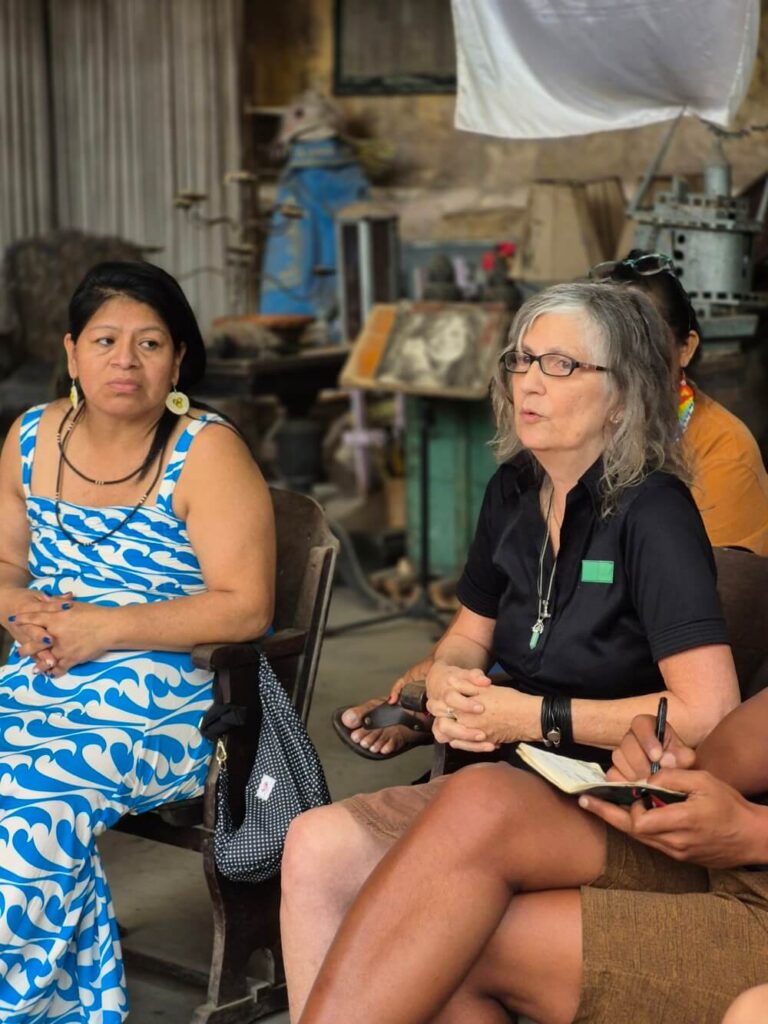
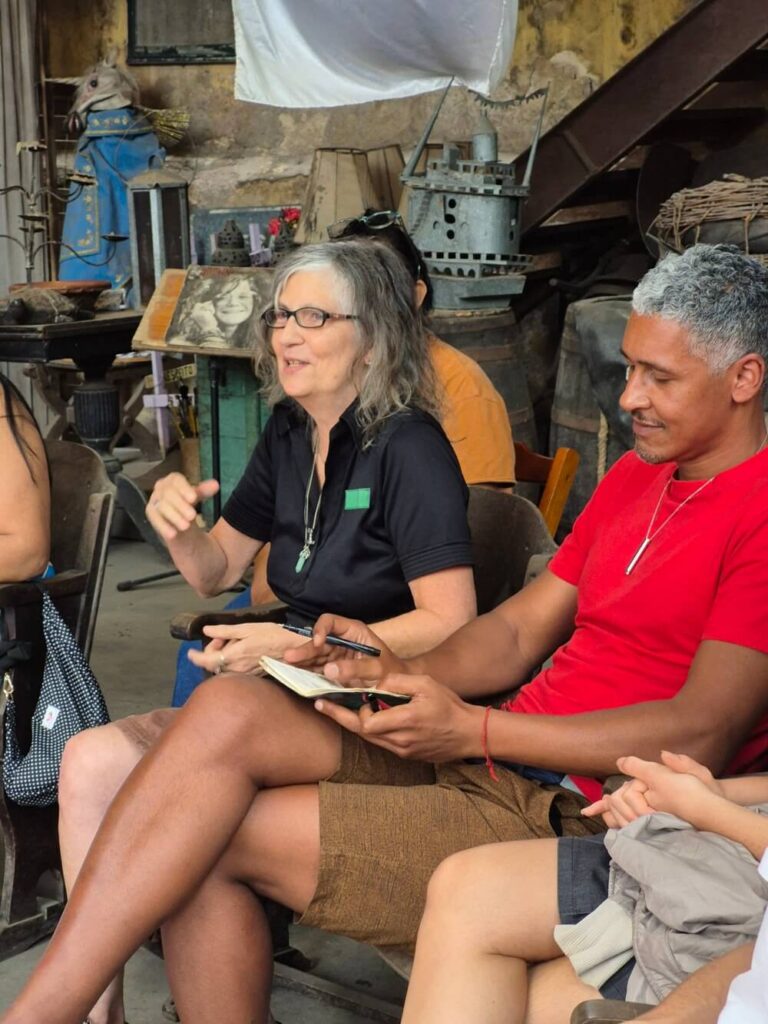
So, we are the salt of the earth. We are old. There’s a little light in the darkness. We might focus on nanopolitics. You know? Welcome our neighbors. Support the people around you. Because the person is within reach of your love. For that you need self-love which is self-care. So, you make changes in yourself. Because we are a human project full of bugs. Full of things to adjust. If you don’t admit that, if you want to be right, we can’t proceed. This can’t exist anymore.
So, I think that was what I wanted to say, there’s much more to say about Pluto and Aquarius!
Sandra Benites
Good afternoon. My name is Sandra Benites. I am from the Guarani people. I am a teacher, anthropologist, and curator. I am also currently the director of visual arts at Funarte. I have done a lot of things. Today, I just want to share a memory and briefly talk about academia.
I will share my experience as an educator, as an academic, and an indigenous person. As indigenous people, we are challenged when we are in the academic environment, a context that is imposed on us. Although we enter academia to seek science, that is, knowledge, in fact, it is not about us seeking knowledge, but rather to add to what is already there, I would say, to fill in some gaps, to be able to dialogue with others. I think that is the idea. Drawing on that, I want to quickly share a recent experience with my son.

My son is an environmental engineer. He is currently studying. He is still in the process of graduating from the Federal University of São Catarina. So, let me tell you a bit about what happened. He started out studying to be a project manager and then a year later he called me and said he was going to drop out. I asked why? He was frustrated and depressed because he had completely lost confidence in himself because the university itself said he didn’t have it. How? When he started, he was 18 years old, a teenager. We know how fragile things are at that time. Anything diminishes us. Also, as indigenous people we are from another place. So, I remember that he told me that if he studied at a private school, he would be able to keep up with his classmates who are super geniuses in physics and chemistry calculations. In his head, he thinks he doesn’t have that ability. I started thinking about it. I told him he could drop out of college, do whatever he wanted to do. The only thing I told him was to follow the indigenous movement.
And he did that. I think that most of the time we mothers don’t do that. Because we want to push our children. We put pressure on them as a result of our colonial society. This also has to do with structural racism. Then I saw that he was very sad, very depressed, as if he had no competence for anything. I told him that it wasn’t his fault. In fact, the university has no competence to receive various forms of knowledge. That’s why he felt excluded, because in fact he is.
I wanted to bring this issue of exclusion to our discussion. At the time, I called him, and I explained this question, and I told him our history. I said that our Guarani knowledge, that is, the indigenous population in general that has this knowledge, this science that dialogues with elements of nature, which we all have, we understand that this involves asking permission to enter the water, asking permission to enter the spirits of the trees, rivers, and animals, to harvest, to plant, too. We perform a collective ritual and we ask permission from the spirits. So, this is a process of producing knowledge and preserving that which is part of our existence, too, because the tree, the water, all of this is part of our existence. I talked about this history and said, I know that it is not that he doesn’t know this, he does know, he has heard this before, but because this is the foundation. Often, when we get lost, we need to go back there to strengthen ourselves.
So, how can this vulnerable person feel valued in the face of a knowledge that is often not even discussed at university. This is very common in universities. I say this because I am also part of this. So, when we talk about us Guarani women, for example, when we are menstruating, we protect ourselves, we don’t go to university, we don’t rush to hand in our work. On that day we rest, we protect ourselves to take care of our spirit, our body, women’s health, physical health, mental health, and the heart. Now, the university doesn’t even want to talk about women at university. If you are menstruating, crazy, or whatever, you have to be there. So, I think that talking about these experiences, what I wanted to bring up for us to think about, is that practice also requires territory. How are you going to guarantee this practical knowledge for other generations that often have nothing left?
And another thing, speaking of all this, I recently went to Itabira, Minas Gerais, to talk about art and experience, and there was a young man, a professor, who told me that the city encourages many people, including many engineers, to work in mining, with the idea of making a lot of money. So, what must this be like in the minds of these young people, who have the idea of making a lot of money, of being successful, without thinking? So, this is one thing, it is a very big responsibility and I believe that in order for us to minimize this load, I think it is important to start at the top, which is the university.
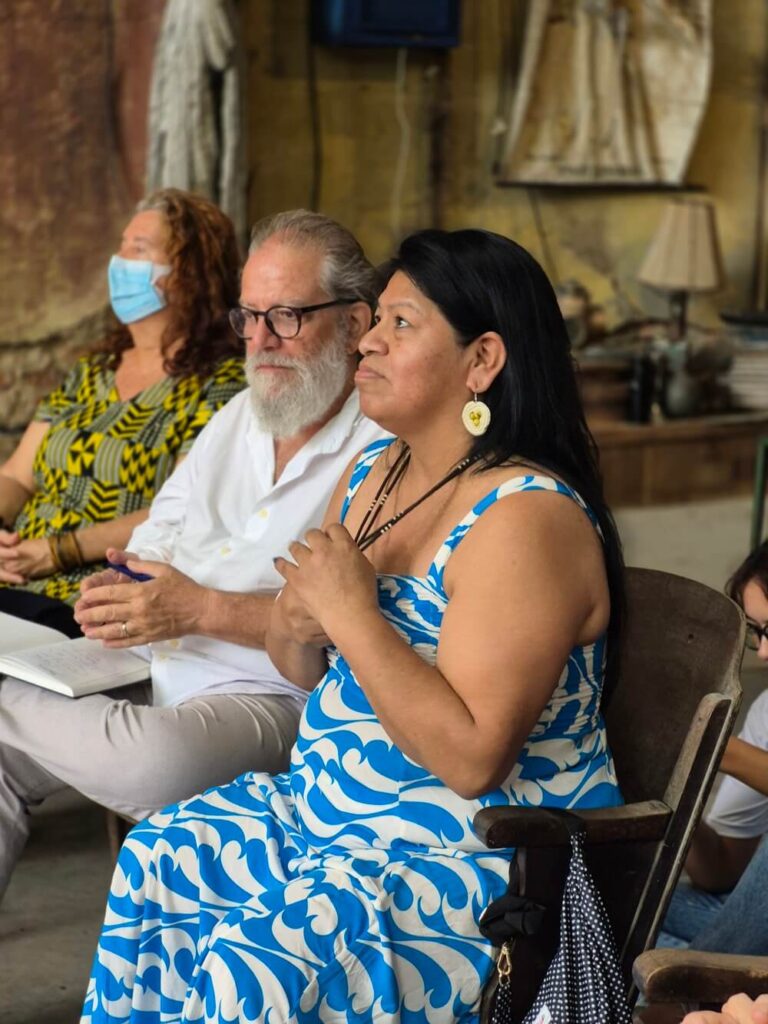
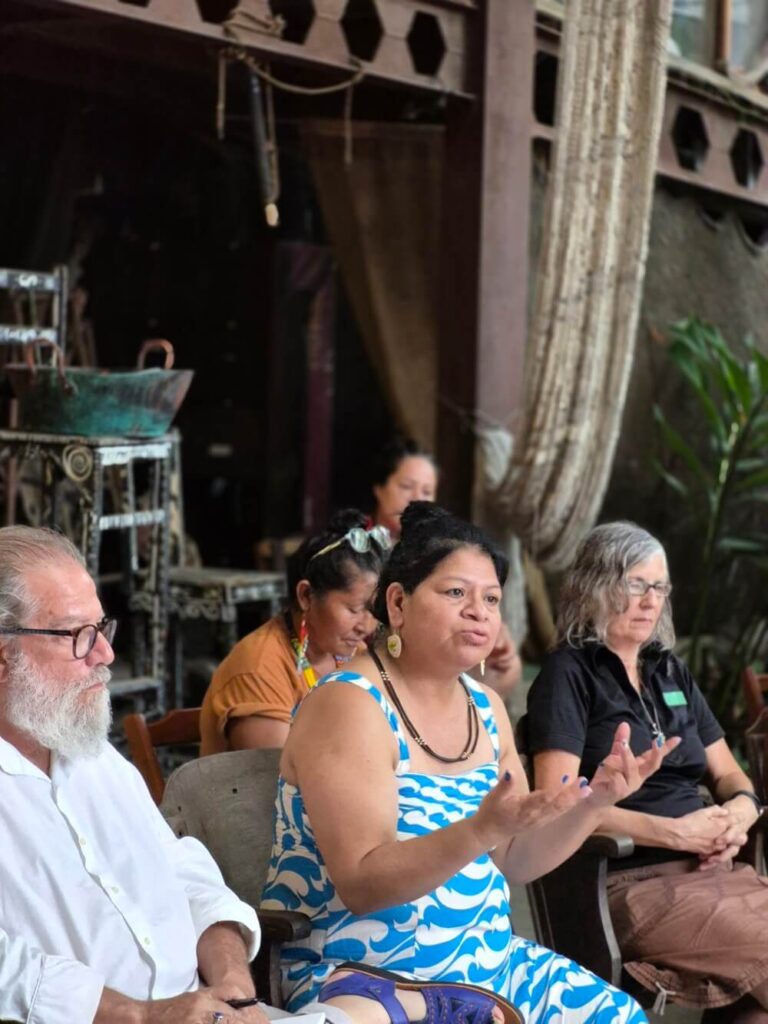
I think it is important to think about and discuss this. So, I am not saying that teachers cannot teach chemistry and physics, I am saying that the way of thinking and doing calculations, physics, and chemistry are different, each one may have a different methodology, but we are talking about the same thing, it is to preserve this, to preserve that. So, that is what we need. Without this, we will not be able to continue, one day we will have no brains. It seems that we are going down this path. I think that too often our brains are completely turned on by this logic that is being exposed to us. So, I think that is it. Thank you very much.
Guilherme
Thank you very much Sandra. It would have been Lígia’s turn to speak now, but since she has a cold and prefers to just listen today, I will speak for eight minutes.

First, I would like to say that this symbol of the Banner of Peace is ancestral. But what is a symbol? In our academic, formalist, conceptual learning, we have difficulty approaching and reclaiming the meaning of symbols (or the symbolic) as the power of being an instrument of transference, transport, and a vehicle for the immanent and the transcendent. The symbol is the materialization of and at the same time, what provokes transference, transport to the unknown, the intangible. Nicholas Roerich encountered this symbol on his expeditions. But it is interesting how its presence on the Banner [of Peace] challenges positivist accommodations. To what extent can this be an ancestral symbol of the origin and becoming of the Earth? A symbol of the power of the future of the Earth threatened by the culture of violence and self-destruction of humanity. This symbol is also recognized as that of the Mother of the World, and her regenerative power that is not yet manifested. A symbol that also challenges us by revealing both a diagnosis of the planetary disease of fragmentation and the ancestral intuition for a culture of synthesis.
We just heard Sandra talk about fragmentation. The arts are fragmented, the sciences are fragmented, and there are religions that want to control all forms of spirituality and transcendence and art institutions that want to control all forms of aesthetic expression. The sciences too are seen as the production of thought.
So, I would like to begin by going back to the story behind the symbol of the Banner of Peace and the Pact of Peace that it represents. This banner is linked to a transcultural movement led by the couple Helena Roerich and Nicholas Roerich. The Banner was part of a bridge between West and East, it’s also known as Pax Cultura or as the Red Cross of Art and Culture. Through periods of war and conflict, the Roerich family, with their two sons, the scientist George Roerich and the artist Svetoslav Roerich, dedicated their lives to seeking a spiritual utopia, with expeditions to Central Asia, which culminated in the Peace Pact signed in 1935 at the White House, with special support from the countries of the Pan-American Union. The Roerichs dedicated more than three decades (beginning in the 1920s) to the defense of unity and peace through the diversity of the arts, sciences, and spiritualities, embracing what they called a “Living Ethics” between West and East. In 1923 the Roerichs carried out their first expedition to Central Asia, exploring the region’s history, archaeology, ethnography, philosophy, art, and religion. In 1928, they founded the Institute of Himalayan Studies “Urusvati” (which means “Light of the Morning Star” in Sanskrit). Helena and Nicholas Roerich conceived the Banner of Peace /Peace Pact based on a culture of synthesis – the unity and diversity of the arts, sciences, and spiritualities. They encountered the symbol of these three united circles in Mongolia and also in other places, cultures, and times, with varying meanings. These three circles refer to a tripartite unity, which makes us think about overcoming the era of fragmentation, pointing to a new era of intuition as synthesis. The addition of the outer was conceived by Nicholas Roerich.
There is no time here to explore in more depth this idea of a culture of synthesis, but this conversation circle is already a call for all of us to think about synthesis, just by listening to the different presentations we have heard so far today. How can we provoke these circular exercises of synthesis? How might we create possibilities for laboratories of synthesis? How, like Mãe Sara, do we make this quantum leap? I am very interested in thinking about the multiple dimensions of the quantic such as the materialization between the experience of the circular forms themselves, the intuitions shared here, and the unfurled Banner at our feet, acting as a means of transportation for a regenerative emergent/urgent becoming. Yet this anticipatory symbol has been with us for millennia. So, returning to the symbolic meaning of the Banner as an instrument of synthesis propagates a shared anticipatory psycholife. We are gathered here in the palpable thickness of interflows that are not yet conscious. We are trapped in a system of diagnostic explanation, but as Fabio mentioned, what we need are poietic events of an expanded sensibility of synthesis – arts-sciences-spiritualities.
Synthesis is also about accepting and welcoming, as Marcia said earlier, that which is not you, the not yet conscious, other ways of knowing? How do you welcome the unexpected? So, this conversation circle around the Banner forms a social sculpture with several circularities as an invitation to thinking-feeling quantically. I am thinking of a school without walls focused on changing sensibilities. Gathering here in a circle around this symbol, can also be seen as an experience of a transtemporal school without walls between past-present-future.
This symbol also resonates with my personal experience. Over the course of almost two decades, I worked at the Museum of Contemporary Art (MAC) in Niterói as director of education and then as general director. MAC [the renowned circular museum designed by Oscar Niemeyer overlooking Guanabara Bay in Rio de Janeiro] inaugurated not only a circular form but also a way of working created for a round museum without walls. There exists an anticipatory utopia – a museum without walls in dialogue with nature and its surroundings – created by the intuition of Niemeyer disobeying modernist white-cube isolation and projecting all glass verandas looking out into the world. This museum without walls already anticipated this culture of synthesis, this union of the arts, sciences, and spiritualities, to which Niemeyer added a spiral ramp, a spiral ramp that walks, looks, and thinks in a round way, inside and outside, the body-museum-world rotate together. There is an anticipatory intuition for a museum-school becoming without walls as a place that protects nature. Dear Bia Jabor, dear Ivan Henriques, artists-educators who worked with me at that time, both here today, were also partners in that journey, where intuition embodied the rituals of the ramp as anticipations of a regenerative era of art, as an offering between heaven and earth. A school without walls was latent there. A laboratory of futures was latent there. Walk in a spiral, be a humanist, and then both fully and merely, be a particle in the cosmic ocean.
You climb the ramp as a ritual of reverence, as a corporal experience, and as a conscious acceptance of being a world body. Thinking in the round, looking and being spherical translate the experience of synthesis with Guanabara Bay. The infinite immensity of being and feeling tiny in the cosmic ocean.
So, I invite everyone to reflect on what it means to think in circles, to think in the round? How do we listen and receive something from the other? Did each person here today capture something? Listening and making of one’s own synthesis, a sharing of resonances. Symbiosis is the objective of this encounter without walls. So, in each moment of this quantic experience, with the spheres of our own eyes, we look at these three Neolithic and ancestral spheres of the Banner of Peace as the utopian function of art – to transport us to anticipatory futures that are not yet conscious. The anticipatory dimension of a spiritual utopia of the arts can be seen as a science of generating encounters that inaugurate futures.
My eight minutes are up. I hope this can be a provocation to now open the circle to anyone who would like to add to their thoughts.
Mãe Sara
Yes, I just want to add to what Anna brought up about listening to the invisible. What happens with this? We have learned to use only our five senses. We just haven’t learned to embrace the arts. That is what we call the invisible. We need to work to see beyond the concrete. We need to use a sixth sense, which is the sense of perception and is the greatest sense we have. But we don’t develop this and we end up not being able to see beyond the concrete. So, first, we need to learn to use this sixth sense, the sense of perception, to be able to see this thing that we think is invisible.

There’s another thing I wanted to talk about. I was going to suggest going back and learning from indigenous people, because they were already here. They know how to live on this land very well. My caboclo6 [person of indigenous / european ancestry and/or referring to a spiritual entity] says: “[In our territory], our political-administrative system is discipline without command, so that each person learns to be aware of their place, of limits.” So, I think this has a lot to do with the educational system. I think that the educational system, instead of teaching dispute, competition, should teach this. I talk a lot about the issue of spirituality, because I learn a lot from indigenous peoples. I learn a lot. My Pomba Gira7 [Afro-Brazilian spiritual entity] once asked someone: “Who was the first man to live on this earth?” Someone answered “Neanderthal”. She continued: “Do you know why they couldn’t survive on earth? Because they were individualists.” They only managed to survive because they learned to live in a collective. If we become individualists again, we won’t survive. We are not separate from nature, including the trees. I had an experience of connection and interaction with this tree. It didn’t speak, it didn’t have a voice, but it communicated with me and I was able to communicate with it. And it performed an impressive healing on me. I was sick, depressed. I went there, sat down there, started my prayers, my meditation and soon I felt this exchange.
We need to open our hearts to this communication with nature. If we don’t open ourselves to this communication, we won’t see it, we won’t feel it, we will think it’s always invisible. But it’s not invisible, we just need to learn to see it. I think that’s it. The people who were born on this land, who lived on this land, they know how to do it. They’re coming to academic learning to be able to survive, but it’s the academy that will survive if they go there. The forest cured me, I didn’t need anything else, just to be there. That’s it.
Joelson Gusson (Public)
My name is Joelson Gusson. I was reading a scientific journal recently and something really caught my attention: this issue of screens. We don’t know how people will ever get away from these screens. It is as if they have been abducted. This has already been diagnosed by global health systems, as a disease, a syndrome. There’s screen addiction syndrome, which is when people can no longer stay away from the screen. Another syndrome that really caught my attention is called nomophobia, which is the fear of being without your cell phone. It’s the fear of your cell phone running out of battery, the fear of losing your cell phone. I think we all feel this fear.

For some, it is a fear of not being able to live without that connection anymore. I study these attachments to the body, these extensions and prostheses. In my opinion, all these extensions or couplings are prosthetics whether they are clothes, hair color, cars, shoes, or eyeglasses. We now have this new coupling that comes from deep down, as Anna said, from the depths of the deep spirits. I just thought I would share this reading. I have no idea what this will resolve or if it will lead to anything. But I think it’s important to talk about this relationship with screen as a place of illness itself.
Cesar Oiticica Filho (Public)
My name is Cesinha Oiticica. I’d like to take advantage of the fact that we have Jennifer Tupinambá with us, who gave us a beautiful gift this year at Parada 7 [artist street parade as a counter gesture to the tradition of military parades on Brazilian Independence Day, September 7th]. More than just the Tupinambás coming all the way from Bahia, they were already coming, but they came earlier to join us for Parada 7. They almost didn’t make it.
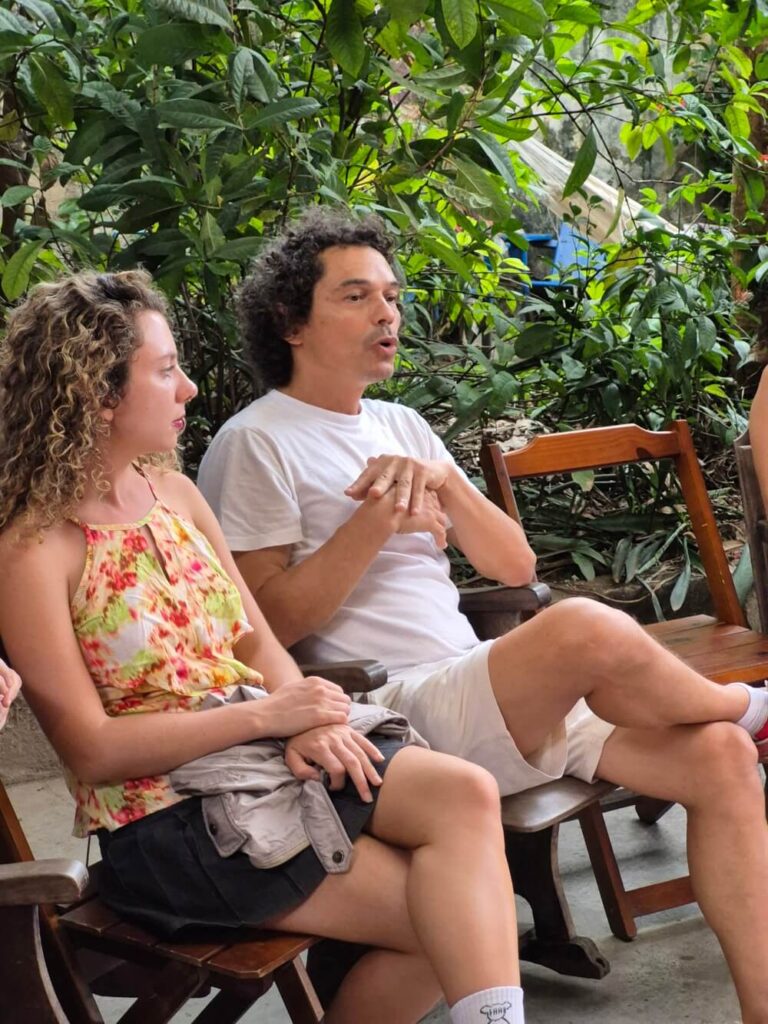
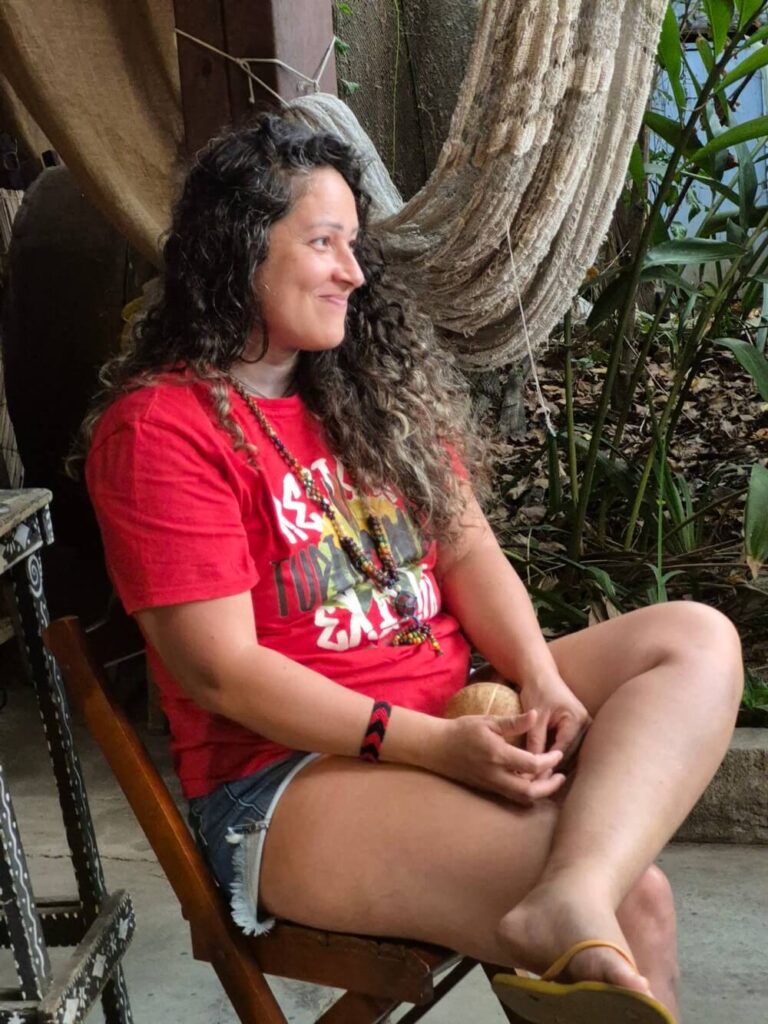
To be quick, it was so emotional seeing the Tupinambás emerge from the earth, in downtown Rio, emerging from the subway at the Carioca station. Everything had gone wrong because the coach drivers couldn’t bring them downtown because they had already been driving for 24 hours. So, they had to take the metro. They emerged from the earth and symbolically reclaimed Rio de Janeiro, literally incorporating one of the banners at Parada 7: “Rio-Terra-Tupinambá” (River-Earth-Tupinambá). It was thrilling. But for me, the most symbolic moment, very much in dialogue with the questions being raised here, was at the very end, when, beyond the discourses of science and spirituality, but bringing them all together, they made a kind of human spiral chain coming together in the form of a snake, a truly living organism, an ancestral animal both of their own and other peoples because they were the people who had the first contact, so they are totally crisscrossed by all the ethnicities that make up Brazil.
This, for me, is a very visual and corporal example of everything we need to do to change. As Mãe Sara said, the answer is already there. Indigenous peoples are already an example, they are already the guide, they already embrace this collective body that we also need to embrace in order to change. We need to learn from them and return to this way of being. Perhaps, it is only in doing so that we can make the change that is coming. That’s it. Thank you, Jennifer.
Marcia Brandão
Something we can talk about in relation to all this. A while ago, 12 people got together and bought a piece of land in the Amazon. 170 thousand square meters, how many years ago? 20 years ago?
Ligia
23 years ago.
Marcia
I’ve never been there, but Lígia, who travels around, has been there several times and now we’ve donated it to a group to build an indigenous school without walls there. We’ve given them the land.
Ligia
Anna herself helped me with this.
Anna Dantes
And Fran Baniwa, right? Because within this collective, Selvagem, we support the strengthening of five projects that we call Escolas Vivas [Living Schools]. The coordinator of this movement is Cristine Takuá. There are five schools, three in the Amazon, one in Manaus which is a center for Tucano medicine, one in the village of Fran Baniwa which is in the Upper Rio Negro, and another with the Huni Kuin in the Rio Jordão in Acre. The other schools are in Minas [Gerais] with the Maxakali peoples and the Guarani from the Rio Silveira village on the southern coast of São Paulo. So, Fran went there with Lígia to the Amazon and together they thought and dreamed about the possibility of creating a kind of advanced campus of the Escola Viva Baniwa on this territory.
Marcia
There is something there that also speaks of the kabbalistic ancestral thought that the future is what builds the present because for something to happen, things happen now, a bit like prophecies, right? Conditions of things that will come.

Anna
I think that in addition to prophecies, they are also ways of reading. We tend to read things in a linear way, but we can read what is happening in several other ways, as something that may have started in the future. And also read in the ways that go inward. Once I went with Sandra to MAR [Museum of Art of Rio de Janeiro] to talk about the Escolas Vivas [Living Schools]. I don’t know if you remember, Sandra. You spoke about menstruation, territory, feminism, what a woman is, and [what is permissible for a woman]. Menstruation is a territory. It is a place to which she returns, so the sense of time can even be inward, something that inverts and completely changes our idea of life. Sandra pointed out that boys need physical territory to understand who they are. Women understand this in seclusion [indigenous ritual during mensuration]. But often, when boys lose their territory, they lose this possibility of transition, of a transition rite. They won’t find this by walking more freely on the land if [their spirit being] is a hunter, a craftsman, or a planter. The Guarani women go on marches for a territory, so that the men can have a territory, so that their children can discover who they are. I don’t know if that was it, but I remember that they asked me to write a text about what I had to say and I wrote about what I had heard from Sandra. I thought it was really incredible, this notion of feminism for the other, not only for your gender, but for your children and also for the time for you to create the territory within yourself. So I think this Banner [of Peace], at its core, is where things are flowing inside, we look at it and measure it medicinally, but maybe it is about something that is [flowing] inside. Then I remembered what you said, Sandra, about menstruation. Just adding these ideas into this circle.
Sandra
That’s why the discussion of education is so complex. Guarani education comes from this process. There is a ritual for boys and a ritual for girls that continues to be associated with rivers, trees, animals. Everything is associated, so if we no longer have this possibility, this relationship with the territory and nature, we end up getting sick. Today, especially among my Guarani people, in Mato Grosso do Sul, we are seeing that violence is rising more and more. Mato Grosso do Sul is the place with the highest suicide rate and the vast majority are boys. In our cosmological understanding, we are earth, our female body is earth, that’s why we call it mother earth. So, in order to strengthen the boys, let’s say, they have another educational process that it is not something separate, but rather a summation, a way that provides an even keel, that allow us to call on them to balance themselves, because today, not only in Guarani society, but in society in general, men are very violent. So, the violence of men has to do with this non-place, of not having this place. This non-place is frustrating, so they become more violent and that means more violence for us too.

For example, we associate the dignity of men with what we call tatá. Tatá means fire, but fire, not necessarily as something bad. Fire can warm and feed but also, if in excess, can become violent. So that is why for us tatá, fire for us, can also mean illness, fury, anger. My grandmother used to tell the story that for us Guarani the end of the world has already happened. We are now in the second world. The end of the first world was when the water rose, the end of the second world, it is said that maybe it will be tatá that takes over the earth. So, using this metaphor, I see that, in fact, this is it, that violence is taking over, it is taking over us and us women.
But I want to get to this issue of universities and exclusion. When you don’t discuss the scope of mothers in universities, when you exclude these mothers, when you exclude these women who are menstruating, who are in their maddening period, you are creating violent people because our spirit is not well. I wrote my thesis on this, connecting these questions with everyday life. For example, I live here in Rio, recently I was on the bus on a Sunday when it stopped for a mother and two children going to the beach. The boy, I think he must have been about 5 years old, was carrying the chair for his mother and she was carrying a baby. The bus stopped and opened the back doors for them, and the boy tried to get on. The bus was full of people in a hurry looking at the mother, no one moved, they just wanted her to sort it out with her son and that was it. Then the boy tried to get on and he fell. When he fell, his mother looked at everyone, everyone was already looking at their feet. Then she pushed the boy on the bus and the boy started crying. She told him not to cry. He stayed like that, holding on, holding back his tears, while she got on with her other baby. And so, it goes on. I see this a lot. Since we are earth, we hold on, hold all the weight. It is important to understand that this leads our children to be frustrated and often violent.
What will this adult child be like when there is no place to cry? This is shocking to me and then I remember my grandmother saying: “If you don’t take good care of women, of mothers, people will take over.” They are taking over. That’s why I think that the school without walls happens on the street, it happens in our daily lives, whether someone helps or not, and then we take this to the world because we are the world. This world is being shaken, not in a positive way; it is being shaken in a very violent way. I go into a crisis when I write, I think about women and sometimes I cry, I get sad, I get depressed because this is what we go through on a daily basis. This needs to be discussed in schools without walls.
Another important thing is memory. Ancestral memory is very important, this memory that I call awakening memory, awakening memory and shaking it up anew, this is so important to us even though it is painful. For example, my grandmother told horrible stories, [but] she didn’t want to tell the [worst] stories of how they suffered during the colonial invasion, or what happened. This is also another point that Brazil denies, completely denying this violence and the suffering of indigenous women, of our culture, of women’s suffering and the many that are still suffering. I think this is a very heavy thing and how are we going to solve it?
Just to wrap up, I recently went to the Pinacoteca in Ceará to talk about memory and art and they asked me if I had any hope, because the vast majority, including those at the university, are already frustrated, tired, and hopeless, at least those who think. Then I said: if we think too much about the future, we will get sick and frustrated without any movement. I believe that what strengthens me as a person, as a woman, is this movement, this circle of conversation, of exchange, of sharing our experiences, of crying together, exchanging our pain, listening, and dialogue. This touches our hearts. For us, there are also feelings [tied] to the stomach, which is why for us Guarani, for example, when we talk about why a scared child has a stomachache, because when a child gets scared or even us adults, when we are very nervous or scared our stomach hurts. Our feelings are responsible for all the fear, anger, and everything we do. So, I believe that’s why we say that when we listen, we have to converse with our ears to deal with feelings and I think that this conversation circle does that, listening to feeling, we get to know each other better. I think we need to find places where we can unite, not just for us, but also for other people. I think that this is a responsibility, and also what gives us motivation to keep fighting for strength. I think that’s it, thank you.
Lucimara Rett (Public)
My name is Lucimara Rett. I just spent a week with the people who came from Rio Grande do Sul for an event called Campus Antropoceno. We had some very interesting discussions there at the Escola Superior de Design [School of Design / Rio de Janeiro State University]. I have been thinking for a long time about the reconnection we need to make between nature and culture. For me the key is the return to the feminine. When I talk about the feminine, I am not only talking about gender, but about feminine energy, about respect for Mother Nature, Gaia Pachamama, as we want to call the recognition of original and traditional ancestral knowledge. I study our connection with time. This symbol [the Banner of Peace] means a lot to me because it was used as a system to count the passing of time called the synchronicity of the thirteen moons that I studied for a long time. This was an appropriation that a person named José Arguelles made of how Mayans counted time, from the original Mayan calendar. The Mayans had this vision of time, they had many calendars and the Tzolk’in calendar is one that is based on the human body.
Reflecting on any of these natural timekeeping modalities, I think we have a key, a clue if we look at our relationship with time. We have the best clock in the world, which is the sun, together with the stars, together with the planets. We [should] learn to look at this natural timekeeper, because we live in an artificial calendar that is less than 500 years old, imposed by a pope, Pope Gregory. We live with irregular months with days, months of 30, 31, 29. We follow a clock time that does not respect our circadian cycles. We sleep with the blue light of our cell phones, much later than we should, and we wake up much earlier than we should or much later than we should. So, I think that biologically we are being distanced from nature by time, by how we manage time, by the calendar and the clock. So, I wanted to share this reflection from my studies.

And just to add something else that I would like to say. I am also from academia. I am part of a program called EICOS (Postgraduate Program in Community Psychosociology and Ecology) at UFRJ [Federal University of Rio de Janeiro]. I once asked Cristina [coordinator of Escolas Vivas], who Anna brought here, how the university could prepare itself to receive people who have this other educational background coming from the Escolas Vivas? The university is not prepared, although there are some anomalies, Vergara’s work, for example, and Scarano’s work at EICOS. The fact that we have tried to research with and not about is already an advance, but it is not enough. I think we need to have the protagonism of these people in academia. So, I leave one more question: how do we do this in a system that is currently disciplinary? How do we deal with the society of control? What do we do with disciplinary society and colonization in academia? I think Fabio and Guilherme are inspiring, but we need more people doing this. I just want to say I am interested and available, thank you.
Guilherme
I think that one of the aspects of the idea of a school without walls is that each person thinks in their own microcosm. Since I am at the university, in the arts department, I recognize that there is a tremendous gap between the speed of change and what is in fact being transformed. For example, affirmative action policies have radically changed the student body but have not yet changed the teaching staff. So, for me, it is very important that we fight because this change will come from basic education, where we have an education with our feet on the ground, an education with the heart, and an expanded sense of art together with the reconfiguration of the sciences and of spiritualities. The university is slow in this, we need to fight. To your point exactly Lucimara, we need to fight to transform and open up space.
Sandra talked here about listening, listening with the body and with responsibility. In Isabelle Stengers’ latest book, she raises a question involving Gaia and a manifesto of deceleration asking: “Is another science possible?” So, I keep asking: Is another art possible? Is another university possible? How do we break down the walls? It’s a challenge for those in university because there is a whole structure of public exams and job vacancies determined by government policies. There is a very strong movement taking place with the anthropologist/doctor João Paulo Tukano and other indigenous peoples fighting for the recognition of indigenous medicine. We also have indigenous art production being presented in contemporary art galleries and museums, but the challenge is to also transform how we listen, learn, and engage with art. I add my words to Sandra’s, we need revolutions in the ways that we care about coming together, listening, and transforming science into ground, territory, and heart, and the arts into ground, encounter, territory, and heart. Within Helena Roerich’s studies of these three circles, drawing on her spiritual master, she promoted the synthesis of a Living Ethics, of a spiritual materialism. Matter is another quantum formulation. It is a vibrating particle but also part of a cosmic realism. This cannot be seen as separate from the cosmic. Why do we think we are separate from the cosmic? These separations are illusions that we need to break. They are walls.
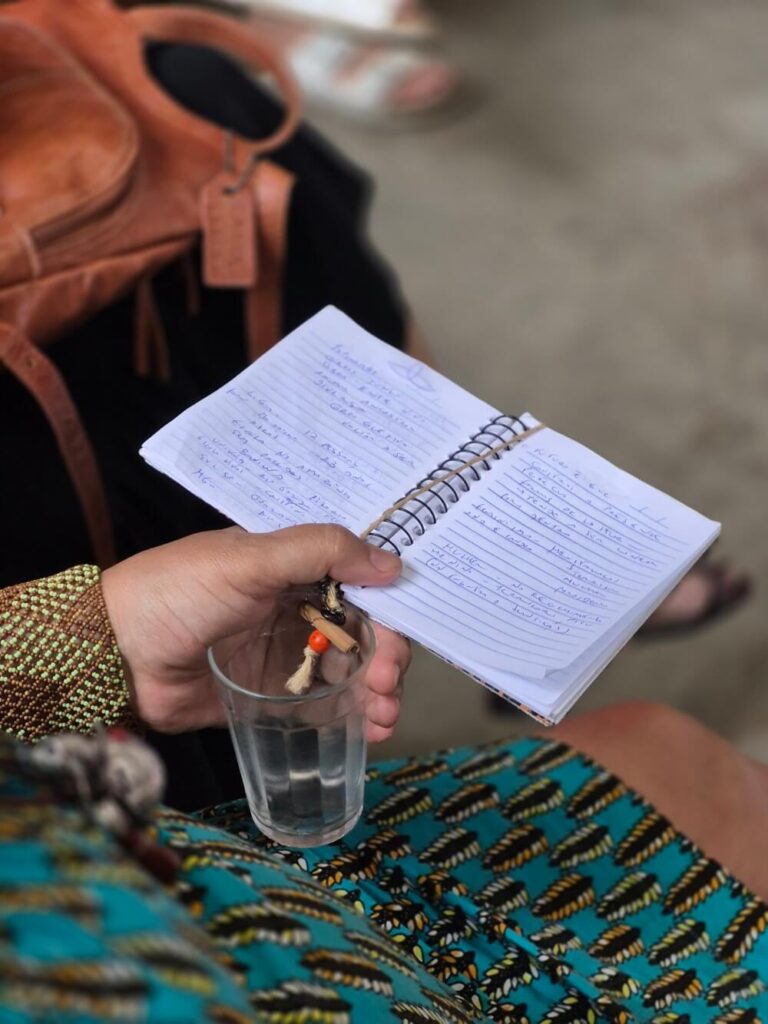
Aline Monteiro (Public)
My name is Aline Monteiro, I am a professor at the UFRJ (Federal University of Rio de Janeiro) School of Education. This is my first time here. I was very happy to listen to the exchanges here. I will follow up with several of you. You will hear from me later! But I have to leave so I just wanted to make sure I didn’t leave without apologizing and explaining. Have a great conversation.
Guilherme
You are taking a piece of infinity.
Aline
A fraction of infinity I will take good care of it!
Candice de Moraes (Public)
Good afternoon, my name is Candice Abreu de Moraes. Thank you very much for the words you all have shared here today. I wish for all of us with sensibility and perceptiveness, the strength and serenity to maintain our mental, spiritual, and physical health.
I wanted to ask a question. I’ve been hearing people say that we need to reconnect with nature, and I wanted to ask those of us who are here if it’s possible to reconnect with nature. Because if you think that it’s possible to reconnect with nature, you’re thinking that you’re not part of the nature that exists, that it’s something that’s outside, somewhere else, that’s not our body, that we have to go there [wherever there is] and connect. So, I wanted to raise this question because I think that we are nature and that everything here is nature, architectural buildings, the work of the symbolic field is also part of this nature. Within this, I’ve been thinking about this connection that we can have with these accessories, these couplings that Joelson brought up, as if we needed these other items in order to exist. In fact, our existence is before any coupling, before anything that we can acquire. It is not purchasable. The things that are part of existence cannot be acquired, bought, and accumulated. It happens in another place, not this place that has been simulated by a system for a long time, as if we had to accumulate in order to exist. In fact, in my view, our existence is prior to all this, from this other time that is not explained by reason but from this symbolic field, this field of lived experience, of the simplicity that nature itself has. So, when we talk about art, if another art is possible, I remember Nêgo Bispo saying that it is in nature that birds sing. Then I remember Angel Vianna saying that all bodies dance like clouds that move and I remember us as nature and I think that our art, it is already given too, we already produce it naturally, our own being is this. Thank you for this conversation circle and the opportunity to speak.

Guilherme
If we are talking so much about reconnecting, it is also because we are in a stage of disconnection, fragmentation, and separation. Recognizing this is important. I read a passage this morning that said: several races have passed through this planet, many of which have left only waste. It was interesting to read this and now we are being provoked by the reconnection with an ancestral future, a future that might be one in which we do not leave waste. How do we not turn out like those races that left waste? When we see the oceans of plastic, we are in a society of consumption and waste, so this turning point is also a question: what do we want the future to be?
Carla Albuquerque
I’m Carla Albuquerque. I’m from UNIRIO university, and I’m also part of the graduate program EICOS at UFRJ. Listening here I’ve been wanting to share my feelings, thoughts, and sentiments, but now something stronger comes to mind: the idea that there are no elected, enlightened people who will save ourselves. I think the issue is really collective, and perhaps we have a privilege, a greater opportunity [to be] here now at this moment. So, I think that our challenge is collective, our challenge is not just for a group of intellectual beings and those with sensibility. I think the challenge is for everyone. It’s just something I’d thought I’d share.
Cristina Basilio Thomas (Public)
I wanted to quote a poem by Roseana Murray, I’ll try to remember:
Look at the sea.
The horizon lightly resting on the water, where sky and sea meet.
Territory of dreams.
Where one ends and the other begins.
Territory of dreams.
Difference is what can move us.
Change our gestures. Our view of things.
In many, many civilizations, differences were annihilated.
Entire peoples were and still are annihilated.
History tells us all the time about this destruction.
Hearing the difference is to expand the territory of the dream.
Opening the door to the other side and accepting it for all its
diversity
It is the only possible bridge to human coexistence.
May the other be the mirror that enriches me.
[people clapping]
Because I was listening to everyone and this poem came to me like that, but I’m very shy, but I couldn’t help it.
Iazana
Taking advantage of this lovely moment to reference another school without walls – the dance school of Angel Vianna – in honor of Angel’s passing who died at 95 recently. On Friday there was a seventh-day mass service. I had the opportunity to attend courses at her school and receive technical training there, which was a great revolution in my life. I thought I would share an image that a colleague told me once when we were there, which was that she had the feeling that before she entered Angel’s school, her body was covered in adhesive tape, it was as if it were covered in adhesive tape, and the work at Angel that we experienced was to gradually remove the adhesive tape. So, I wanted to bring this image here to honor Angel and to thank Angel publicly and say that the bridges where we can shelter our dreams of these schools that cross our path, will make it possible for these paths to happen. Then I started thinking that this question I myself raised about how technology is removing time from experience is just another layer of the adhesive tape and that this is the work we are already doing, in various ways through art, through original recovery, through disruptive thinking itself, which has always led the way. I also wanted to remember the image that the Company posted on Instagram about Angel, which is [from a filming of] everyone in the City Council. A great tribute to Angel, being honored as a citizen of Rio, where in that space that is very much closed in with walls, all together, the people who were there raised their arms and danced, occupying that space with a totally different meaning.8
Guilherme
Very nice.
I think now we need to move on to a circular closure. Would anyone like to say anything else?
Shirley Britto (Public)
Thank you. I’m Shirley Britto and I’m part of a theater group called Teatro de Anônimo (Anonymous Theater) here in Rio de Janeiro, which is now turning 39. I just wanted to thank this group, for all the things I learned today, for all the things I reconnected with. I think I also agree with you that we are part of nature. I’ve become so sure of what I do, what I love, I love people, human beings, animals, nature, and so I’m on the right path, but at the same time [I’m worried] about this crazy world trying to lead us to selfishness and individuality. But I have a lot of hope, because this group, here, exists and I think there will be many more, because we’re going to multiply this here. I just want to thank you, thank you, thank you.
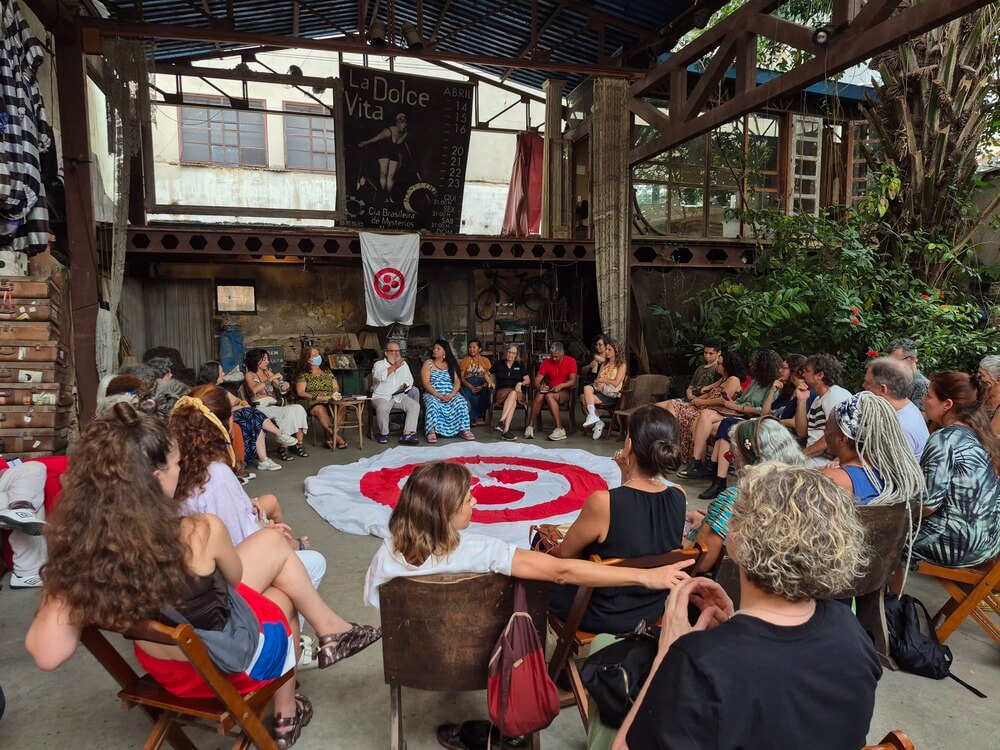
Anna
I was going to talk about closing too, I really want to thank you all. It’s always very special to be here in this house/home, where mystery is part of the Company and the mystery and the Company is just one house/home. I thought it was beautiful that today is the 8th and each of us having eight minutes to speak. It’s also very special to talk about these schools without walls, remembering that today is the day of the Queen of the Forest, Our Lady of the Conception. So, in syncretism, the forest is celebrating because the light of this great force is being celebrated and here, we are in a circle in this place of Floresta Cidade [Forest City both referring to Iazana Guizzo’s outreach university program and the very nature of the space of the Company]. I think everything is very auspicious, so I will give my thanks to the Queen of the Forest who is the great teacher.
Lígia
I really wanted to start this circle today singing to Our Lady of Conception, but since I have a bad cold, I thought I wouldn’t be able to, but can you all sing along with me? Help me?
[Lígia and the audience sing]
Our Lady of Conception comes to greet the people in this hall
Our Lady of Conception comes to greet the people in this hall
Saravá, saravá is from Aruanda, it is from Umbanda, it is saravá
Saravá, saravá is from Aruanda, it is from Umbanda, it is saravá
Our Lady of Conception comes to greet the people in this hall
Our Lady of Conception comes to greet the people in this hall
Saravá, saravá is from Aruanda, it is from Umbanda, it is saravá.
Saravá, saravá is from Aruanda, it is from Umbanda, it is saravá.
We would also like to salute our masters, Angel Vianna, for example. We have been through some very important moments in her journey. We put a lot of energy into her seventh-day mass on Friday. In the future we need to host another conversation circle so we can also talk about the Company’s school without walls that we created many years ago, when I met someone who taught me how to work with a school without walls. But we will do this in the future and tell the story of this wonderful person.
But I’ll end now by inviting you to next Sunday, December 15th, where we’ll pay tribute to Angel here at Praça de Harmonia [Harmony Square] as part of the show O Alto do Belo Amor. I invite you all to be here with us. Also, after the show there will be a choro [type of music] in the bandstand. The choro is from Casa do Choro by Luciana Rabello, so this finale will be very special. This is part of the end of the year for us or rather readying to open up a new cycle. I invite you all to come here to our school without walls. Thank you for coming, thank you for each one of you, for each contribution, just thank you.

***
Anna Dantes
Anna Dantes is chief editor and director of the publishing company Dantes Editora specializing in expanded publishing formats – laboratories, workshops, magazines, curatorships, exhibitions, fashion collections, study cycles, and films. Since 1994, she has created, carried out and collaborated on projects aimed at preserving indigenous knowledge and memory. For the past eight years, she has been working with the Huni Kuin people in Acre on the Una Shubu Hiwea, Livro Escola Viva project, which has had partners such as the Rio de Janeiro Botanical Garden and Itaú Cultural. She has published two books, including Una Isi Kayawa, winner of the Jabuti Prize in Natural Science. She is currently also dedicated to the project Selvagem, a study cycle on life, featuring discussion groups and the editing of books that deal with the correspondences between scientific, artistic and traditional knowledge.
Fabio Scarano
Fabio Rubio Scarano is the Curator of the Museum of Tomorrow, holder of the UNESCO Chair in Literacy for Futures, and Professor of Ecology at UFRJ. A forestry engineer with a Ph.D. in ecology, Fabio has served on the UN panels for climate (IPCC) and biodiversity (IPBES) and was a director at the Rio Botanical Garden, Conservation International, and the Brazilian Foundation for Sustainable Development. He has received two Jabuti Literature Awards in the area of Natural Sciences.
Iazana Guizzo
Iazana Guizzo is an architect and urban planner. She is the coordinator of the project Floresta Cidade [Forest City] an outreach, teaching and research project at the Department of Architecture (FAU) at UFRJ, where she is also a professor. She has a PhD in urban planning, a master’s degree in psychology and a degree in contemporary ballet. The regeneration of cities in the face of climate urgency, community participation, interspecific life and Afro-Amerindian cosmoperceptions are topics of her research interest. She works in the fields of architecture, urban planning, and art and has collaborated with Companhia de Mystérios e Novidades since 2020.
Lígia Veiga
Actress, musician, and dancer, she was a member of the Rio de Janeiro group Coringa Grupo de Dança and performed in the Italian street theater Teatro Pirata in the 1980s. She is the founder and director of the Grande Companhia Brasileira de Mystérios e Novidades (1981). Since 2007 the Company has been situated in the port area of Rio de Janeiro and engages with the region through shows, festivals, workshops, forums, parades, and activities throughout the city’s yearlong cultural calendar. She created the Projeto Gigantes pela própria Natureza (Giant Project by Nature) – a traveling orchestra on stilts, consisting of practical and theoretical workshops that inaugurated the educational activities of the Casa de Mystérios and Praça da Harmonia
Luiz Guilherme Vergara
is an associate professor in the art department and a member of the Graduate Program in Contemporary Studies of the Arts at the Fluminense Federal University (UFF). He was coordinator of the undergraduate course in arts (2019-2024) and director of the Museum of Contemporary Art (MAC) in Niterói 2005-2008 and 2013-2016. He coordinates the research group (CNPq) ynterfluxes – contemporary art Community and Nature.
Mãe Sara
Spiritual leader and coordinator of the União Umbandista de Luz, Caridade e Amor (Umbanda Union of Light, Charity and Love) in the Saúde neighborhood in the center of Rio de Janeiro.
Marcia Brandão Alves
Márcia Brandão is the founding partner of MBA Cultural (1999), a pioneering company in Brazil in the implementation of fourth-generation Science Museums, multisensory interactives, with an emphasis on accessibility and contemplating multiple intelligences (H. Gardner). She is responsible for the creation, conceptualization, thematic research and development of executive projects and manages the production, execution and installation of long- and short-term exhibitions, as well as in the development of exhibition technologies, multimedia, games, animations, videos and soundtracks.
Sandra Benites
is the Director of Visual Arts at FUNARTE. [National Brazilian Foundation of the Arts]. She is an educator, researcher, and curator. She is a descendant of the Guarani Nhandewa people. She holds a Master’s degree in Social Anthropology from the Museu Nacional-UFRJ and a PhD from the same program. Her research and work have focused on the arts and lives of indigenous communities, pointing to the need for counter-colonial changes in institutions, museums, and exhibitions, and the care for the particularities of different peoples, ethnicities, and cultures. She was the curator of the exhibition Dja guata Porã | Rio De Janeiro Indígena at the Museu de Arte do Rio de Janeiro (2017) and also part of the curatorial team of the Museu das Culturas Indígenas which opened in São Paulo in 2022.
1 T.N. Given the significant variants in translations, formats, and the numbering of verses, we opted to do a free translation of the Portuguese translation read by Lígia Veiga on the day of the circle rather than use an official published English translation.
2 The ancestral future is an expression advocated by the well-known Brazilian indigenous leader and philosopher Ailton Krenak.
3 Helena Roerich, Heart: Signs of Agni Yoga, first edition 1932 (New York/Niterói: Agni Yoga Society/ Niterói Avatar Cultural Foundation, 2nd edition, 1975, 4th printing 1982) 7.
4 Ibid p.7-8.
5 T.N. Scarano here draws on a distinction made by Paulo Freire. The verb “esperar” in Portuguese means both to wait and to hope. The noun “esperança” means hope from which Paulo Freire created the neologism “esperançar” turning it into a verb to remove the sense of waiting in “esperar” for things to happen and implying that being hopeful is a state of action and agency.
6 A caboclo refers to a person of mixed European and Indigenous American ancestry, but also, in cultural and spiritual contexts like Umbanda, can be the name for an intelligent, wise, and spiritual entity or ancestor, often depicted as an Indigenous hunter and warrior.
7 A Pomba Gira is a significant spiritual entity in Brazilian religions like Umbanda, often considered a female Exu. She symbolizes female power, independence, and sexuality, and is invoked for help with issues concerning love, relationships, and removing obstacles.
8 Instagram Cia de mystérios: https://www.instagram.com/p/DDFEh6ROOFG/?locale=ar-en&hl=en
